On 15 April 1452, one of the greatest universal geniuses was born in a small village in Tuscany. As we all know, Leonardo da Vinci created some of the most iconic paintings of all time, and people will line up for hours to get a glimpse of his “Mona Lisa” or “The Last Supper.”
But let’s be honest, his creative and inventive genius embraced a staggering number of fields and technologies. Initially, he immersed himself in the study of the humanities, and he quickly mastered drawing, painting, and sculpture, with interests in anatomy, architecture, chemistry, mathematics, and engineering.
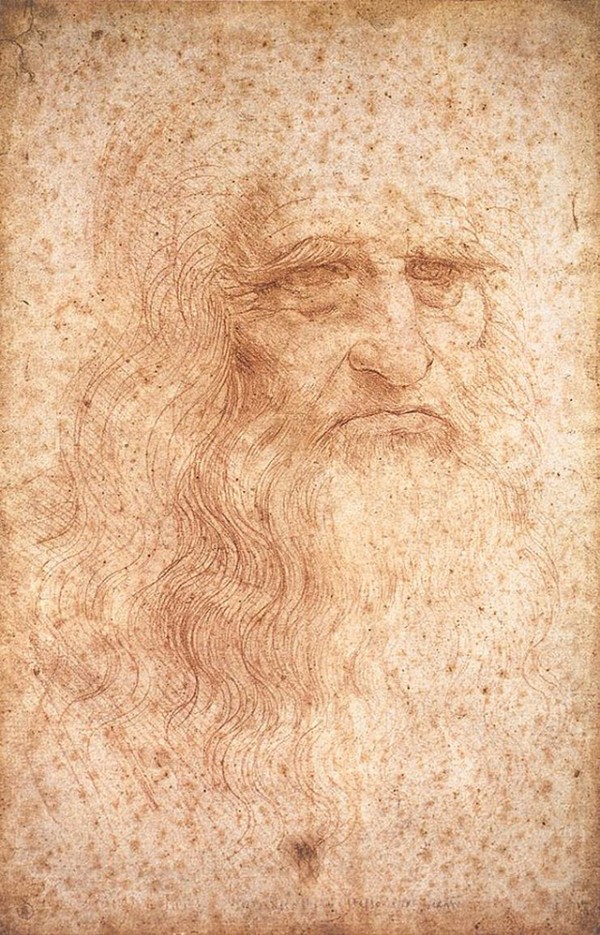
Leonardo da Vinci
I suppose we shouldn’t be surprised that Leonardo da Vinci was also a skilled musician and that he invented a couple of musical instruments. To celebrate the birthday of this incredible Renaissance polymath, why don’t we have a closer look at his musical inventions?
Claudin de Sermisy: “Au Joly Bois”
Forgotten Musical Machines
Apparently, Leonardo da Vinci was a skilled musician with a beautiful singing voice. He taught himself to play the lyre, and he could brilliantly improvise his own songs. In fact, contemporary reports suggest that he was by far the best musician at the court of the Sforza family.
Leonardo recorded his interest in music in his daily journal writings. These journals contain roughly 13,000 pages of drawings and notes.
Leonardo sketched countless unimaginable marvels, ranging from flying machines to hydraulic pumps, and from a mechanical knight to a steam cannon. Fascinatingly, his journals also contain designs for unique musical instruments.
Marchetto Cara: Cangia sperar mia voglia (Convivium Musicum, Ensemble)
Viola Organista
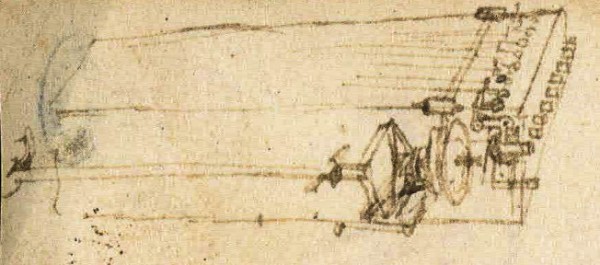
Viola organista
Leonardo designed many elaborate models of the viola organista, an instrument that uses a friction belt to vibrate individual strings, with the strings selected by pressing keys on a keyboard.
It is not known whether Leonardo ever built a working prototype of this instrument, but the concept was taken up by the German instrument builder Hans Heyden. The design of his 1575 “Geigenwerk” is rather different, already featuring an instrument shaped like a harpsichord and a fully chromatic keyboard.
This instrument and other attempts are mainly museum curiosities, but the Polish musician Sławomir Zubrzycki completed a modern replica in 2013. Containing four bow-wheels and 61 keys, he actually played it in a performance in Kraków.
Sławomir Zubrzycki: Praeludium in D minor
MonoBell Carillon
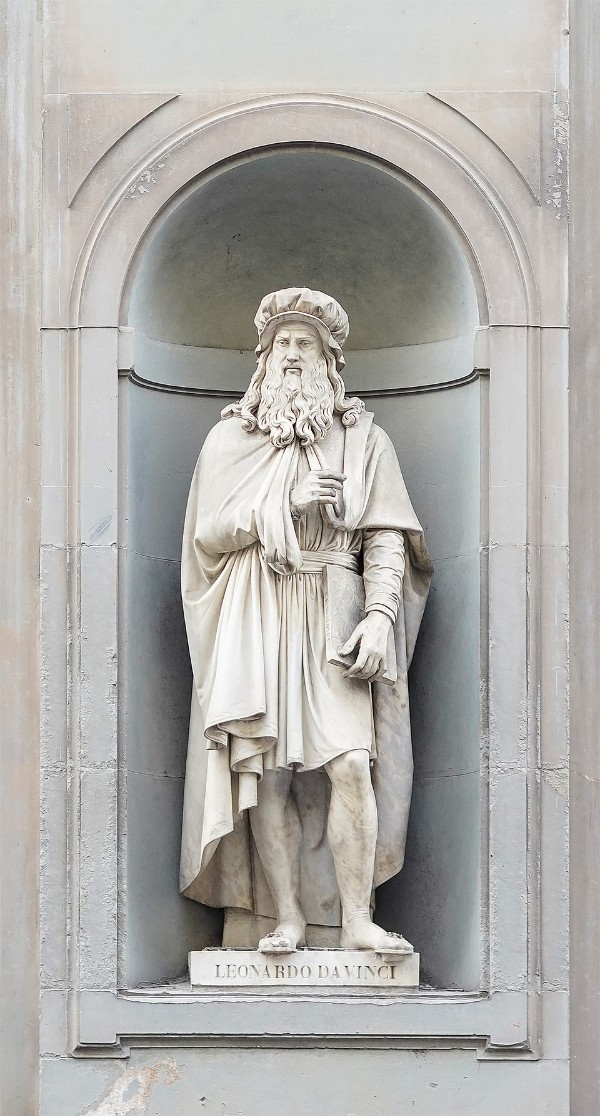
Leonardo da Vinci
When Emanuel Winternitz, curator of musical instruments at The Metropolitan Museum of Art, examined two notebooks by Leonardo da Vinci, found only in 1967 in the National Library in Madrid, he discovered two pages devoted to musical instruments.
One design featured a bell with no clapper inside, with two hammers striking the rim from opposite sides. Now here comes the fun part: four organ-style keys control a tracker action linked to four oval heads that serve as dampers.
In essence, we find a non-swinging bell without a clapper that produces a change of tone. The change of tones might be comparable to that of an organ, and it was probably aimed to mimic a carillon-like effect.
Vincenzo Capirola: O mia ciecha e dura sorte (Sirinu, Ensemble)
Perpetual Pipe
© kcstudio.org
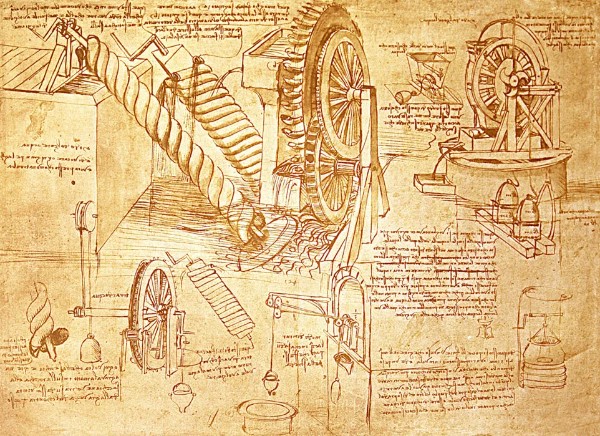
The same manuscript also features sketches for a double-acting bellows for continuous wind, supplying a triple trumpet or pipe instruments. The imaginative bellows system is divided by a fixed central wall, with one part fixed to a belt at the waist, and the other moved by the arm or elbow.
This produced “continuous wind,” and the air flows without interruption. In turn, the bellows is connected to three trumpet-like pipes that are likely producing fixed tones. Most likely, this instrument produces a fanfare-like sound.
Since there are no finger holes, it’s certainly not a bagpipe. In all likelihood, this instrument sounds a triad. Leonardo was impressed enough with the new bellows that he applied it to a small set of organ pipes and even a larger chamber organ.
Leonardo da Vinci: Codex Madrid (folio 75 verso and 76 recto)
Even centuries later, these forgotten musical machines are endlessly fascinating. Leonardo da Vinci’s genius apparently knew no bounds. This ultimate Renaissance polymath wasn’t content with existing instruments; he saw musical possibilities where others heard only limits.
For more of the best in classical music, sign up for our E-Newsletter