Tchaikovsky is often thought of as one of the most romantic of the Romantic Era composers, famous for his dramatic overtures and symphonies.
However, he didn’t have a conventional romantic life. He was a gay man. His brother and confidant Modest was, too, which means that many of his romantic and sexual feelings were remarkably well-documented.
Like many men of his era, Tchaikovsky often separated the idea of love from sexual acts (he is frank in his correspondence with Modest about his interactions with male prostitutes).
So it is important to note that just because Tchaikovsky was attracted in some way to the following men, they didn’t necessarily have physical relationships. A major part of Tchaikovsky’s love life was always pining over unrequited love. Arguably, that’s an emotion embodied by much of his music.
It’s also worth remembering that, because of the way that homosexual activity was viewed in Russia during Tchaikovsky’s lifetime, it is sometimes necessary to guess and read between the lines to come to a more complete understanding of his life experience.
That said, all five of the following men made profound emotional impacts on Tchaikovsky, and he was unquestionably drawn to all of them in ways that we would think of as romantic today.
Aleksey Apukhtin (1840-1893)
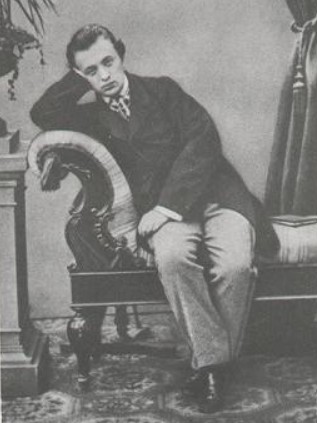
Aleksey Apukhtin
Aleksey Apukhtin was born into the Russian gentry in November 1840, a few months after Tchaikovsky.
It was clear from early in Apukhtin’s youth that he had an affinity for literature. As a child, he memorised the entire output of Russian nationalist poet and playwright Alexander Pushkin.
In fact, in 1852, when he began studying at St. Petersburg’s Imperial School of Jurisprudence, he was seen as a potential future Pushkin.
Tchaikovsky had begun attending the Imperial School at the age of ten, and the two became friends in 1853. Tchaikovsky wrote for the school paper that Apukhtin edited, and the two would hide out together in the music room, dreaming of becoming great artists.
However, immediately after his graduation, Apukhtin’s mother died, a loss that devastated him. As he moved into adulthood, he became more cynical about his own abilities and the general value of art.
The two remained friends for decades, but never regained the closeness they’d shared as teenagers.
There are a few reasons why scholars suspect Apukhtin may have been a love interest of Tchaikovsky’s. For one, the Imperial School was an all-male boarding school, where romantic and sexual experimentation was common. In addition, later in his life, Apukhtin became open about his homosexuality and even lived openly with his male lovers.
We’ll likely never know for sure, but it’s very possible that at some point during their school years, one or both of them at least had crushes on each other.
Learn more about the friendship between Tchaikovsky and Aleksey Apukhtin.
Sergey Kireyev (1844-1888)
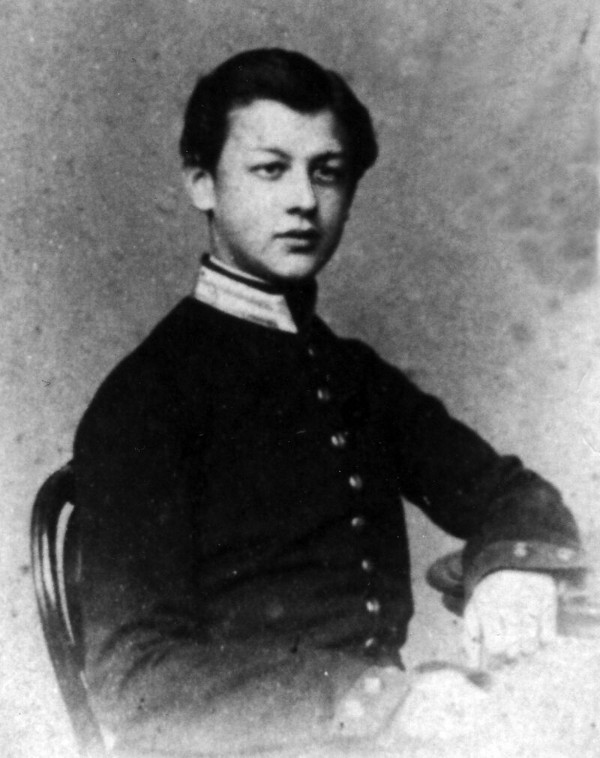
Sergey Kireyev
Sergey Kireyev was four years Tchaikovsky’s junior and attended the Imperial School alongside him, enrolling in 1855, the year he turned eleven.
Tchaikovsky’s brother Modest theorised that the two had met at church, as they were not in the same classes due to their age difference.
For decades, a draft of Modest’s biography of his brother was censored due to its homosexual content. After decades, the full document was released.
In it, Modest makes it clear that Tchaikovsky and Kireyev had some kind of romantic connection that began when Tchaikovsky was sixteen and Kireyev was twelve.
Modest went so far as to label this relationship “the strongest, most durable, and purest amorous infatuation of [Tchaikovsky’s] life.”
Kireyev was also one of the first people to whom Tchaikovsky confessed his dream of becoming a famous composer.
Eventually, Kireyev began to be teased by bullies for his relationship with Tchaikovsky. He began treating Tchaikovsky harshly, going so far as to slap him in front of a group of students, but Tchaikovsky still remained devoted to him.
Modest compared their dynamic to a medieval ideal, suggesting that, like courtly tales of love, the boys’ relationship was erotically charged but platonic.
“Like a medieval knight, Petya etched the initials SK upon his shield, and everything that he did he would dedicate to this name,” Modest declared.
It is believed that Tchaikovsky’s early song “My Genius, My Angel, My Friend” was secretly dedicated to Kireyev.
Pyotr Ilyich Tchaikovsky: “My Genius, My Angel, My Friend”
Eduard Zak (1854-1873)
Eduard Zak (alternate spelling Sack) was born to a family of German immigrants in 1854, when Tchaikovsky was fourteen.
In 1867, when Zak was thirteen, he enrolled in the Moscow Conservatory. The following year, he enrolled in Tchaikovsky’s composition class, and the two got along well. Ultimately, though, Zak decided not to go into music and dropped out of the Conservatory in 1870.
We know that the two became very close during their time together at the Conservatory because a letter survives in which Zak writes a postscript to Tchaikovsky using the familiar “thou” – a signifier of emotional intimacy that would not normally have occurred between teacher and student.
Tchaikovsky did what he could to help Zak. In 1871, Zak took a job in present-day Ukraine working on the railroad. His boss was Tchaikovsky’s older brother Nikolay.
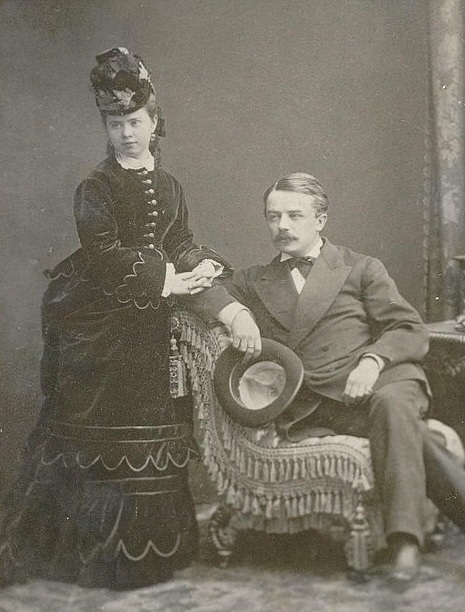
Nikolay Tchaikovsky, with his wife Olga © en.tchaikovsky-research.net
In the autumn of 1871, Tchaikovsky wrote Nikolay:
Since you (to my extreme pleasure) want to save Sack from business trips during the winter, would you not consider it possible and to his benefit to give him in the near future a brief vacation in Moscow? …
I tell you frankly that if I observe in him any moral or intellectual decline, I shall take measures to find him other work. But be that as it may, it is absolutely essential for me to see him. For God’s sake, do arrange this.
It seems reasonable to hypothesise that Tchaikovsky was desperate to see his former student. Maybe he was concerned that he was working too hard on the railroad and was having a difficult time, or maybe he had romantic feelings for him…or both.
Tragically, in the fall of 1873, Zak died by suicide.
Tchaikovsky was devastated. He wrote to his publisher:
I am now under the impression of a tragic catastrophe that has occurred to someone close to me, and my nerves are terribly shaken. I am unable to do anything. Therefore, I ask you not to rush me with the piano pieces.
Tchaikovsky never forgot Zak or his tragic fate. He wrote in his diary in 1887, a full fourteen years later:
Again, thought of and recalled [Zak].
How amazingly clearly I remember him: the sound of his voice, his movements, but especially the extraordinarily wonderful expression on his face at times.
I cannot conceive that he should now be no more. His death, that is, complete nonexistence, is beyond my comprehension.
It seems to me that I have never loved anyone so strongly as him.
My God! No matter what they told me then and how I try to console myself, my guilt before him is terrible! And at the same time I loved him, that is, not loved, but love him still, and his memory is sacred to me!
Yosif Kotek (1855-1885)
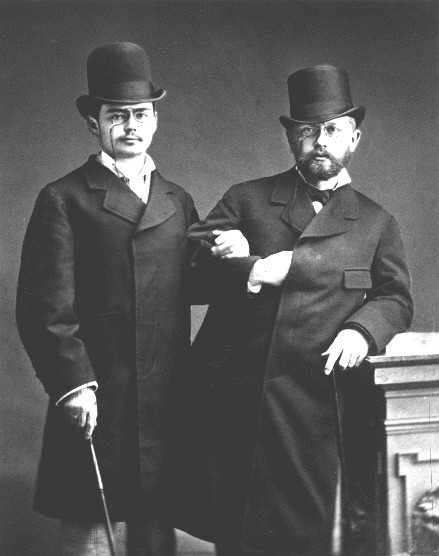
Yosif Kotek and Tchaikovsky
Yosif Kotek was another Tchaikovsky student who became a dear friend and, later, romantic interest.
Kotek was born to a Czech father and a Russian mother in 1855, fifteen years after Tchaikovsky.
A talented violinist, he enrolled at the Moscow Conservatory in 1871, at the age of sixteen, graduating in 1876. Tchaikovsky was his composition teacher.
They continued their relationship after graduation. In January of 1877, Tchaikovsky wrote agonised letters to Modest, describing how intense his adoration for Kotek was.
I have known him for six years already. I always liked him, and on several occasions, I have felt a little bit in love with him. That was like a trial run for my love. Now I have momentum and have run right into him in the most decisive fashion.
I cannot say that my love is completely pure. When he caresses me with his hand, when he lies with his head on my chest and I play with his hair and secretly kiss it, when for hours on end I hold his hand in my own and tire in the battle against the urge to fall at his feet and kiss these little feet, passion rages with me with unimaginable force, my voice shakes like that of a youth, and I speak some kind of nonsense.
However, I am far from desiring physical consummation. I feel that if that occurred, I would be cool to him. I would feel disgusted if this wonderful youth stooped to sex with an aged and fat-bellied man. How horrible this would be, and how disgusting I would become to myself! It is not called for…
Yesterday I gave myself away completely… I burst. I made a total confession of love, begging him not to be angry, not to feel constrained if I bore him, etc.
All of these confessions were met with a thousand various small caresses, strokes on the shoulder, cheeks, and strokes across my head. I am incapable of expressing to you the full degree of bliss that I experienced by completely giving myself away.
Tchaikovsky also indicated to Modest that he wanted to marry that year and no longer indulge his same-sex desires. It is possible that he viewed his relationship with Kotek (such as it was) as a kind of last hurrah before settling down with a wife.
That spring, Tchaikovsky reassured Modest that his feelings for Kotek were no longer so intense. When Tchaikovsky married his wife a few weeks later, he chose Kotek to be one of the witnesses.
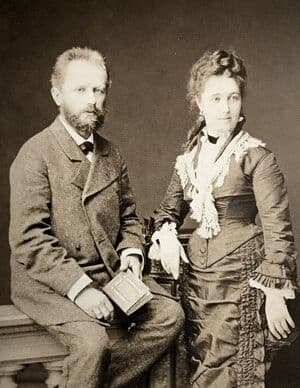
Tchaikovsky and his wife
Predictably, Tchaikovsky’s marriage collapsed within a matter of weeks, and he had a nervous breakdown. He went to Kotek for comfort.
It’s no coincidence that Tchaikovsky wrote his violin concerto in an explosion of creativity in March 1878. He considered dedicating the work to Kotek, but decided against it for fear of encouraging gossip.
Kotek and Tchaikovsky continued to have their ups and downs over the following years. Tragically, Kotek died of tuberculosis in 1884. He was just twenty-nine years old.
Tchaikovsky’s violin concerto
Vladimir “Bob” Davydov (1871-1906)
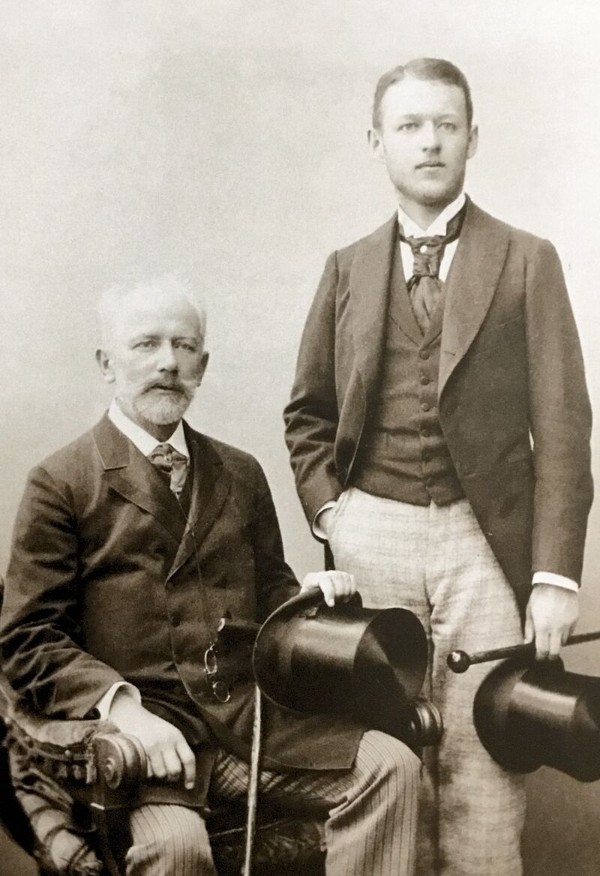
Vladimir “Bob” Davydov and Tchaikovsky, 1892
Many of Tchaikovsky’s love interests unnerve modern sensibilities, between their age differences and power disparities.
But none of Tchaikovsky’s crushes are more uncomfortable to think about than the one he had on his sister’s son, Vladimir (nicknamed “Bob”) Davydov.
Davydov was born in 1871, when Tchaikovsky was thirty-one. His sister believed that the baby took after Tchaikovsky, which may have engendered particularly intense paternal feelings.
Inevitably, Bob became Tchaikovsky’s favourite nephew. In 1878, he dedicated his Children’s Album to him.
Tchaikovsky: Children’s Album, Op. 39 (Complete)
As Bob grew, Tchaikovsky viewed his nephew with rose-colored glasses, believing him to be much more artistic than he really was.
When he went to visit his sister’s family in 1884, he sprinkled his diary entries with countless breathless details about his interactions with Bob.
After his sister died, and Bob grew into a young man, the intensity of Tchaikovsky’s connection to Bob only increased. In July 1891, he wrote to him while traveling:
Bob! I adore you.
Do you remember, I told you that even greater than my joy at beholding you with my own eyes is my suffering when I am without you.
But when in a strange land, contemplating an infinite number of days, weeks and months without you, all my love for you feels especially important. I hug you!
One thing that the two men may have bonded over was Vladimir’s realisation that he was, like his uncles Tchaikovsky and Modest, gay.
However, despite Tchaikovsky’s adoration for him, or maybe because of it, their relationship could be awkward, and alternated between mutually friendly and strained. Bob was frequently overwhelmed by the intensity of Tchaikovsky’s attention.
Tchaikovsky dedicated his sixth and final symphony to Bob, which premiered a few days before a fatal restaurant meal in October 1893, during which Tchaikovsky caught cholera by drinking a glass of unboiled water. It is believed that Bob was at this meal. He was also present at Tchaikovsky’s deathbed.
Since he had no children, Tchaikovsky left his estate to Bob. However, Bob could never escape his famous uncle’s shadow. He struggled with morphine and alcohol addiction for years, and eventually died by suicide in 1906. He was thirty-five years old.
For more of the best in classical music, sign up for our E-Newsletter