Franz Schubert once asked: “Is there any joyful music? Not that I know of.” This remark inspired harpsichordist Andreas Staier’s programme. Following his 2013 album Pour passer la mélancolie (To Dispel Melancholy), his Shanghai recital revisits the same theme, weaving together seventeenth-century European works, from Louis Couperin’s haunting Tombeau to Georg Muffat’s monumental Passacaglia.
How does the fleeting sound of Baroque instruments evoke Vergänglichkeit (transience)? And how does Baroque mélancolie differ from the Romantic ideas of Sehnsucht and Weltschmerz (world-weariness)? Staier reflects and replies to my questions, drawing on insights from his album liner notes and earlier interviews.
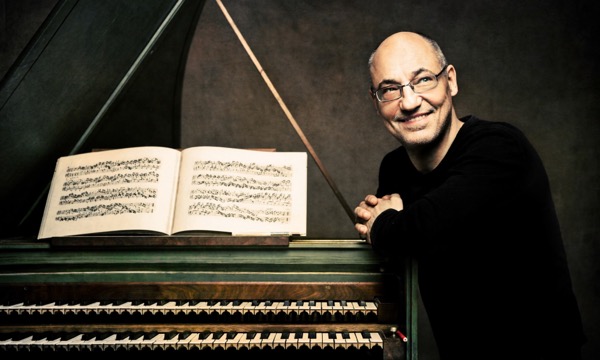
Andreas Staier (Photo from The Guardian)
Discovering the Harpsichord
Staier initially studied modern piano. As a child, he often played duets with a girl who was five years older. At her home stood a small harpsichord with a rather unimpressive sound, but the instrument unexpectedly captured his interest. At around the age of ten, he acquired two volumes of The Fitzwilliam Virginal Book, setting him on the path to becoming an early music expert.
Following WWII, the harpsichord experienced a revival, with figures such as Gustav Leonhardt emerging as leading representatives of the instrument. Today, however, Staier worries that interest in this art form is gradually waning. Combined with cuts to cultural funding, this has led concert organisers to favour familiar repertoire.
He jokes that “roughly 90 per cent of invitations ask him to play Bach’s Goldberg Variations.” Although he fully recognises the greatness of the work, he hopes to introduce audiences to a wider range of lesser-known harpsichord repertoire. His Shanghai recital provides an ideal opportunity to share some of these treasures.
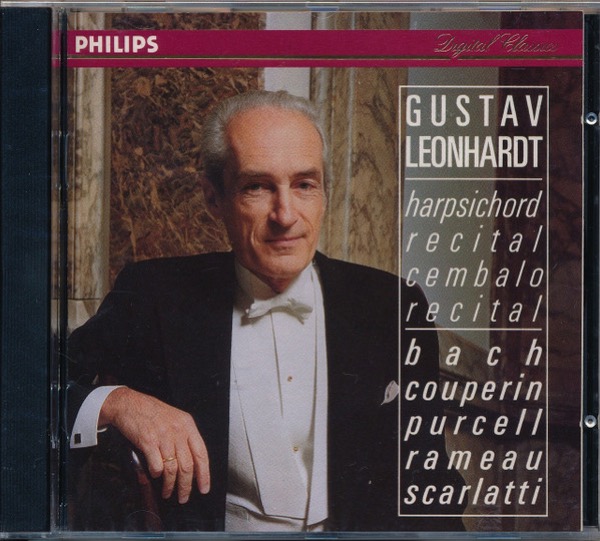
Gustav Leonhardt Harpsichord Recital CD Cover
Between the Abyss and the Heavens
Staier has placed two of his favourite works at the end of each half of the program: Couperin’s Tombeau de Monsieur de Blancrocher and Muffat’s Passacaglia in G minor. He explains that “Couperin follows the logic of a dream, drawing the listener into an abyss-like meditation. Muffat, by contrast, builds a monumental structure that seems to reach towards the heavens.”
Muffat’s work is also “an exemplary synthesis of French and Italian musical styles. After a stately opening in the style of tragédie lyrique, the movement gradually incorporates an increasing degree of Italian virtuosity.” For Staier, the work seems to trace a musical journey from the French composer Jean-Baptiste Lully to the Italian composer Arcangelo Corelli.
Georg Muffat: Apparatus musico-organisticus: Passacaglia (Andreas Staier, harpsichord)
The Encounter of Three Traditions
French and German composers are represented in roughly equal numbers in this recital. Staier points out that, from the seventeenth century through the first half of the eighteenth, German composers were deeply influenced by Italian and French music. Following the destruction of the Thirty Years’ War (1618–1648), German art, too, lay in ruins. “It was therefore only natural for German artists to seek inspiration from the models provided by the two great cultural nations, Italy and France. These German imitations may often sound somewhat more laboured and less spontaneous than their models; on the other hand, they are more ambitious and diverse.” Staier comments.
Speaking of French music, Staier pays particular attention to the genres of the tombeau—musical memorials composed in honour of the deceased. Such works express grief while also allowing the memory of the departed to live on through music. For example, after the death of Chambonnières, the teacher of Couperin, a musical tombeau was composed in his memory. These compositions often use sudden pauses and hesitations to evoke the transience of human life. The sounds of the lute and harpsichord naturally fade after being plucked. This poignant disappearance makes them particularly apt vehicles for the tombeau’s reflections on time, memory, and mortality.
Louis Couperin: Suite in F Major: VI. Tombeau de Monsieur Blancrocher, BG 81 (Andreas Staier, harpsichord)
“Sorrow, Stay”
How does melancholy in Baroque music differ from the sentimentality of Romanticism? Staier explains that the former is rooted in religious faith, whereas “Romantic melancholy, by contrast—or perhaps more accurately described as wistfulness or Weltschmerz (world-weariness)—is concerned with the loneliness and abandonment experienced by modern humanity. One need only think of Caspar David Friedrich’s paintings or Schubert’s Winterreise.”
Melancholy had already attracted considerable attention in ancient Greece. Staier writes: “Why is it that all outstanding men, whether philosophers, statesmen, poets, or artists, have apparently been melancholics? This is the question with which a treatise attributed to Aristotle begins.” The ancient theory of the four temperaments associated melancholy with “the planet Saturn, autumnal season and the autumn of life, twilight, coldness, avarice, but equally genius, geometry, and profound, brooding introspection.”
Staier also highlights the theme of vanitas, as his harpsichord programs explore the musical interpretations of the transient, earthly vanity. Visually, Staier cites “Albrecht Dürer’s 1514 enigmatic engraving Melencolia I, Georges de La Tour’s painting of a young woman gazing at a dying candle, and Domenico Fetti’s depiction of a woman holding a skull against a landscape of ruins all of which serve as reminders that human life is ultimately fleeting. The opening line of Andreas Gryphius’ well-known poem could serve as a motto for a distinctly Baroque interpretation of melancholy: “You see, wherever you look, nothing but vanity upon earth.”
Méditation by Andreas Staier
For Staier, “the suspension of movement, the interruption of rhythmic continuity and pulse bring this music, even in its compositional structure, into close proximity with the memento mori tradition. Meditative spaces open up, evoking silence, emptiness, or solitude; funeral bells toll.” The lute technique known as style brisé, characterised by broken, arpeggiated chords, was adapted for the harpsichord by composers such as Chambonnières and Couperin. Staier describes it as: “The gentle breaking of chords, the pauses and hesitations, and the melody’s tendency to recede into itself were from the outset closely related to the expressive character of the lament.”
Even a single note on the harpsichord, as it fades away, can serve as a reminder of the transience of all earthly things. The Antwerp harpsichord maker Andreas Ruckers alludes to this in the inscriptions he placed on several of his instruments: “Sic transit gloria mundi” (Thus passes the glory of the world). Staier points out that “regular patterns and recurring movements often symbolise the passage of time, the flowing and ebbing of water and of life itself, or the solemn tread of the pompe funèbre.” The topos of twilight and darkness finds its musical counterpart in descending melodic lines (catabasis) and in the preference for low registers darkened by chromaticism. Finally, the ostinato structures found in certain chaconnes and passacaglias can readily be heard as “symbols of an inescapable fate.”
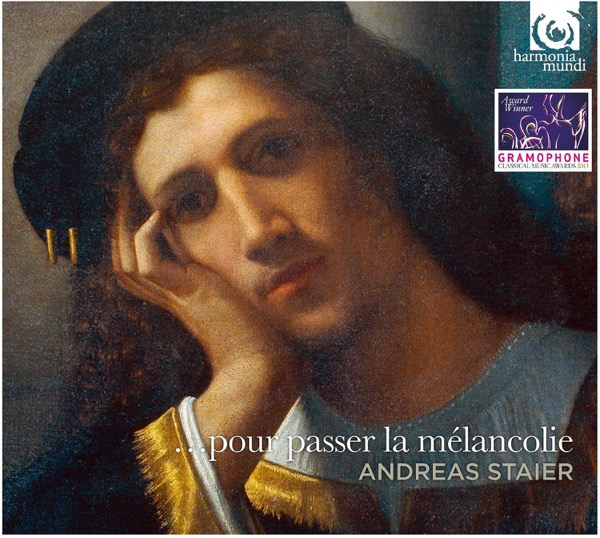
Andreas Staier’s Mélancolie CD Cover
Improvisation versus Notation
In the 2020 interview at the Library of Congress, Staier points out that musical scores possess an inherently visual quality. The arrangement, density, and overall shape of the notes can communicate information to performers even before they examine the notation in detail. The French genre of the Prélude non mesuré (unmeasured prelude) is a particularly striking example of this intuitive freedom. Such scores generally indicate pitches without specifying precise rhythms. Sometimes they consist almost entirely of whole notes, with occasional slurs suggesting relationships between notes. Performers must organise the musical narrative themselves, guided by harmony and proportion, in a process that comes close to improvisation. Staier illustrates this with an analogy from driving: “if you drive very fast into a curve, it will feel very different from driving slowly into the curve and maybe then speeding up.”
Conversation with Andreas Staier
This expressive freedom is not exclusive to French music. Staier notes that German music also has a strong improvisational tradition, highlighting the limitations of musical notation itself. Although scores are often assumed to preserve a composer’s intentions accurately, even precise markings cannot always capture expressive nuances. Citing Schubert, Staier observes that “sometimes composers themselves seem unable to decide between markings such as accents, sforzandos, and decrescendos, because what they really want to express may be a combination of several effects.”
Froberger’s Lament Made in London to Dispel Melancholy, which opens Staier’s recital, illustrates the expressive freedom of Baroque music. The piece was inspired by an unfortunate journey to England, during which Froberger discovered that all his belongings had been stolen. Written with bar lines, the lament nevertheless carries the instruction to be “played with all liberty,” reflecting a French style of vague notations. Staier uses this example to highlight that: “rhythm is not simply a mathematical relationship. An eighth note is not simply equivalent to two sixteenth notes.” What the composer wishes to express may lie somewhere between these precisely defined terms.
Johann Jacob Froberger: Suite No. 12 in C Major: I. Lamento sopra la dolorosa perdita della Real Msta di Ferdinando IV, Re de Romani (Andreas Staier, harpsichord)
Palette of Keyboards
Staier explains that French music is more dependent on its sound medium, while Bach’s compositions are distinguished by rigorous structures and a polyphonic approach, making them easier to transcribe for other instruments. He recalls hearing “an outstanding saxophone quartet arrangement of The Art of Fugue,” but suggests that such an arrangement would not necessarily do justice to Couperin. German composers, he observes, tend to prioritise “structure and solidity”. Although these qualities are strengths, they may sometimes come at the expense of elegance. With characteristic humour, Staier concludes: perhaps “we Germans are pedants.”
Andreas Staier on Bach’s Goldberg Variations
Performing music from different countries does not necessarily require using a harpsichord from the corresponding tradition. Staier believes that European musicians interacted more frequently in the past than we might imagine, making it appropriate to perform German music on a French instrument. What matters most is the instrument’s character and the overall artistic vision. Sometimes, he deliberately uses the same harpsichord to allow different compositions to emerge through a shared sound world from German, French, and Flemish-French instruments.
From the shadowy introspection of Couperin to the magnificent virtuosity of Muffat; from the fading notes of French tombeau to Froberger’s free rhythms, Andreas Staier hopes that his Shanghai program will reveal the multifaceted world of Baroque music. Melancholy, after all, is not simply sadness: it reflects on impermanence and the human condition, while seeking to capture something eternal as the notes dissolve into silence.
See Andreas Staier’s schedule: https://andreas-staier.de/live
For more of the best in classical music, sign up for our E-Newsletter