I have played the violin for nearly thirty years. I started on a ¼-size violin as a child. I’ve been in a youth orchestra, attended a summer chamber music festival as a teenager, and studied with well-known teachers. I’ve played in the local symphony and chamber orchestra, where I shared the stage with many talented musicians who began their studies in kindergarten.
But when I look back, my favourite performances have actually been with a local group of adult amateurs, many of whom began studying their string instrument in retirement.
I can say from experience that adults can learn the violin, play it beautifully – even when they doubt themselves.
Here are some tips geared specifically to adult violin students and their unique learning situation.
© johnsonstring.com
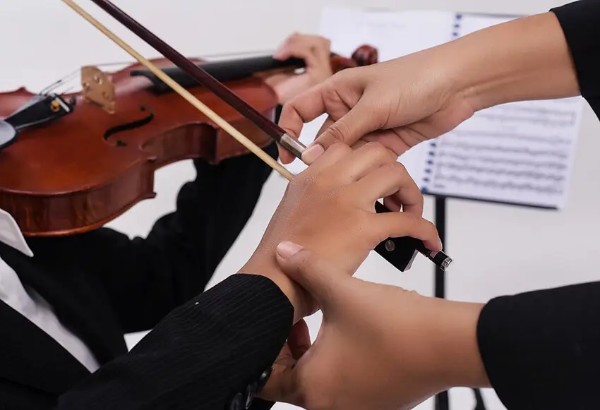
1. Your first challenge: before you play a single note, find a teacher who loves working with adults. Have them help you with your setup.
The violin is too complicated to learn from a book, YouTube, or TikTok alone.
If you do, you risk cementing bad habits that can take months or even years to undo. In some cases, you may even injure yourself and wind up in occupational therapy for an overuse injury.
You need a teacher to start you off. Weekly in-person lessons are preferable, but some people get good results from lessons every other week, or online.
Ask your teacher to recommend a local violin shop where they can properly fit you for a shoulder rest and instrument.
While there, they’ll assess if you need any other adjustments. For instance, I’ve benefited from switching to a centre-mount chin rest instead of a side-mount, which makes my playing more relaxed.
You won’t know to make these adjustments without expert guidance.
2. Your second challenge: learn how to be okay with sounding bad.
There’s no sugar-coating it: the violin is genuinely difficult. Playing in tune alone requires months, if not years, of muscle memory.
Adults are used to relying on muscle memory for everyday tasks – riding a bike, driving, typing. Starting to learn a skill from scratch, in a way they haven’t done since childhood, can be deeply frustrating.
Accepting this upfront will hopefully make it easier for you to stay patient with yourself.
Adult beginner violinist – 2 years progress video
3. Focus on improving just one or two things at a time.
Unlike a squirmy, distracted four-year-old, you’ll remember your teacher’s suggestions vividly.
As a result, you may hear all those suggestions at once in your head, then grow discouraged or paralysed by your inability to follow them all simultaneously.
That’s why it’s best to focus on absurdly small skills.
For instance, you may want to spend five minutes playing the first few measures of Twinkle, Twinkle Little Star, with your sole focus being relaxing your grip on the instrument’s neck.
That focused, incremental work adds up faster than you’d expect.
4. Multiple short practice sessions are better than one marathon session the day before your lesson.

© Musicnotes, Inc.
Between work, family, and everything else, finding a spare hour to practice can feel impossible.
The good news is that ten minutes of focused practice is often more effective than an unfocused hour.
Some violinists even keep their instrument hanging on a wall hook so it’s always within reach.
5. Little kids may be able to learn faster – but you can learn smarter.
Indeed, children don’t have jobs or families to support. Advantage: children.
But they haven’t learned how to learn yet. You have.
You will recognise what needs fixing faster than a child will. You can apply problem-solving skills they don’t have. You will know what questions to ask your teacher – and how to ask them. Advantage: adult.
Adult vs Kid (Beginner) Music Students
6. If something hurts you, don’t push through it.
In fitness culture, you often hear the phrase “no pain, no gain.”
But in the violin world, where we’re focused on micro-movements and fine motor skills, that saying doesn’t apply.
If something hurts you, tell your teacher immediately. They should help you root out the cause of the tension.
Playing the violin should not hurt.
7. Your first pieces may feel juvenile. Treat them seriously anyway.
Many method books are written for elementary-aged or middle-school students.
It can be humbling to find yourself defeated by nursery rhymes like Twinkle Twinkle and Hot Cross Buns.
But they’re in the books for a reason: they build important skills you’ll need to advance.
Treat those nursery songs with all the gravitas of Brahms.
8. Have goals, but celebrate the steps in between, and enjoy the process of improvement.
If your goal in your first week of study is to play your favourite song, you’ll be disappointed.
However, that doesn’t mean the goal is out of reach. Give yourself more time – and find satisfaction in the steps along the way, like learning a new note or scale.
9. Look for a friendly amateur group to play with.

Ask your teacher and local violin shops if they have any leads on amateur groups. Many require no audition, or hold inclusive auditions where no one is turned away, and focus on beginner- and intermediate-level repertoire.
Along the way, you’ll learn vital skills you can’t learn on your own, like how to share a music stand, how to count rhythms in an ensemble, how to blend with other players, and more.
Kinsale Amateur Orchestra Society Documentary
10. Be proud of the effort, not just the outcome.
As I said, I started playing the violin as a kid, and I’ve met so many incredible musicians along the way.
But the people who inspire me the most are adult amateurs. I don’t care what pieces they’ve played or how they sound.
Their passion for music – and for the harder, quieter work of becoming better at something difficult – is contagious. Every single one is a blessing to the musical community.
In the end, learning the violin as an adult isn’t so much about the instrument as it is about the sheer joy of meeting new friends, learning new skills, and growing as a person.
For more of the best in classical music, sign up for our E-Newsletter