Queen Christina of Sweden, born in Stockholm in 1626, stands as one of the most intellectually fierce and unconventional figures in European history. Inheriting the crown at just six years old after her father, King Gustavus Adolphus, died in battle, she was raised and educated like a prince under the guidance of Chancellor Axel Oxenstierna. She quickly gained a reputation across the continent for her sharp mind, her mastery of multiple languages, her deep love of classical philosophy, and her stubborn independence.
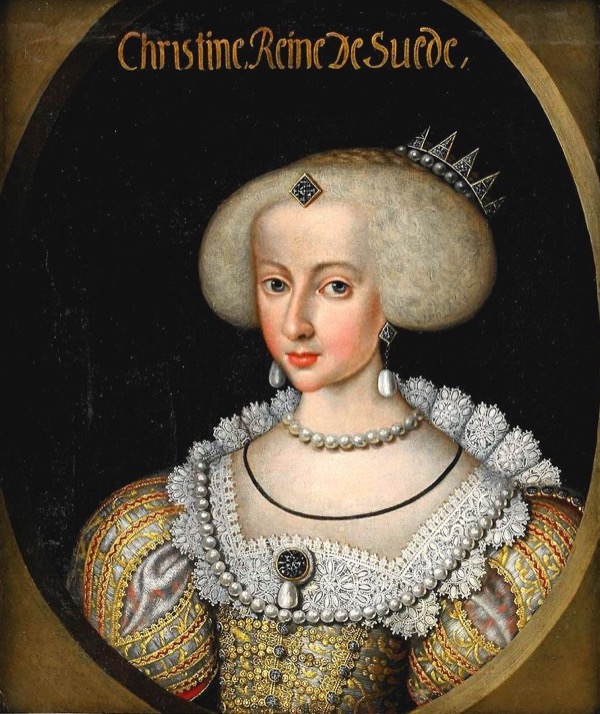
The 14-year-old Christina as queen, painting by Jacob Heinrich Elbfas
Christina’s relentless drive to surround herself with world-class brilliance was legendary; she famously invited the French philosopher René Descartes to Stockholm to teach her philosophy and assist with court ballets in the freezing early morning hours, a gruelling journey that tragically led to his fatal pneumonia in 1650.
Yet political power in a frozen northern kingdom could never satisfy her restless spirit. In 1654, at twenty-seven years old, she shocked the entire continent by abandoning her throne, refusing to marry, converting to Catholicism, and leaving her homeland behind. She set out on a lifelong journey toward Italy, where she would spend the rest of her days transforming Rome into a bustling stage for Baroque culture and eventually becoming the most influential musical patron of her era.
Her passion for music had already started reshaping the isolated Swedish court years before her famous departure. First, the young queen actively imported French dance masters like Antoine de Beaulieu and sets of French violinists to bring fresh energy to her palace. Before long, her expanding artistic attention shifted toward the dramatic new art of Italian opera, leading her to hire an entire Italian troupe featuring artists like Alessandro Cecconi and Vincenzo Albrici.
Vincenzo Albrici: Dixit Dominus Domino meo (Weser Renaissance; Manfred Cordes, cond.)
After stepping down from the throne in 1654, Christina began her dramatic journey south toward Rome, turning her travel itinerary into an extended cultural spectacle. A pivotal milestone occurred in the autumn of 1655 during her stay in Innsbruck, Austria. Hosted by Archduke Ferdinand Karl, this stop marked the moment of her official, public reception into the Catholic Church. To celebrate her conversion and honour such an extraordinary guest, the court staged a week of lavish festivities centered on a monumental musical event: the premiere of Antonio Cesti’s opera L’Argia, written specifically for this occasion. This memorable week in Innsbruck served as the perfect prelude to her new life, proving that wherever Christina went, spectacular music was sure to follow.
Antonio Cesti: L’Argia: Sinfonia – Prologue: De’ gotici splendori (Francesca Aspromonte, soprano; Il Pomo d’Oro)
When Christina finally made her grand entry into Rome in December 1655, passing through the Porta del Popolo, Pope Alexander VII welcomed her with full royal honours. She took the additional name Alexandra to mark her new Catholic identity, and she quickly threw herself into the heart of Roman society. Establishing her principal residence at the Palazzo Riario, she turned her home into a lively gathering for scholars, painters, poets, and musicians. She built a private theater right inside her palace and founded intellectual academies where scholars met to debate art and literature, with every single meeting concluding with a magnificent concert. In 1671, her vision expanded to the general public when she helped launch Rome’s very first public opera house, the Teatro Tor di Nona. By backing this venture—which opened with Francesco Cavalli’s Scipione affricano—she tore down the old rule that opera was a private luxury meant only for wealthy cardinals and noble families.
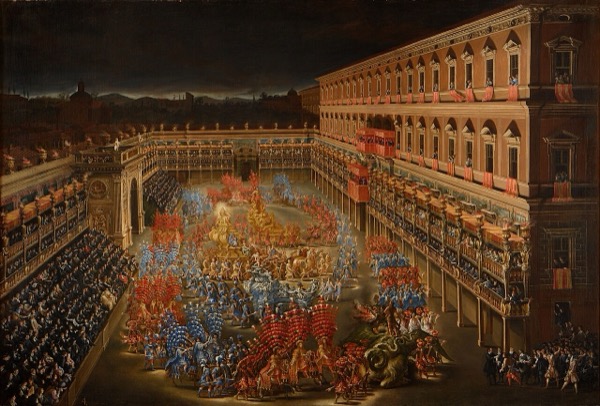
Celebrations for Christina at Palazzo Barberini on 28 February 1656
Also, Christina acted as a brave protector for musicians facing political or religious trouble. When an eighteen-year-old Alessandro Scarlatti had trouble with papal authorities early in his career due to a family scandal, Christina stepped in without hesitation, appointed him her official music director (maestro di cappella). Scarlatti never forgot her sharp artistic ear, later noting in a letter that she found true delight in the most complex polyphonic compositions of the era, such as the madrigals of Gesualdo. The famous violinist Arcangelo Corelli was another legendary artist who flourished under her care, choosing to dedicate his groundbreaking Opus 1 Trio Sonatas directly to her in 1681 and leading massive orchestras for her special academy celebrations. Other major composers, including Bernardo Pasquini and Alessandro Stradella, spent years writing operas and cantatas specifically for her court.
Arcangelo Corelli: Sonata a 3 in G Major, Op. 1, No. 9 (Ensemble Aurora)
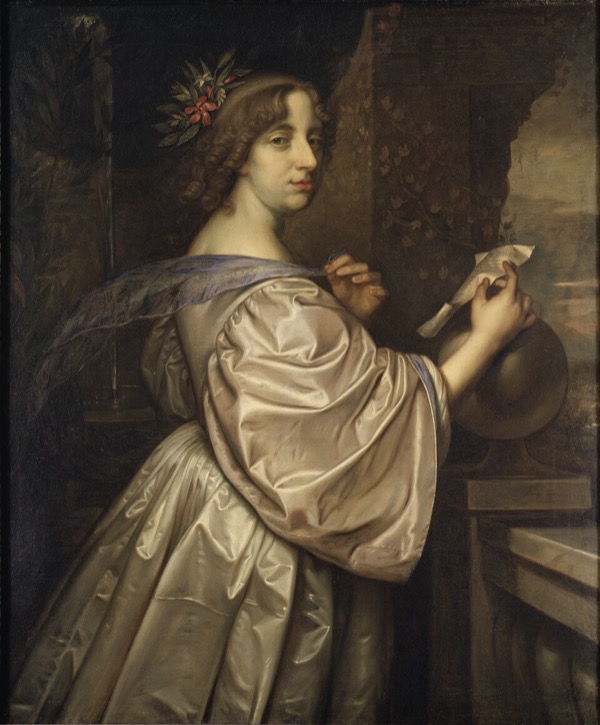
Queen Christina of Sweden, painted by David Beck 1650
When Christina died in 1689 at the age of sixty-two, she was given the rare honour of being buried inside St. Peter’s Basilica, a tribute granted to almost no other woman in history. She had willingly traded a traditional royal crown in the north for an artistic kingdom in the heart of Europe. By using her wealth, rank, and refined taste to shield controversial talents, build new theaters, and commission immortal works from Innsbruck to Rome, she gave Baroque music the room and resources it needed to truly thrive. Her unconventional choices left behind a vibrant musical legacy that proved far more lasting than any political empire.
For more of the best in classical music, sign up for our E-Newsletter