Karen Power is an Irish composer and sonic artist based in Cork whose work explores the relationship between acoustic instruments and the sounds of the world around us. For more than a decade, field recording has been central to her practice, taking her to environments including the Arctic and Antarctica, where she captures sounds that might otherwise go unheard.
Her latest album, listening between poles, released by Farpoint Recordings, brings together four works shaped by field recordings made in the Arctic in 2013 and Antarctica in 2022. Spanning orchestral, piano, violin, and stereo acousmatic works, the album reflects Power’s evolving interest in listening closely to environments and finding ways to bring their sounds into musical contexts.
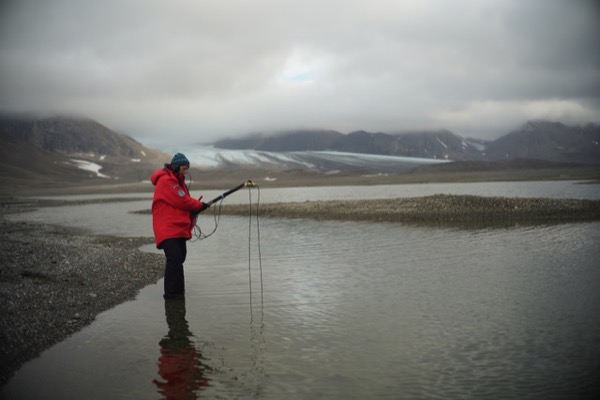
Karen Power (image by John Godfrey)
That interest grew from her background in electroacoustic music. Initially, Power used technology to transform and extend instrumental sounds, exploring possibilities that could not exist in live performance. Gradually, however, she realised that musical instruments did not necessarily produce the sounds she found most compelling.
“A lot of the sounds that I was particularly interested in exist all around us,” she explains, “and actually kind of work quite well if they’re just listened to in a different context.”
That realisation changed both what she recorded and how she listened. Rather than entering an environment with a predetermined idea, Power approaches field recording as a form of “eavesdropping,” allowing the environment to reveal itself.
Over time, that listening has become more conscious. When she first began recording, Power says, she listened more naively, without necessarily understanding the ecosystems around her. With experience, she has learned to “take myself out of the listening,” paying closer attention without immediately imposing human expectations.
This becomes particularly powerful in places such as the Arctic and Antarctica, where human presence is limited.
“It is a very strong experience,” she says.
For Power, recording is itself a form of composition. She describes her approach as “composing the space,” using different microphones and perspectives to shape how listeners will encounter an environment. An iceberg might produce an intense crackling sound while walruses occupy the surrounding space; one microphone might capture the ice up close while another records the wider landscape.
Some of the most striking material on listening between poles comes from underwater recordings made with hydrophones. Beneath the surface, ice interacts with water in ways that remain invisible: ice shifts and pops, gases escape, and other sounds emerge from the environment.
Power gives these recordings different roles depending on the work. In …Antarctica calling…listen… (2023), the orchestral piece is fully notated and conducted, while performers are also provided with links to imagery to help them engage with the places behind the sounds.
Karen Power – Sonic Cradle
The violin piece Sonic Cradle (2016) takes a more improvisatory approach. During the recording session, violinist Barbara Lüneburg follows conventional notation while also responding to private material heard through headphones that no one else in the room can hear. The performer becomes another listener within the work, responding to a world that exists partly outside the concert space.
Power thinks of the environment as a “partner.” Her recordings influence the musical material as well as her choices of instruments, performers, and collaborators. Although she continues to compose without field recordings, many of her recent works have grown from the places she has encountered.
She approaches instrumental and environmental sounds differently, but does not necessarily hear them as fundamentally separate. “I hear them actually similarly,” she says. What matters is what each material requires.
The Arctic has been especially important to that development. Power first travelled there in 2013, spending nine days recording during a two-week residency. She had no specific project in mind. She wanted to travel to the Arctic and surround herself with ice.
That experience, she says, “changed everything.”
Nearly a decade later, she travelled to Antarctica. The two places offered different experiences: Antarctica appeared nearly unimaginably vast, while the Arctic carried its own sense of endlessness. Yet both confronted her with the same awareness of human smallness.
“I could disappear at any moment, and the environment would just go on,” she reflects.
That sense of connection is central to listening between poles. Power sees the Arctic and Antarctic as remote bookends of the globe, with humans occupying the space between them. Even familiar sounds can be transformed by their surroundings. The same wind can move through different landscapes and emerge sounding entirely different.
Time is also important to her work. Power wants listeners not simply to understand musical time intellectually, but to experience it and become aware of their movement through a piece.
The album also reflects a shift in why she records these environments. Climate change was not initially a motivation for her field-recording practice, but repeated encounters with rapidly changing landscapes have made it increasingly difficult to ignore.
“I’m recording things that would probably not be there in another ten years,” she says. “I’m almost becoming an archivist.”
Her recordings therefore serve purposes beyond composition. Power has created radio works using environmental sounds and voices and has worked with young children and ensembles, continually finding ways to expand listening beyond the traditional concert hall.
Ultimately, her work asks not only what we hear, but how we listen and whose voices we make space to hear.
Listening between poles brings that idea together through sounds of ice, wind, water, animals, silence, and the spaces between them. What began as a desire to hear these remote places has become an effort to listen closely, preserve what may disappear, and invite others to hear the world differently.
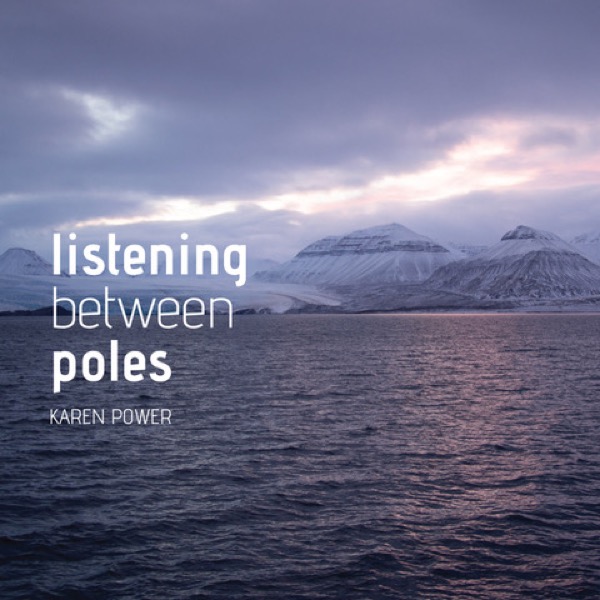
Listening Between Poles by Karen Power
Performers: Features the RTÉ Concert Orchestra, Isabelle O’Connell, and Barbara Lüneburg.
Label: Farpoint Recordings
Release date: 3 September 2026
To know more about Karen Power, visit https://www.karenpower.ie.
For more of the best in classical music, sign up for our E-Newsletter