The Margravial Opera House (Markgräfliches Opernhaus) in the Franconian town of Bayreuth, Germany, stands as one of the world’s most complete and magnificent surviving court theatres from the Baroque era. Recognised by UNESCO as a World Heritage site in 2012, this 18th-century masterpiece offers an authentic glimpse into the festive culture, artistic ambition, and architectural brilliance of European royalty before the French Revolution.
Unlike many theatres of the same historical period, which were either destroyed by fire or heavily modified over the centuries, the Margravial Opera House has survived almost completely intact. Today, managed by the Bavarian Palace Administration, the opera house functions as both an active museum and a performance venue.
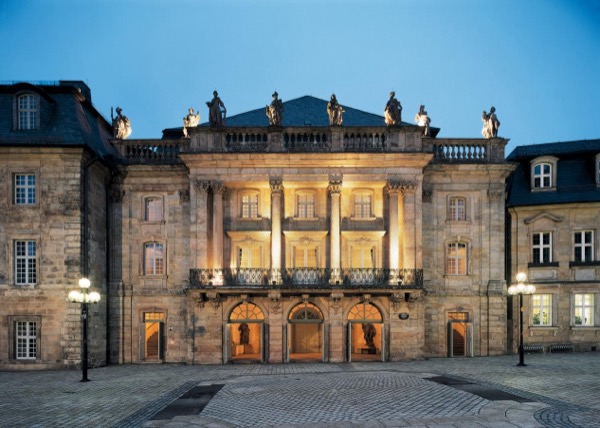
Margravial Opera House
The Creative Mind Behind the Vision
The history of the Margravial Opera House is inseparable from the life and vision of Margravine Wilhelmine of Brandenburg-Bayreuth (1709–1758). Born a Prussian princess and the favourite sister of King Frederick the Great, Wilhelmine married Margrave Frederick of Brandenburg-Bayreuth in 1731. Together, they began ruling the principality of Bayreuth in 1735.
Wilhelmine was a remarkably talented artist, composer, and librettist in her own right. Starting in 1737, she personally took charge of the opera theatre in Bayreuth, guiding its artistic direction for nearly twenty years. Under her leadership, the court theatre acquired a unique, highly personal identity.
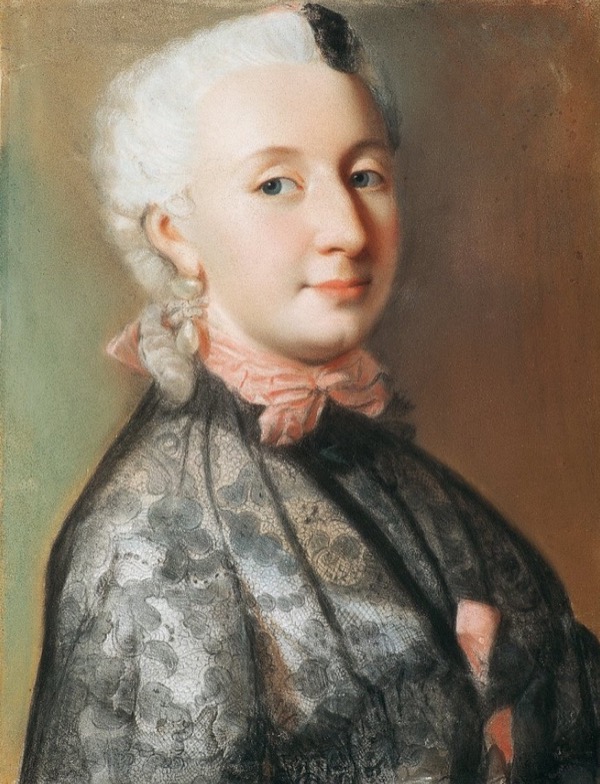
Wilhelmine von Preußen by Jean-Étienne Liotard (1745)
In the early decades of the 18th century, Bayreuth possessed an older comedy and opera house built in 1714/15 by the court architect Johann David Räntz. However, this existing facility failed to satisfy Wilhelmine’s grand artistic ambitions. She desired a theatre that could match the finest cultural capitals of Europe, such as Vienna and Dresden. She wanted a monumental building that would signal a new era of peace, wisdom, and cultural flowering under her reign.
Italian Baroque Interior and Stone Exterior
Construction of the Margravial Opera House began in 1744 and was completed in 1750. The exterior sandstone facade was designed by the court architect Joseph Saint-Pierre. It features balanced classical proportions that integrate seamlessly into the street layout of Bayreuth. For the interior, Wilhelmine hired two of the most celebrated theatre designers of the era: Giuseppe Galli da Bibiena and his son Carlo Galli da Bibiena. Belonging to a famous Italian family of theatrical architects and painters, the Bibienas were renowned across Europe for their mastery of illusion, dramatic perspective, and elaborate decoration. They transformed the interior of the Bayreuth opera house into a triumph of Italian late-Baroque theatre architecture.
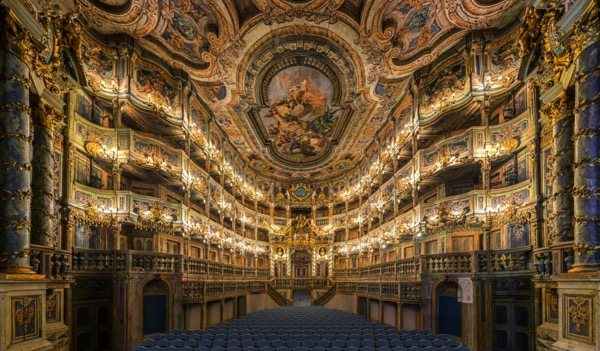
© Achim Bunz
The interior of the auditorium is crafted entirely from wood and painted canvas, creating a warm and rich visual experience. The seating arrangement follows the classical loge system, featuring three stacked tiers of boxes that traditionally reflected the social hierarchy of 18th-century society.
The auditorium is filled with remarkable artistic details. Located in the centre of the tiers, the Prince’s Box is lavishly decorated with ornate motifs, caryatids, and heraldic symbols. Surprisingly, Margrave Frederick and Margravine Wilhelmine rarely used this central royal box to watch performances. Instead, golden chairs were placed in the middle of the first row on the main floor so the royal couple could observe the stage up close. Above the auditorium, the ceiling features a grand central painting by Dresden artist Johann Benjamin Müller depicting Apollo surrounded by the nine muses, framed by medallions illustrating scenes from Ovid’s Metamorphoses. Directly above the stage entrance, a prominent coat of arms flanked by two trumpet-blowing figures proudly displays the Brandenburg eagle alongside the Prussian royal crown. The stage itself covers an impressive surface of 180 square meters, making it one of the largest theatre stages in Europe at the time of its completion.
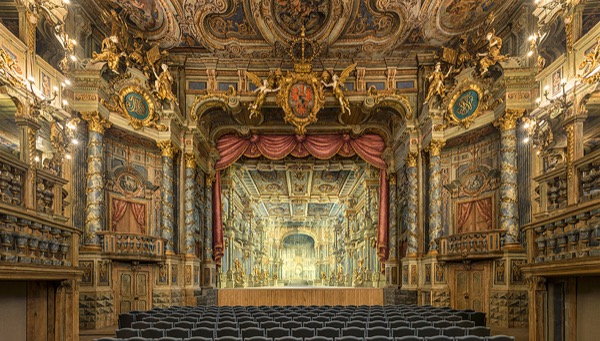
© Achim Bunz
In addition to its decorative beauty, the building features an extraordinary structural innovation overhead. Engineered by court carpenter Adolf Adam Feulner, the roof relies on a self-supporting timber truss design spanning 25 meters without any internal supporting columns. This daring construction pushed 18th-century carpentry techniques to their absolute limits, utilising long timber beams felled in nearby forests during the winter of 1746/47. UNESCO’s advisory body, ICOMOS, explicitly praised this remarkable roof structure as an essential component of the site’s World Heritage status.
Inauguration and the Grand Festivities of 1748
Although construction was completed in 1750 with the final addition of the entrance vestibule, the opera house was officially inaugurated in late September 1748. The occasion was the royal wedding of Wilhelmine’s daughter, Princess Elisabeth Friederike Sophie of Brandenburg-Bayreuth, to Duke Carl Eugen of Württemberg.
During the lavish wedding celebrations, two Italian operas composed by Johann Adolph Hasse—Artaserse and Ezio—were performed on the new stage. The festivities brought European nobility to Bayreuth, though the immense building costs ultimately placed a heavy financial burden on the principality.
A Quiet History and the Wagner Connection
Margravine Wilhelmine passed away in 1758, and following Margrave Frederick’s death in 1763, regular opera operations ceased. Ironically, this quiet period saved the wooden theatre from destruction. With few candles and oil lamps lit over the decades, the building escaped the catastrophic fires that claimed almost all other 18th-century opera houses. Throughout the late 18th and early 19th centuries, the unheated building saw only sporadic use by travelling troupes—staging plays by Molière and Schiller, as well as the local debut of Mozart‘s The Magic Flute in 1793/94. After Napoleon sold Bayreuth to the Kingdom of Bavaria in 1810, the “Royal Opera House” was even repurposed temporarily for military storage, including drying army flour. Decades later, in 1871, the theatre’s famous stage attracted Richard Wagner to Bayreuth; though he found its intimate Baroque auditorium unsuitable for his grand music dramas, the visit inspired him to build his own Festspielhaus nearby. In the late 20th century, the auditorium gained new global fame when it served as a primary filming location for the Oscar-nominated 1994 film Farinelli, showcasing its mesmerising Baroque interior to cinema audiences worldwide.
Farinelli (1994) excerpt, filmed inside the opera house
UNESCO Recognition and Today’s Visitor Experience
On June 30, 2012, UNESCO officially added the Margravial Opera House to the World Heritage List. The committee highlighted the building as an unprecedented monument of 18th-century Baroque theatre architecture, celebrating both its artistic quality and exceptional level of preservation.
© Bayerische Schlösserverwaltung
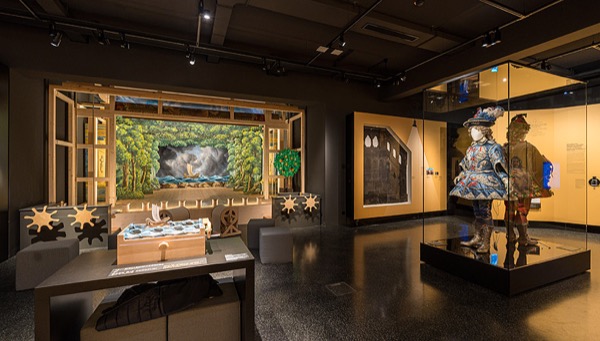
Following extensive restoration efforts, the building remains open to the public through guided tours and museum exhibits featuring detailed stage models and interactive historical displays. Beyond serving as a historical museum, the venue truly comes alive each autumn during the annual Bayreuth Baroque Opera Festival. Inside the intimate, wood-carved auditorium, world-class performances awaken the Baroque spirit long slumbering within its fragile frescoes. As stage spectacles, luminous music, and theatrical seduction fill the hall, the opera house transforms once more into a vibrant living tableau, offering modern audiences an authentic taste of 18th-century grandeur, mischief, and beauty.
For more of the best in classical music, sign up for our E-Newsletter
Watch Il Divino Sassone (Vivica Genaux) | Bayreuth Baroque Festival 2020 here.