At last there’s an evidence-based guide to practising
For centuries, celebrated musicians have shared their thoughts on technique and artistry in memoirs, essays and interviews. Yet remarkably few have written about the daily act of practising. Professional violist Molly Gebrian laments that it took her nearly two decades to learn how to practice: “If only there had been a handbook on how to practice!” She has now provided one.
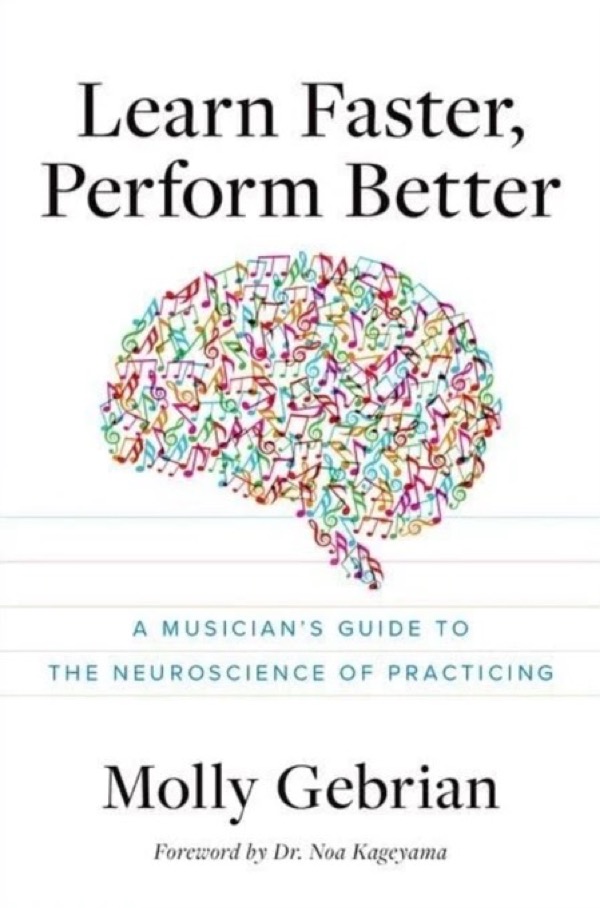
Learn Faster, Perform Better by Molly Gebrian (Oxford University Press)
Gebrian, who teaches at New England Conservatory, holds degrees in both music and neuroscience. In her recent book, Learn Faster, Perform Better, she draws on empirical research from neuroscience and cognitive psychology to offer practical advice for musicians. Her recommendations are grounded in science, but they are anything but dry—they are actionable, surprising, and frequently transformative.
What is practice, really?
One of Gebrian’s central tenets is that simply playing through a piece is not practising. “Practising is problem solving,” she writes. She advocates for deliberate practice, defined by Anders Ericsson in 1993 as working on specific skills to address weaknesses and eliminate errors. But how should that be done?

Neuroscience and musical practice
Throughout Learn Faster, Gebrian translates complex neurological concepts into plain language, then applies them directly to music. Her “brain basics” underlie much of the book:
The brain consists of billions of neurons that communicate across tiny gaps called synapses. When a neuron sends a message, it releases neurotransmitters that bind to receptors on neighbouring neurons, generating electrical signals.
Every time you practice or learn something new, you are physically changing your brain, strengthening some neural pathways and weakening others.
The goal of much practice, therefore, is to reinforce the pathways that produce correct playing while diminishing those that encode mistakes. As Gebrian puts it, practice is about which pathways you are reinforcing.
Mistakes, she insists, are not merely acceptable but essential: they reveal where the neural wiring needs attention. Once a problem is identified and corrected, Gebrian recommends repeating the passage five times in a row without error—a process that helps myelinate the correct neural circuit. Myelin, the fatty sheath around neurons, thickens with correct repetition, turning good habits into automatic reflexes.
The Power of Breaks
Some of Gebrian’s most striking advice challenges long-held assumptions about hard work. Numerous studies show that marathon practice sessions are counterproductive. Breaks, she argues, are not a pause from learning—they are part of it. In one study she cites, more improvement occurred during rest periods than during the activity itself.
One process called long-term potentiation (LTP), through which synapses strengthen, requires molecular building blocks that take the brain about an hour to assemble. So when learning something new, shorter, spaced sessions are far more effective than long, continuous blocks.
The biggest break of all—sleep—is critical. With a full night of sleep, the last 25% of time, consisting of non-Rapid-Eye-Movement sleep (NREM), makes for dramatic advancement of learning. Gebrian goes so far as to say, “Getting a full night’s sleep is as beneficial as practising itself.”
Interleaving vs. blocking
Rather than “blocked” practice—focusing on one section for an extended period—Gebrian champions “interleaved” practice: switching frequently between sections, pieces, or technical tasks. This approach keeps the brain more highly engaged and leads to better retention and performance the next day, which is the true test of learning. She offers a range of interleaving strategies.
Mental practice: music without sound
Practising in your head—without movement or sound—might seem like a poor substitute for the real thing, but Gebrian shows otherwise. In one experiment, mental practice produced changes in the motor cortex as dramatic as physical practice. This technique is especially useful when the instrument is unavailable or when fine-tuning interpretation away from the physical demands of playing.
Memorisation and speed
Gebrian also provides a clear framework for memorisation, divided into three phases: encoding (initial learning), consolidation, and retrieval. Each of these calls for a different set of practice strategies. She describes a remarkable method for bringing music up to tempo—one she calls “interleaved clicking up”—which I have already adapted to my own practice with startling results. Her video demonstration of this technique is well worth watching:
How To Practice to Increase Speed
A Book That Delivers
This is, without question, the most useful book on learning music I have read. Partly what makes it exceptional is Gebrian’s ability to weave together neuroscience, behavioural research, and concrete musical application—without losing sight of the musician’s practical needs. The book describes more than 100 practice strategies. Many of her ideas and techniques are also demonstrated on her website, MollyGebrian.com.
She is not alone in this field. Psychologist Noa Kageyama, who teaches at Juilliard and the Cleveland Institute of Music, offers similarly evidence-based advice for performers at BulletproofMusician.com. Every generation of musicians builds on the last; today, science-based practice is helping that progress accelerate more than ever.
Learn Faster, Perform Better by Molly Gebrian is published by Oxford University Press.
For more of the best in classical music, sign up for our E-Newsletter