Born on 13 June 1974 in Paris, the French-Swiss cellist Ophélie Gaillard has over thirty albums to her credit. She has recorded in a variety of styles and genres, all acclaimed for their richness and technical brilliance.
Renowned for her versatility and emotive performances, Gaillard has consistently attempted to convey deeply human passions through her instrument.
To celebrate her birthday on 13 June, let us sample one of her most emphatic albums, the 2017 release Exiles, a recording inspired by Jewish musical heritage and displacement.
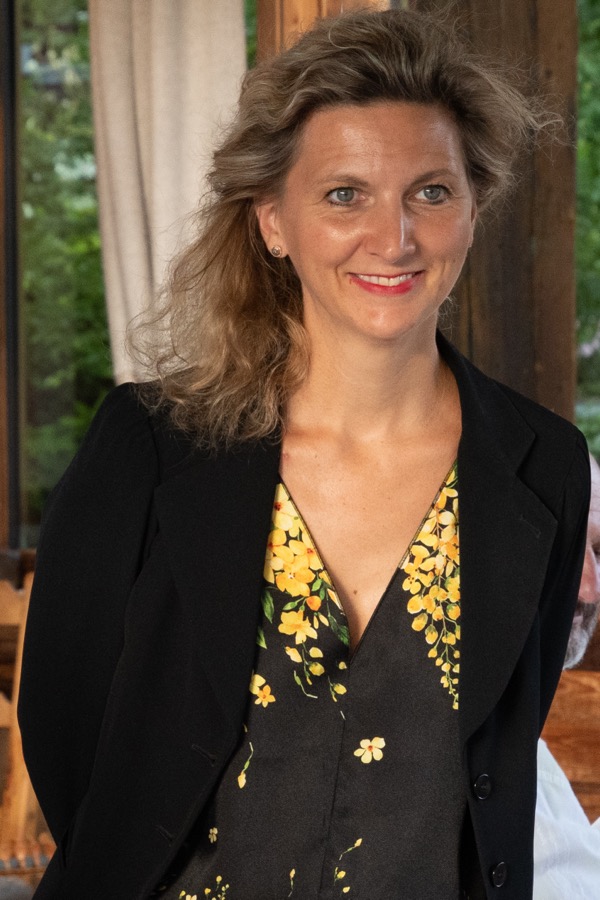
Ophélie Gaillard
Ophélie Gaillard performs Prokofiev: Overture on Hebrew Themes
Where Exiles Began
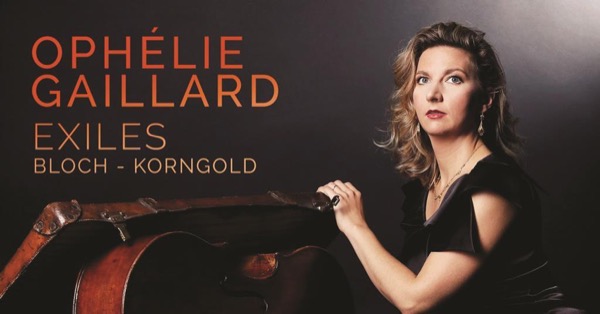
Ophélie Gaillard, Exiles (2017)
Gaillard conceived the Exiles project over a number of years through a lengthy period of gestation. She credits hearing the clarinettist Giora Feidman and the cry of his shofar clarinet, and the singer and lyricist Chava Alberstein with providing the initial spark.

Ophélie Gaillard
Sergei Prokofiev was not Jewish, and the cause of his exile was the Russian Revolution. He arrived in New York at the beginning of September 1918, and he reunited with his close friend Simeon Bellison, who had founded the Jewish émigré ensemble Zimro.
The troupe was collecting funds for the creation of a music conservatory in Jerusalem, and Bellison commissioned an Overture on Jewish Themes from Prokofiev. The composer calls on klezmer melodies that haunt the collective émigré memory.
Ernest Bloch: From Jewish Life (arr. C. Lehn for cello and chamber ensemble) (Ophélie Gaillard, cello; Sirba Octet)
The Pain of Exile
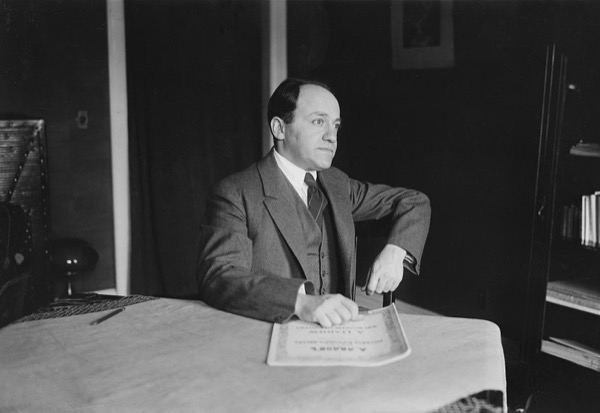
Ernest Bloch, 1917
The music of Ernest Bloch features prominently on the Exiles recording. In fact, the title might well originate from a phrase that Romain Rolland wrote to Ernest Bloch on 28 December 1924: “There is something good about exile. It makes one suffer.”
Bloch was born in Switzerland, but spent the majority of his life in the United States. Yet, he felt stateless everywhere and remained unsatisfied as both a man and an artist. And thus, he inspired for a new harmony, which he found in the Bible.
The three short pieces titled “Prayer,” “Supplication,” and “Jewish Song” make up From Jewish Life. Originally written for cello and piano in 1924, Gaillard selected an arrangement of the accompaniment consisting of clarinet, cimbalom, and double bass. This accentuates the meditational nature and clarifies the modal language of the solo cello.
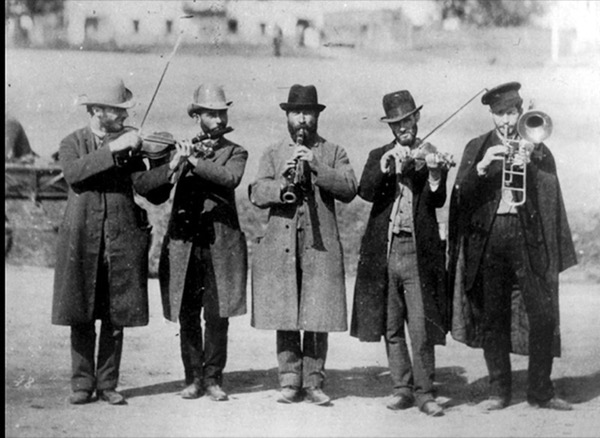
Klezmer musicians
Chava Alberstein: Sarah Sings a Lullaby to Little Isaac (arr. C. Lehn for cello and chamber ensemble) (Ophélie Gaillard, cello; Sirba Octet)
The Whisper of Yiddish

Chava Alberstein
Gaillard credits Chava Alberstein with providing inspiration for Exiles, and she also credits her for teaching her Yiddish. Gaillard describes it as a language too tender yet offering resistance, so fragile and tenuous that one wants to welcome it in a whisper.
Chava Alberstein has released over sixty albums in Hebrew, English, and Yiddish. She is known for her liberal activism and advocacy for human rights and for Arab-Israeli unity. She was born in Poland, but moved to Israel with her family in 1950.
Alberstein comes from a strong Jewish folk music background, music that combines the exultation of dance movements and profound nostalgia. The clarinet often plays a central role, and this traditional repertoire often leaves room for improvisation.
Traditional: Freilechs – Sim Shalom – Azoy Tantzmen in Odessa (arr. C. Lehn for cello and chamber ensemble) (Ophélie Gaillard, cello; Sirba Octet)
The Emotional Core of Exiles

Ophélie Gaillard (Photo by Bernard Martinez)
The central work on Exiles is Ernest Bloch’s Schelomo. Gaillard first learned to play it at the age of eleven, and when she performed it at a competition with pedagogue Philippe Muller on the jury, he quickly invited her to study with him at the Conservatoire de Paris.
Schelomo is an epic story without the aid of words, and while it is inspired by the Bible, its narrative is larger than can be embodied by a single human being. In fact, the cello represents the voice of King Solomon, and the orchestra represents the world around him.
Subtitled “Hebraic Rhapsody,” the score follows no precise programme, but the essential part of the spirit is contained in the leitmotif “All is vanity” from the original text. Gaillard credits this score with teaching her all about vibrato and rubato.
Critics were very enthusiastic, praising the emotional intensity of Gaillard’s playing and her imaginative programming. The critical consensus suggested that Gaillard turned an intellectual concept album into something emotionally vivid.
For more of the best in classical music, sign up for our E-Newsletter
Ernest Bloch: Schelomo (Ophélie Gaillard, cello; Monte-Carlo Philharmonic Orchestra; James Judd, cond.)