The harpsichord is an instrument of proud, historical contradictions. When treated with theatrical flair, its plucked metal strings can evoke an entire lost world of Baroque opulence; when starved of imagination, however, it risks transforming the concert hall into a relentless factory floor. Ironically, this tension was laid bare in Hamburg—a city that boasts a world-class collection of historical keyboard instruments and a legendary legacy of master makers, from the Zell and Fleischer families to the Hass dynasty. Despite this rich heritage, truly exceptional period keyboard performances remain a rarity in the city’s musical calendar. In this regard, the Elbphilharmonie’s ambitious “Cembalomania” series represented a magnificent breakthrough. For this grand finale, the festival pulled out all the stops, staging a formidable fleet of four instruments at once. Yet, when judged by the highest artistic standards, the actual live results of this concluding performance from Accademia Bizantina left much to be desired, offering a curation and interpretation that ultimately struggled to convince.
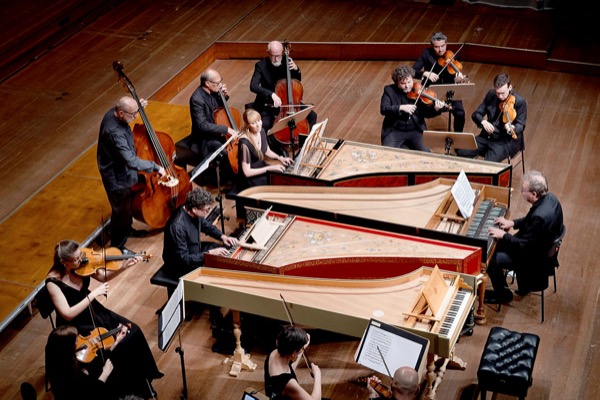
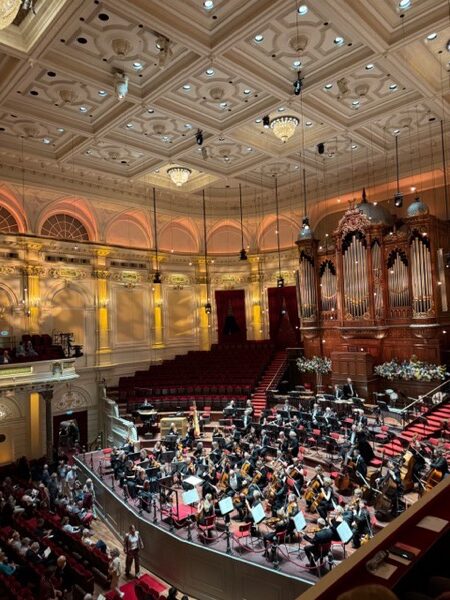
Accademia Bizantina / Ottavio Dantone (Photo: Jann Wilken)
Accademia Bizantina / J.S. Bach – Brandenburg Concerto No. 5 in D Major, BWV 1050: III. Allegro
The first half opened with the Brandenburg Concerto No. 5 in D major, BWV 1050, Dantone took his seat at a replica of a double manual Zell instrument. Performing with a highly streamlined approach, Accademia Bizantina immediately established a clear structural architecture. Yet, the overall reading felt unmistakably conventional, charting a safe course that avoided taking bold risks in tempo, phrasing, or dramatic dynamics. During the first movement’s extensive keyboard solo, Dantone attempted to inject some breath-like pauses and rubato, but these moments sound occasionally staggered and disjointed. Compounding this dryness was an overly polite sonic projection from the solo violin and transverse flute. This lack of heightened sense of excitement became more pronounced in the Affettuoso, where the relatively sparse musical material yielded a monochromatic texture, while the closing movement failed to unlock the multi-layered potential of the ripieno strings.
Accademia Bizantina / J.S. Bach – Concerto for Flute, Violin and Harpsichord BWV 1044: I. Allegro
Redemption arrived swiftly with the next Concerto for Flute, Violin, and Harpsichord in A minor, BWV 1044. Here, the ensemble actively exploited the three-dimensional acoustic space, adjusting the players’ physical positions on stage. Driven by a sharply contoured, highly rhythmic motif, a vivid and robust musical character instantly took shape, successfully establishing a genuine, conversational contrast between the solo violin and flute. In the slow movement, Dantone’s harpsichord displayed an impressive differentiation of timbre between his left and right hands, weaving a compelling chamber-music triangle with the two solo parts. The finale owed much to the harpsichord as well; his solo work served as a radiant, exceptionally poised foundation upon which the rest of the orchestra layered a brilliant, lustrous sheen.
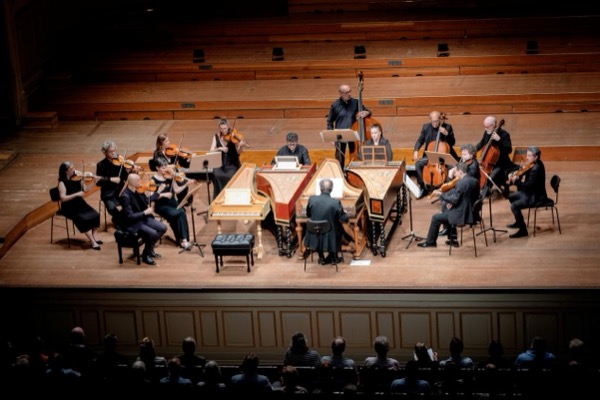
Accademia Bizantina / Ottavio Dantone (Photo: Jann Wilken)
However, the promises of the first half faded after the intermission, as the two Concertos for Three Harpsichords (BWV 1063 in D minor and BWV 1064 in C major) severely amplified the evening’s underlying flaws. While it is unfair to blame the performers entirely—given that Bach‘s dense, contrapuntal writing for multiple keyboards can inherently lean toward the mechanical—Dantone conspicuously lacked the inspired, operatic spark that normally characterises his finest performance. Tonight, one heard little true cantabile singing or subtle nuance.
Sonically, the three harpsichords played by Dantone, Stefano Demicheli, Valeria Montanari and Chiara Cattani (the latter two played one each of the triple concerto) were voiced so similarly that they lacked individual profiles. Deprived of distinct solo moments, the collective keyboard output frequently dissolved into a muddy, undifferentiated wash of sound. When paired with Bach’s extensive use of unison string writing in the ripieno, the overall listening experience became relentlessly rigid. It was a stark reminder of the early, dogmatic days of the HIP movement, which critics famously derided as a soulless, metronomic “sewing machine” style. The moments of relief only arrived in the final movements of both works. BWV 1063 was elevated by a beautifully expressive, chromatic cello line, while BWV 1064 featured a surge of innovative, keyboard coloratura passages that briefly shattered the strict metrical grid.
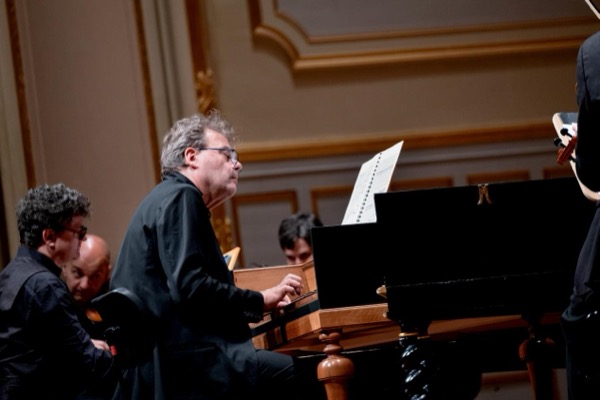
Accademia Bizantina / Ottavio Dantone (Photo: Jann Wilken)
Ultimately, the true consolation of the night came from the south: the Concerto for Four Harpsichords in A minor, BWV 1065. Although Accademia Bizantina’s strings remained overly conservative in their dramatic scope and dynamic range, Antonio Vivaldi‘s unmistakable operatic DNA refused to be suppressed. Reimagined through Bach’s German craftsmanship, Vivaldi’s fiery Italian theatricality, and vibrant sonic colours finally burst through the textbook monotony. For the first time in the second half, the music shed the provincial, claustrophobic atmosphere of a budget-tight German small court utilizing instrumental counterpoint as a substitute for fine singers. The addition of the fourth instrument—a distinct Italian harpsichord—finally injected the performance with the necessary spark. Vivaldi’s characteristically energetic phrasing found its natural home in the instrument’s sharper attack.
While one can easily imagine that this heavy Bach programming was a deliberate nod to the preferences of the North German audience, it was equally clear that Accademia Bizantina failed to deliver it with the highest level of heartfelt engagement and true artistic conviction.
For more of the best in classical music, sign up for our E-Newsletter