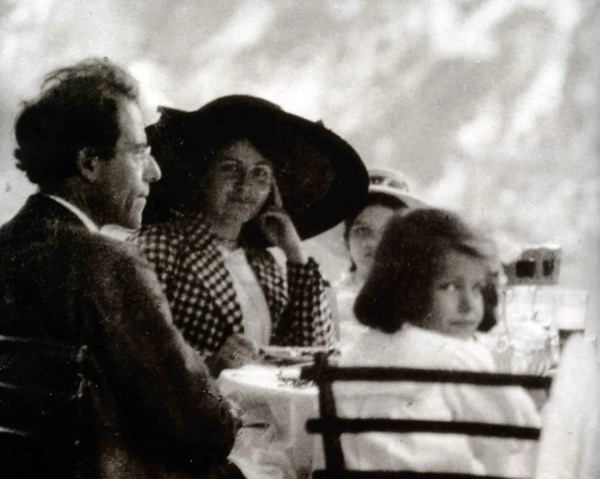
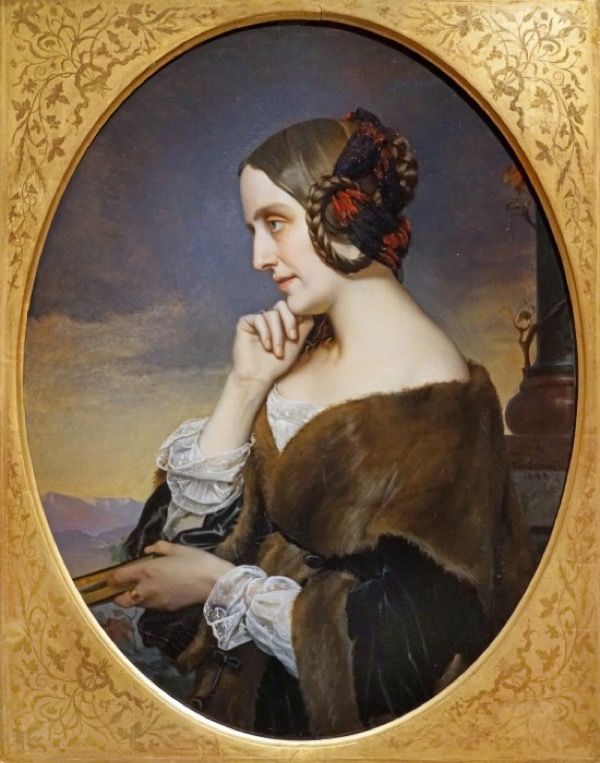
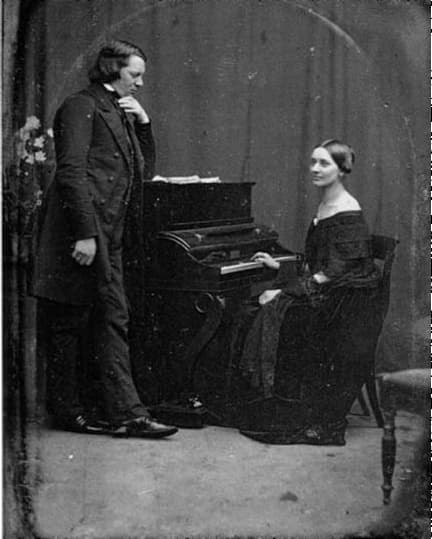
Over the course of her life, Alma Mahler (1879–1964) enchanted a veritable constellation of influential men, not as a passive muse, but as an active, opinionated, and often volatile presence.
A composer, muse, socialite, and sharp observer of the artistic world around her, she was connected to some of the era’s most significant painters, writers, and musicians.
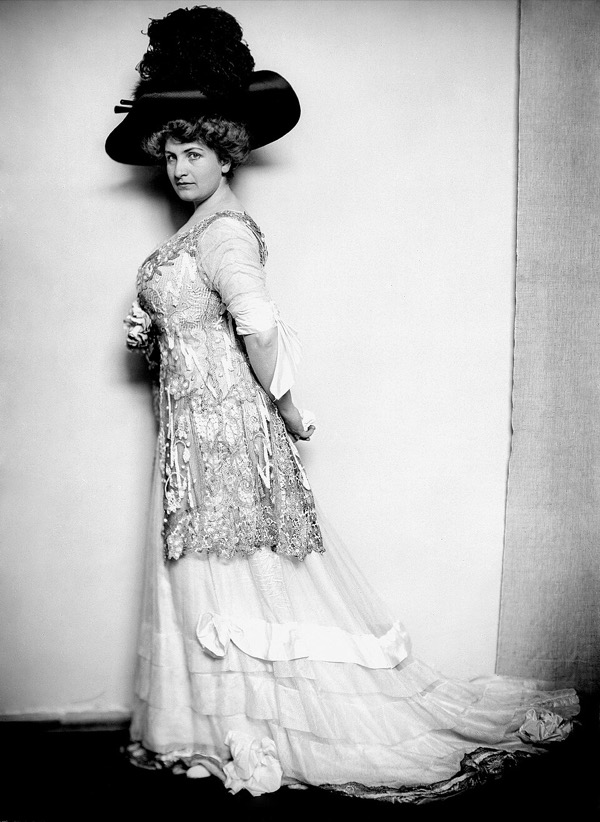
Alma Mahler
She had romantic relationships with Gustav Klimt, Alexander Zemlinsky, Gustav Mahler, Walter Gropius, Oskar Kokoschka, and Franz Werfel. All of these relationships offer a revealing lens into both her personal life and creative Vienna around the turn of the century.
Today, we’re looking at how her relationships influenced not only her own personal artistic trajectory, but the works of the men she loved…and how those relationships affected her own creative output.
Gustav Klimt (1862–1918)
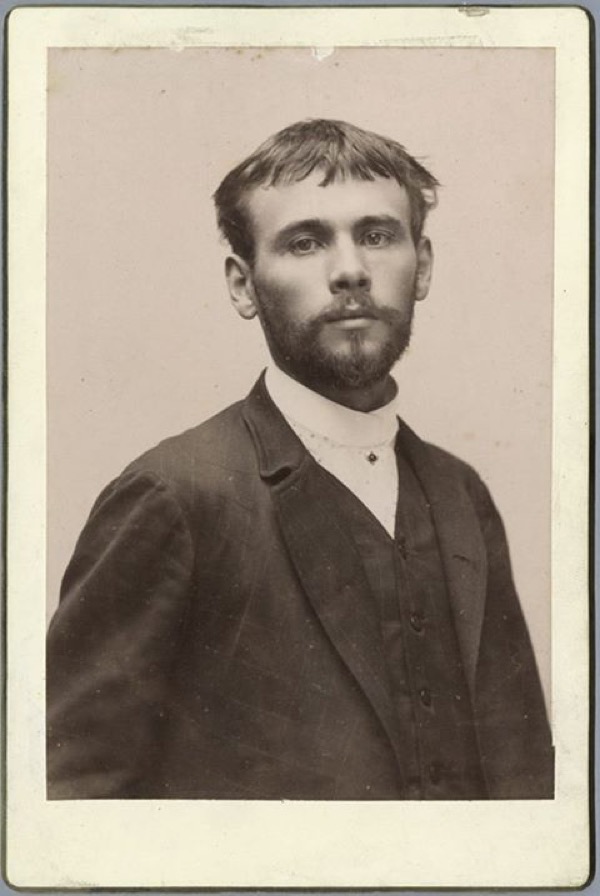
Gustav Klimt
In 1897, Alma’s stepfather, Carl Moll, co-founded the Austrian Secession art movement with fellow artist Gustav Klimt.
As colleagues, Moll and Klimt frequently had dinner together. It was during one of these dinners that Klimt first noticed the 17-year-old Alma, who was half his age.
The following year, in 1898, Moll, Alma’s mother, Alma, and Klimt vacationed in Italy.
During that trip, Klimt became infatuated with Alma and kissed her. He claimed he was in love, and told her that she was a “rare, unusual kind of girl.”
Her mother and stepfather ended up finding Alma’s diary entry and were appalled. Klimt may have been a famous artist, but the age difference was alarming, and he had recently impregnated two of his models. Klimt was ordered to return to Austria by her family.
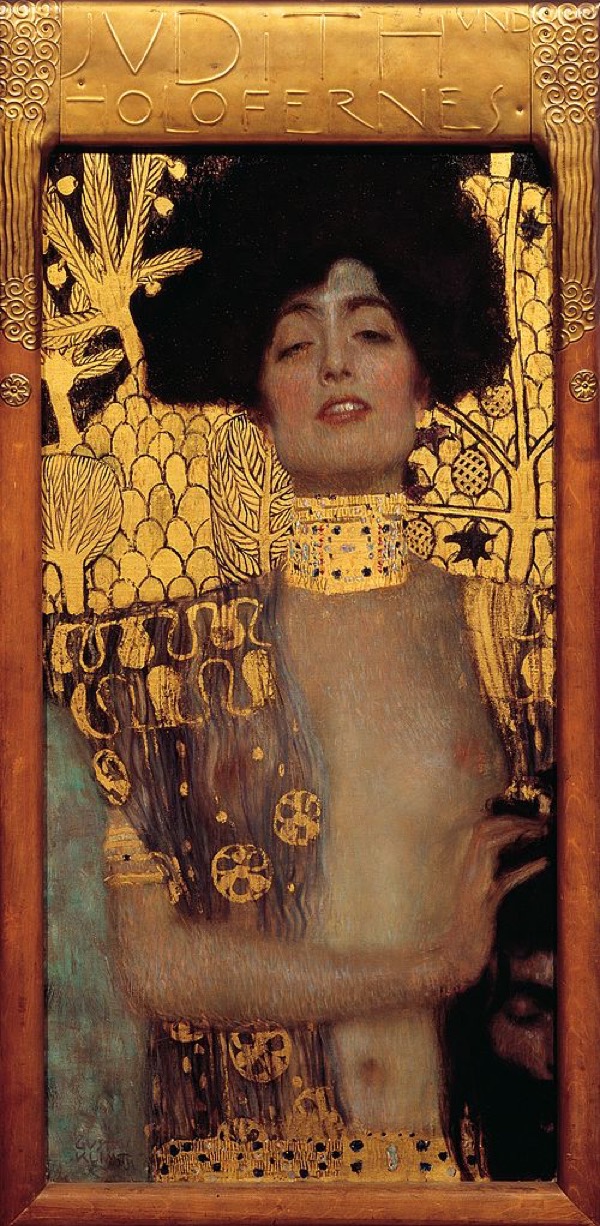
Gustav Klimt: Judith I
It is possible that Alma helped to inspire the imagery of some of the powerful women in his art of the time, including 1898’s Athene and 1901’s Judith I.
She described the relationship in her diary:
“Gustav Klimt entered my life as my first great love, but I was an innocent child, totally absorbed in my music and far removed from life in the real world. The more I suffered from this love, the more I sank into my own music, and so my unhappiness became a source of my greatest bliss.”
Alexander Zemlinsky (1871–1942)
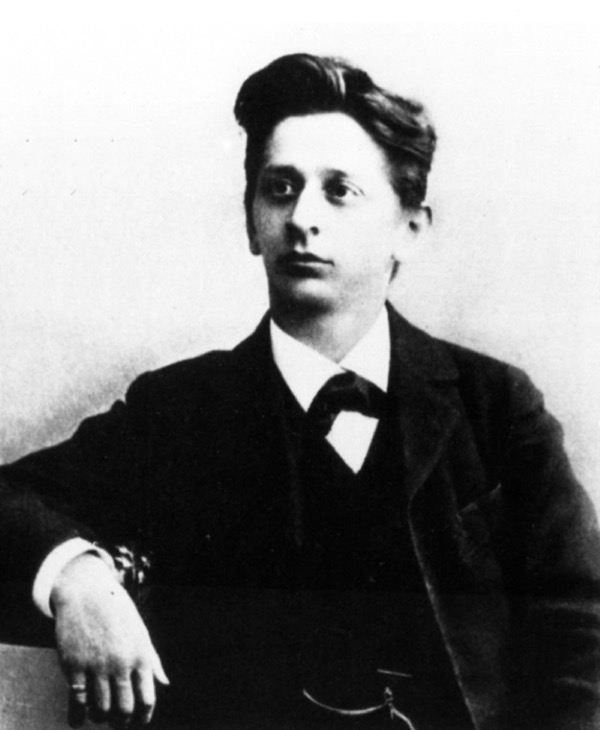
Alexander von Zemlinsky
In 1900, the year she turned 21, Alma’s love of music led her to study with composer Alexander Zemlinsky, who was eight years her senior.
She ended up writing dozens of songs while working with him. Some of the songs she wrote during this period survive, revealing an ear for line and harmony that was strikingly mature for her age.
Alma Mahler’s Five Songs arranged for alto and orchestra
She wrote in her diary, “He is dreadfully ugly, almost chinless – yet I found him quite enthralling.”
Thanks to the rampant anti-Semitism of the era, she was also put off by his Jewish ancestry. A family friend went so far as to tell her not to “spoil the good race” by marrying him.
Despite this, she became engaged to him anyway, and their relationship turned physical.
Once, Zemlinsky suggested a game to play: “If we can think of someone with whom neither of us has a bone to pick, we’ll down a glass of punch in their honour.” The figure they settled on, whom both thought highly of, was Gustav Mahler.
Ultimately, Alma ended the relationship and became romantically involved with Mahler.
It is believed that Zemlinsky drew on the pain of rejection while writing his 1922 opera Der Zwerg (The Dwarf), about an ugly dwarf in love with a cruel and beautiful princess.
Read about their doomed relationship.
An excerpt from Zemlinsky’s Der Zwerg
Gustav Mahler (1860–1911)
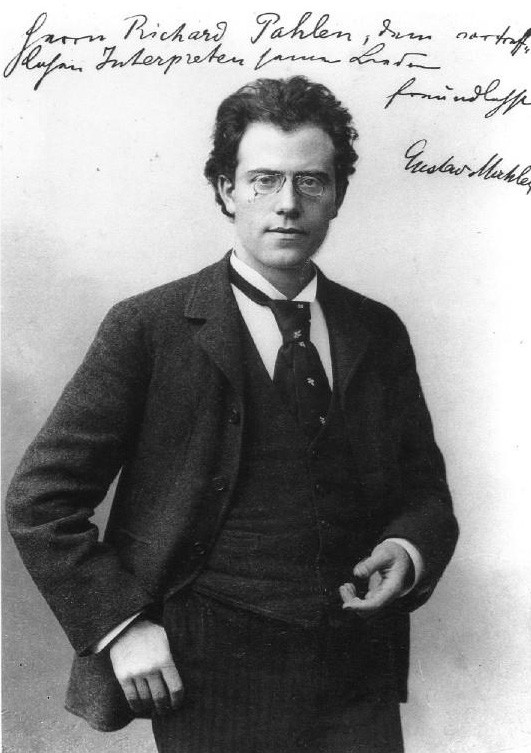
Gustav Mahler
Alma met Gustav Mahler in November 1901. He was 41; she was 22.
At the time, he was the director of the Vienna Court Opera, as well as a celebrated composer. She found both his genius and social prominence deeply attractive.
Their courtship was a whirlwind, and they were engaged within weeks of their first date. They married on 9 March 1902. Alma was already pregnant.
Mahler’s Symphony No. 5 (1901–1902)
They had two daughters: Maria (also known as “Putzi”) and Anna (nicknamed “Gucki”) in 1904. (Maria’s death in 1907 impacted both Gustav and Alma deeply.)
Her relationship with Gustav was very different from her relationship with Zemlinsky. Before their wedding, Gustav forbade her from composing, believing strongly that there could be only one composer in a marriage. After receiving the letter in which he made this ultimatum, Alma cried all night long. But she accepted his terms.
Although Gustav later encouraged her to compose again, this early prohibition at a pivotal time in her creative development left a lasting imprint.
Despite his dismissal of her talent, she had faith in his genius, devoting the later part of her life to tending to his posthumous reputation and legacy.
Walter Gropius (1883–1969)
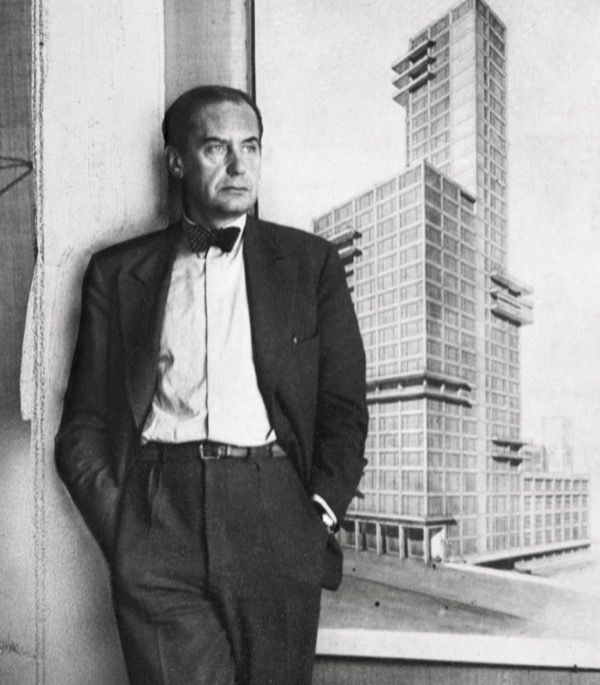
Walter Gropius
After nine years of marriage, tensions began bubbling over between the Mahlers.
Alma was devastated by the death of her daughter, feeling unsupported in her own interests and passions, and dealing with the manifest age difference between her and the chronically ill Gustav.
She wrote in her diary that his “work, exaltation, self-denial and never-ending quest” consumed him to the point where “he noticed nothing of all it cost me. He was utterly self-centered by nature.”
The stage was set for an explosive affair – and in 1910, the spark for it was lit. That summer, while on vacation without Mahler, she met architect Walter Gropius.
Gropius would go on to found the Bauhaus School and the International Style, ultimately becoming one of the twentieth century’s most influential architects. But at that time, he was just another man under Alma’s spell.
She wrote in her memoirs about their meeting:
“Gliding, slowly around the room with the youth… I heard that he was an architect… We stopped dancing and talked.”
They slept together that night.
Their liaison was revealed after Gropius sent Alma a love letter that was accidentally addressed to Gustav. (Alma believed he’d done it intentionally.)
On the heels of the death of his daughter and a diagnosis of a terminal heart issue, the shock of his wife’s infidelity hit Mahler hard.
Adagio from Mahler’s Unfinished Symphony No. 10
He begged Alma to stay in the marriage and attempted to make changes in the relationship that he hoped would restore their emotional intimacy.
However, he didn’t have much time left: he died in 1911. After his death, Alma had a fling with artist Oskar Kokoschka before returning to Gropius.
They eloped on 18 August 1915 in a ceremony that was so rushed, they pulled people off the street to act as witnesses.
She wrote in her diary:
“My desire is pure and clear… I have no other wish but to make this talented man happy!”
Afterwards, he left for the front. She gave birth to their daughter Manon Gropius in early 1916, when Gropius was still at war.
The stress of wartime separation ate away at their connection, and by early 1918, Alma was having an affair with poet Franz Werfel.
Alma and Gropius separated in 1919 and divorced in October 1920.
Oskar Kokoschka (1886–1980)
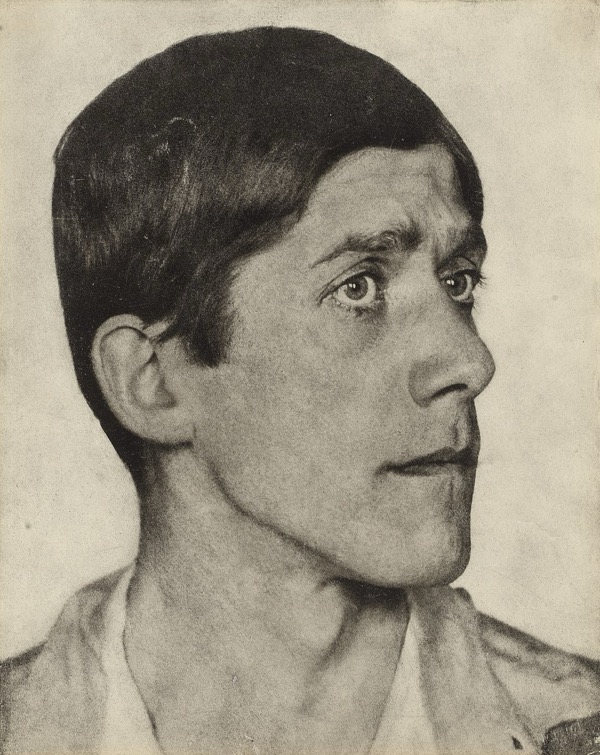
Oskar Kokoschka
In 1912, the year after Mahler’s death, Alma met Oskar Kokoschka, an artist six years her junior. He was one of the most important Expressionist painters of the era.
Kokoschka became obsessed with Alma, writing her hundreds of love letters and waiting outside her home to stalk her.
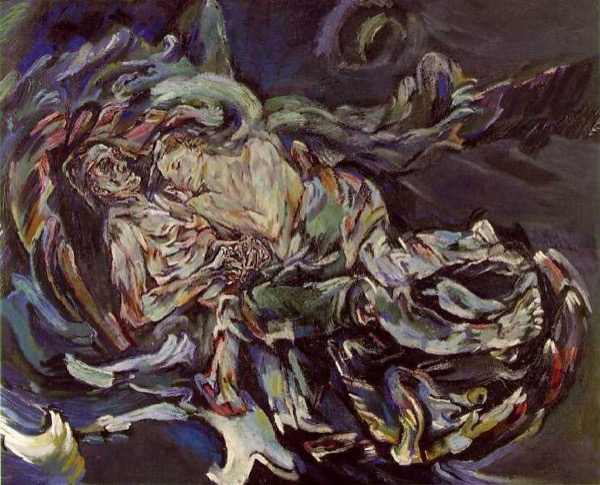
Oskar Kokoschka: The Bride of the Wind
In 1914, he painted Die Windsbraut (The Bride of the Wind), which portrayed Kokoschka and Alma lying next to each other.
The two did enjoy a physical relationship, but, especially after her experiences with Mahler, she refused to give up her independence.
After he left for the front during World War I, the cracks in their relationship became too much to bear. By 1915, she had returned to Walter Gropius.
Kokoschka coped with the loss by commissioning a life-sized nude doll in Alma’s likeness, carrying it around Vienna. Read the full story.
Franz Werfel (1890–1945)
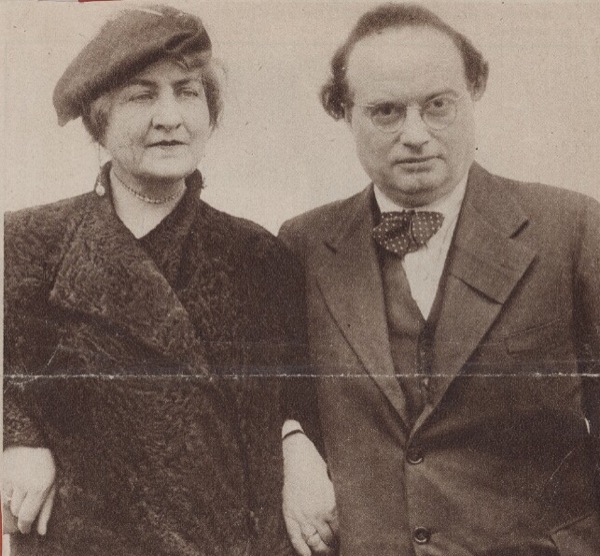
Alma Mahler and Franz Werfel
Alma first met Franz Werfel in the summer of 1917, when she was 37, and he was 26. By that fall, while she was still married to Gropius, she began an affair with Werfel.
In 1918, she had a son named Martin Carl. (Gropius and Werfel argued over his paternity.) Tragically, the baby died as an infant.
After Alma and Gropius divorced in 1920, she kept dating Werfel, but didn’t marry him until July 1929.
During the 1930s, the Nazis came to power in Germany. In 1938, after the Anschluss, the couple fled Austria and Vienna, escaping to the United States via the Pyrenees.
They settled in Los Angeles, joining the expatriate community of artists, musicians, and intellectuals who had settled in California.
They remained married until 1945, when Werfel died of heart failure.
She famously combined the last names of two of her husbands, becoming known in the last decades of her life as Alma Mahler-Werfel.
Other Possibilities
Hans Pfitzner (1869-1949). In 1909, during her first marriage, Alma had at least a flirtation with German composer Hans Pfitzner, who was a colleague of Mahler’s.
Ossip Gabrilowitsch (1878–1936). Around the same time, Alma also reportedly flirted with Russian pianist and conductor Ossip Gabrilowitsch.
Johannes Hollnsteiner (1895–1971). In the 1930s, during her marriage to Werfel, Alma became close friends with the Austrian Catholic priest named Johannes Hollnsteiner.
Bruno Walter (1876–1962). Walter was a Mahler protégé, well-known for being a prominent early champion of Mahler’s work after the composer’s death. During her widowhood, Alma and Walter spent a lot of time together, leading to gossip.
Conclusion
Alma Mahler’s love life has captivated people for over a century, and it’s easy to see why.
Her affairs intersect with some of the most important artistic movements of her time, from the Vienna Secession to early modernist music and literature.
Each relationship – whether with Klimt’s symbolist intensity, Zemlinsky’s vulnerability, Mahler’s towering genius, Gropius’s architectural idealism, Kokoschka’s obsessive passion, or Werfel’s literary devotion – reveals a different facet of Alma’s complex identity as muse, creator, partner, and lover.
Together, these relationships reveal the many facets of Alma herself and illuminate the cultural world she shaped and so often defied.
For more of the best in classical music, sign up for our E-Newsletter