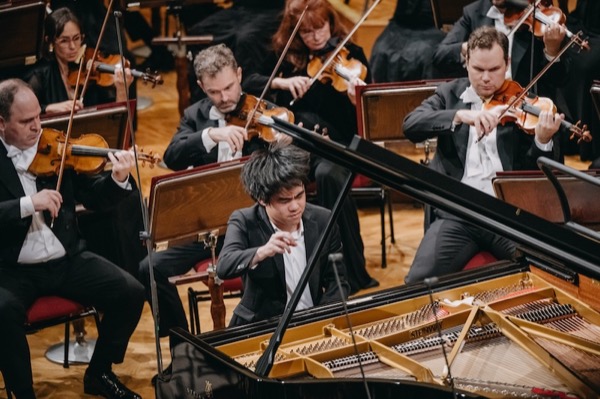
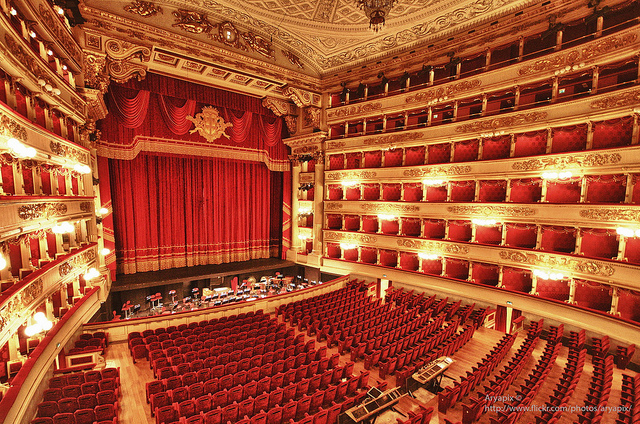
One of the defining features of the BBC Proms—long celebrated for its accessibility—has been its relaxed approach to dress. In the 21st century, however, this hardly feels distinctive anymore. In concert halls and opera houses alike, formal dress codes have largely disappeared, and the expectation of dressing up is gradually fading—both on stage and in the audience.

A few years ago, a teacher of mine confided to me how much she disliked seeing audience members turn up in hoodies and sneakers. To her, it felt—at least outwardly—like a lack of respect for the formally dressed musicians on stage. But when I saw Sheku Kanneh-Mason perform a concerto at the Royal Festival Hall in a floral shirt, coloured socks, and trainers—and still bring the house down—I found myself reconsidering the question: do we really need to dress formally for concerts anymore?
Sheku Kanneh-Mason – The Swan (From Carnival of the Animals)
What counts as “formal” has always been a moving target, shifting across time, place, and culture. As our lives change, so do our ideas about what different clothes are for—and how we wear them. The shirt, now a staple of formal dress, was once little more than an undergarment; aristocratic men, before the 19th century, thought nothing of wearing stockings and high heels. Today, turning up to a standard concert in full white tie might feel as oddly theatrical as wearing a powdered wig and breeches would have in the 20th century. And in European halls, I’ve often seen audiences in eye-catching traditional dress—surely just as dignified, and just as “formal,” in their own context.
For many people, dressing up—however impractical—is still a way of showing respect: for the performers, and for the art itself. In a sense, audience members and musicians alike accept the small discomforts of formalwear in order to present their best selves to one another, and to the music. Footage from the mid-20th century often shows audiences in uniform evening dress, especially at major festivals such as Bayreuth or Salzburg. Maybe it is this visual memory that has shaped a lasting idea, if not a stereotype, of what concert-going and opera-going are supposed to look like.
That idea still lingers, but its hold is loosening. Older audiences tend to feel more at ease in suits, dresses, and leather shoes—attire that, for many of them, once formed part of everyday life. For younger generations, however, the picture is quite different: while some arrive in business-like or designer outfits, most dress casually—especially at concerts by the crossover stars and other “big names.”
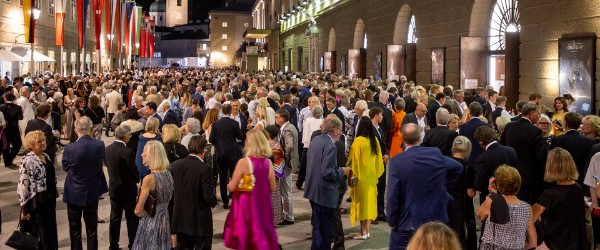
© Salzburger Festspiele, festival street Hofstallgasse / Andreas Kolarik
Practicality, of course, matters regardless of age. In the damp chill of autumn and winter, fleece jackets and padded vests are everywhere, and soft-soled shoes are often the most comfortable choice. I have, on many occasions, spotted the late Alfred Brendel in the audience—well into his nineties, always with his walking stick—wearing comfortable black leather sneakers beneath a loosely cut suit.
Do audiences today really need to dress formally? Is it still a necessary way of showing respect? Perhaps not—especially as “formalwear” drifts further from everyday life. The pianist Nicolai Lugansky, for example, always appears on stage in impeccable white tie; yet when I happened to see him in the same hall the following evening, he was an entirely unassuming figure in a jumper, casual trousers, black trainers, and a canvas bag slung over his shoulder. I have also seen people attend Bayreuth Festival and Salzburg Festival in T-shirts and slippers without being denied entry—perhaps even a more sensible choice than sitting through the stifling heat of the Festspielhaus, perspiring throughout.
Brahms: Ein deutsches Requiem
And yet, speaking for myself, I still like to dress up for concerts—especially when hearing artists I deeply admire. Every concert is an occasion: dressing differently from daily life makes it easier to enter a different state of mind. That, I believe, is true for performers and audiences alike. One need not dress up for the sake of glamour alone, but dress appropriately: bright colours may feel out of place in a Requiem, while lighter music need not be confined to black and white. Rather, one should dress in a way that truly suits the occasion—and even the repertoire.
But if there is one rule for concert dress code, I would say this: nothing that rustles. In moments of stillness, when musical tension hangs by a thread, the slightest crinkle of a down jacket can undo everything.
For more of the best in classical music, sign up for our E-Newsletter