Inspirations Behind Michael Daugherty’s Cadillac Ranch
Organised by year, just like the cars, American composer Michael Daugherty has made an exceptional work for wind band out of one of the unique sculptures in the world.

Cadillac Ranch in the 1970s (photo by Wyatt McSpadden)
The public art installation was created in 1974 by Chip Lord, Hudson Marquez and Doug Michels, who were a part of the art group Ant Farm. It’s quite simple: it consists of a row of ten Cadillacs (1949–1963) buried nose-first in the ground.
The two architects of the group, Chip Lord and Doug Michels, had been looking at a book on car design, and they focused on the cars’ tail fins, so they buried the cars nose-first in the ground.
Their idea was to create a field where it looked like cars were growing. The original idea was for ‘a field of ’49 Fords or 59 Cadillacs that would grow out of the ground. But for that, they needed a site… and money.
To get these, the San Francisco collective wrote to ‘a number of eccentric millionaires around the country’ and got a response from Stanley Marsh 3, described as ‘an American artist, businessman, philanthropist, and prankster from Amarillo, Texas’. The family money came from oil and gas, and he said he would fund the project as long as it was placed in Amarillo, Texas. All parties came to an agreement, and Ant Farm proposed a budget of $250 for the backhoe to dig the holes and $300 for each car. Their first car, the 1949 Cadillac, nearly broke the budget at $700!
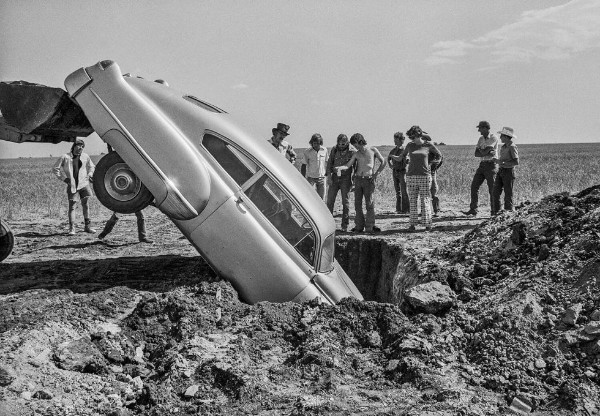
Installing the first car (photo by Wyatt McSpadden)
They dug the holes, placed the cars, and on 21 June 1974, the Summer Solstice, the installation was unveiled. There weren’t any signs, and to get to it, you can go through a barbed wire fence and ‘hope for the best’.
It languished on Marsh’s ranch until the CBS correspondent Charles Kuralt talked about it on his Sunday program ‘On the Road’ (see at 13:24) in 1975.
On The Road Charles Kuralt (Piney Woods, Coffee Cups, Wheat Harvest, Cadillac Ranch, Nebraska)
That brought attention to the piece….and bullet holes (a common problem in the West with vertical pieces of metal). Other people would scratch their names in the paint, and then came the bane of urban America: tagging.
At first, just simple names were spray-painted on the cars, and then it graduated to full paint jobs.
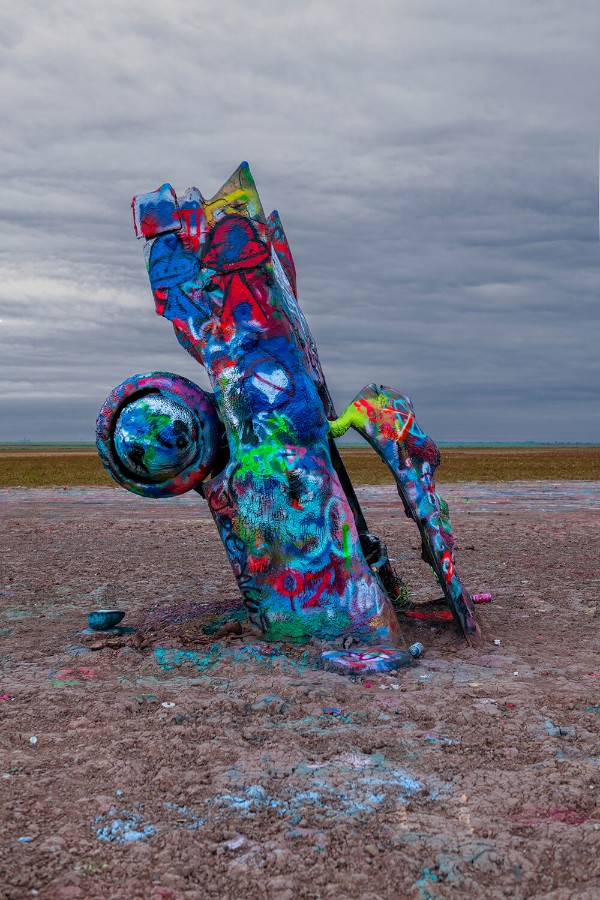
Painting the cars (photo by Wyatt McSpadden)
Stanley Marsh wasn’t displeased – it showed he owned a piece of art that people had opinions about. They had to care enough to find their way out to the middle of nowhere to see it, and they expressed themselves all over the art.
The installation was moved in 1997, two miles west, to keep the lights of the city out of its view lines. The artists said that moving the sculpture was harder than planting it in the first place.
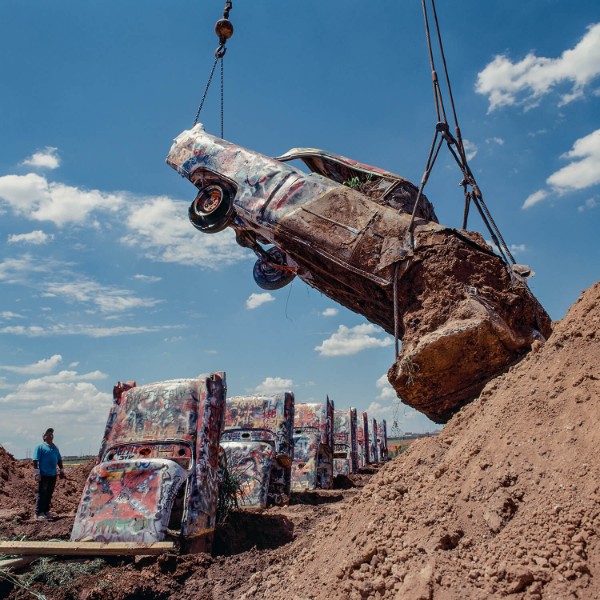
Moving the Sculptures (photo by Wyatt McSpadden)
Now owned by Stanley Marsh 4 (the family uses Arabic numerals rather than Roman because 3 thought III was pretentious), he sees the sculpture as a kind of ‘participatory work of art that everybody is welcome to collaborate on’.
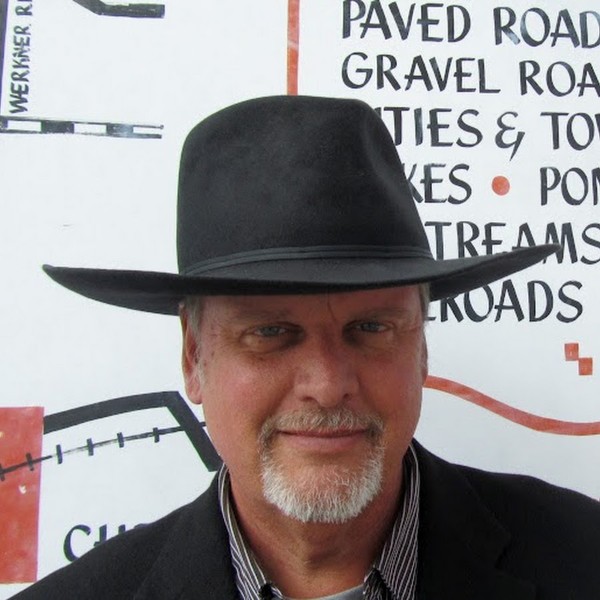
Michael Daugherty
American composer Michael Daugherty wrote his Cadillac Ranch in 2024 for a commission from Texas Tech University in celebration of its 100th anniversary. He used the image of the gradually changing tailfin design to create a variation set based on the four-note theme, based on the four syllables of the title: ‘Ca-dil-lac Ranch’. He also used the idea of the 10 Cadillacs as a basis for his structure, ‘musical pitches are often presented in 10-tone rows or rhythmic pulses in groupings of 10’. He associated the different years of the cars with ‘popular and contemporary musical idioms associated with the era of each Cadillac’.
Michael Daugherty: Cadillac Ranch (2024)–Amarillo Symphony, George Jackson
It’s a very American kind of art: take the 2nd most expensive thing most people will buy in their lifetime (after their house) and bury it. See what happens. See how it evolves. See how the viewers own it.
What do you hear in the music? Do you hear the same kind of evolution as the cars exhibit? Is there a variation that speaks to you and becomes your own Cadillac? In variation 7, you can hear the kind of cool that Bernstein had created in his 1957 work West Side Story, Variation 8 (1960), with its trombone solo that sounds like one of those louche James Bond themes. The final movement, 10 (1964), brings the percussion section to the fore. You can almost imagine the cars slowly vanishing in the setting sun….
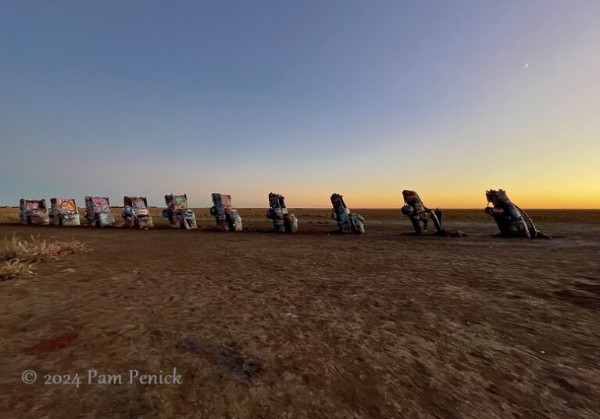
Cadillac Ranch Sunset (photo by Pam Penick)
Its future is uncertain. Chip Lord of Ant Farm is in favour of just letting it all rust away, just like when a farmer retires his old truck to the field, and it rusts down to nothing. Stanley Marsh 4, on the other hand, is looking at options for preserving and protecting it. For now, it’s there, and in that, we are content.
For more of the best in classical music, sign up for our E-Newsletter