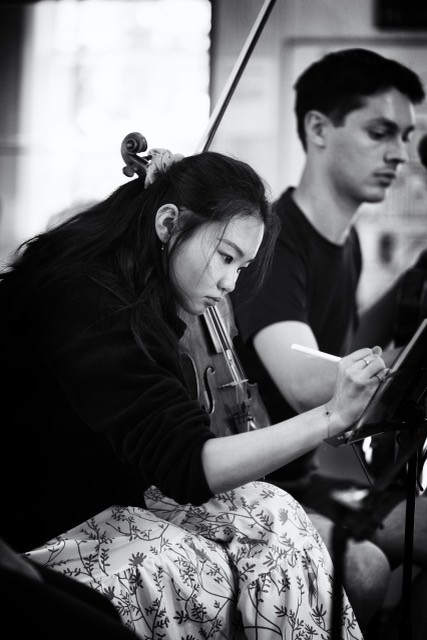
Internationally acclaimed violinist Angela Chan has built a career marked by major competition victories, appearances with leading orchestras, and a growing reputation for thoughtful, deeply personal musicianship. Speaking from Belgium during a busy European tour, Chan reflected on her musical upbringing, the challenges of life on the road, and the artistic values that shape her performances today.
Angela Chan
Chan’s musical path began early. Born in Hong Kong, she first picked up the violin at three and a half under the guidance of her mother. While her father is not a musician, music runs strongly through the maternal side of her family. Her grandparents were both professors at the Wuhan Conservatory, with her grandmother playing the flute and her grandfather playing the bassoon.
“My mom actually tried many things growing up,” Chan recalled. “She danced ballet and played piano before she finally chose the violin.” When Chan was born, teaching violin felt natural for her mother, who introduced her daughter to the instrument at a very young age.
Amy Beach’s Romance in A Major, Op. 23
At five, Chan began studying with Michael Ma in Hong Kong while her mother continued to support her practice at home. When Chan was twelve, however, her mother presented her with a life-changing decision. Academic demands in Hong Kong were becoming intense, and if Chan wanted to pursue music seriously, she would need to train elsewhere.
“She told me, ‘I don’t want to force you anymore. But if you want to continue, you might need to leave Hong Kong,’” Chan remembered. After a week of reflection, she decided to pursue the violin seriously, a choice that soon led her to Beijing. There, she enrolled in the middle school affiliated with the Central Conservatory of Music, entering an environment vastly different from her earlier musical experiences.
“In Beijing, everyone was there for music,” Chan said. “Half the day was academics, and the rest was lessons, orchestra, or chamber music. All my friends were musicians who were really serious about improving.” Because her mother remained in Hong Kong, Chan lived in Beijing with her grandmother, while her violin teacher, Vera Tsu, became an important mentor. “She was very strict,” Chan recalled. “She never praised me directly, but she pushed me very hard. I think without her, I wouldn’t be where I am today.” After three and a half years in Beijing, Chan briefly returned to Hong Kong to attend the senior program at the Hong Kong Academy for Performing Arts before moving to the United States to study at the Curtis Institute of Music in Philadelphia. Arriving at sixteen, she experienced yet another cultural shift. “The system there was very different,” she explained. “It was much freer. No one was constantly watching you. You had to learn to manage your time and discover what kind of musician you wanted to become.”
Béla Bartók’s Divertimento, Sz 113 – 3. Allegro assai
Competitions have also played an important role in Chan’s career, including her victory at the prestigious International Joseph Joachim Violin Competition in Hanover, Germany. Yet for Chan, memories of competitions are not defined only by prizes. Some moments stand out for far more unexpected reasons. At one early competition in Weimar, she arrived a few days early to settle in, only to wake one night to strange noises in her hotel room. “I woke up and saw a mouse on the table eating my snacks,” she recalled with a laugh. “We had eye contact for what felt like five minutes. It was terrifying.” On another occasion in Singapore, hotel guests complained about her practicing during the day. Chan solved the problem with a clever trick she learned from violinist Hilary Hahn. “I turned on the television very loud and practiced along with it,” she said. “After that, no one complained anymore.”
Angela Chan
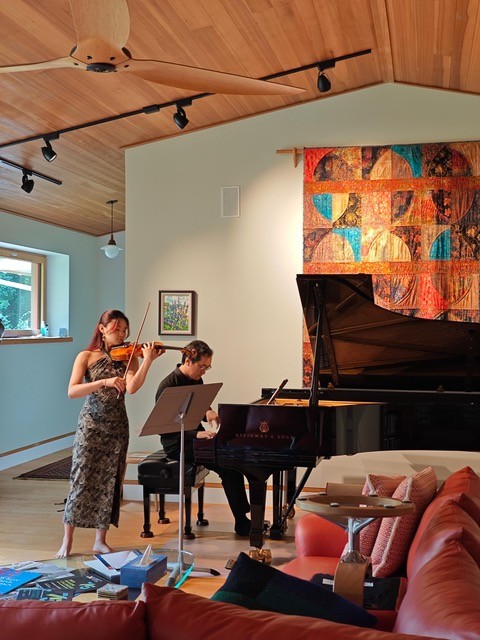
With an increasingly international schedule, Chan spends much of her time traveling, and maintaining a practice routine on the road can be challenging, especially in Europe where hotel restrictions or local customs sometimes limit playing hours. “I travel with several practice mutes and try to practice in the hotel, if possible,” she explained, noting that mental practice has also become an essential part of her preparation. Her daily routine typically includes three to five hours of practice, balanced with reading, listening to jazz, and occasionally attending Pilates classes when time allows. Concert days follow a noticeably quieter rhythm. “I wake up and do everything slowly,” she said. “I even walk more slowly.” One ritual, however, remains constant: she drinks coffee exactly three and a half hours before every performance, a habit she developed during her years at the Curtis Institute of Music when she discovered it helped her focus before going on stage.
Despite her confident stage presence, Chan describes herself as deeply introverted. “I really need time alone to recharge,” she explained. “But performing is different. On stage, I don’t have to talk. I can communicate through music.” That ability to express herself through sound makes performing feel natural, even if social situations or public speaking can be draining. Among the many musical settings she works in, chamber music remains especially meaningful to her. “With chamber music, you really get to know the other musicians,” she said. “You rehearse more and develop a deeper connection.”
Ludwig van Beethoven’s Violin Concerto in D Major, Op. 61- 1. Allegro ma non troppo
Chan’s season also includes performances with several major orchestras around the world. Following appearances in Europe, she travels to China for concerts with the China Philharmonic Orchestra and the Shanghai Symphony Orchestra, performing the Violin Concerto No. 2 by Karol Szymanowski. Later engagements include Felix Mendelssohn’s Violin Concerto with the Hong Kong Philharmonic Orchestra. During the summer, she will return to the renowned Marlboro Music Festival in Vermont for seven weeks of chamber music.
In the end, it is this quiet authenticity that continues to shape Angela Chan’s voice as an artist on the international stage.
Learn more about Angela Chan by visiting https://angelachanviolinist.com.
For more of the best in classical music, sign up for our E-Newsletter