We remember Leopold Mozart today as the father of Wolfgang Amadeus Mozart, but his life story includes many more chapters than just the ones on his son.
Leopold’s story on its own is incredibly remarkable. He was born into modest circumstances, yet became a respected violinist, composer, teacher, and author of one of the most influential violin treatises of the eighteenth century.
He also became a shrewd manager who carefully – some would say controllingly – oversaw the early careers and lives of his daughter Nannerl and his son Wolfgang.
Today, we’re looking at the life of Leopold Mozart.
Leopold Mozart’s Family
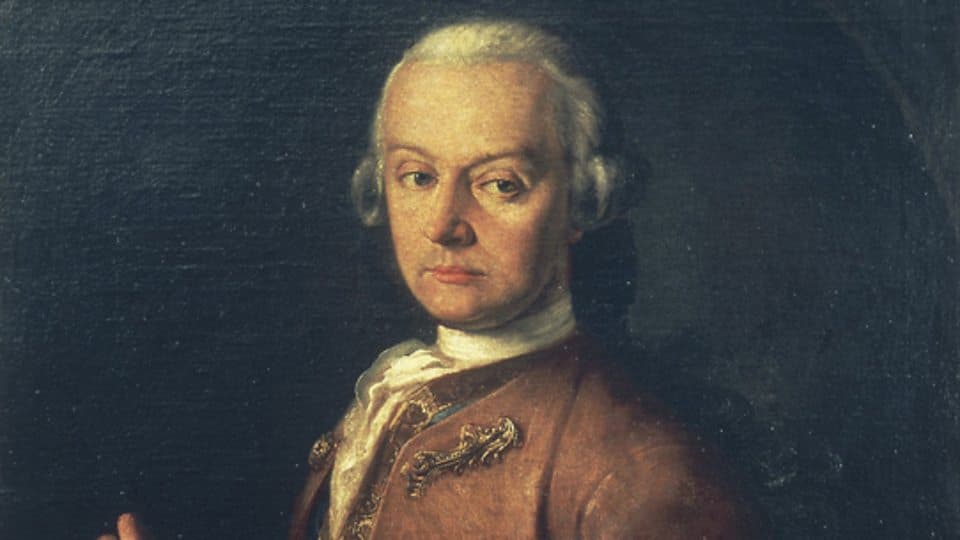
Leopold Mozart
Leopold Mozart was born in Augsburg in present-day Germany on 14 November 1719, the oldest of eight children.
His father, Johann Georg, was a bookbinder, and his mother, Anna Maria, was his father’s second wife (and nearly two decades younger than him).
Leopold was sixteen when his father died. By his late teens, when he left for university, his relationship with his mother had completely collapsed.
Leopold Mozart’s Education
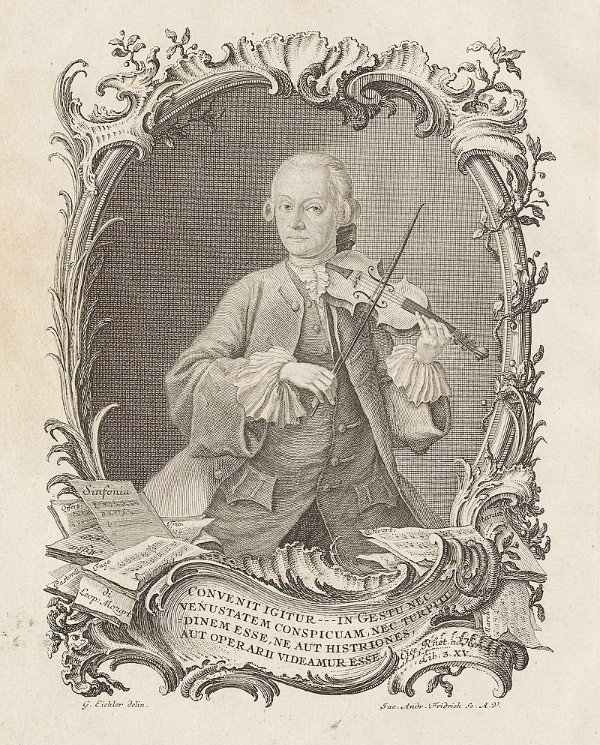
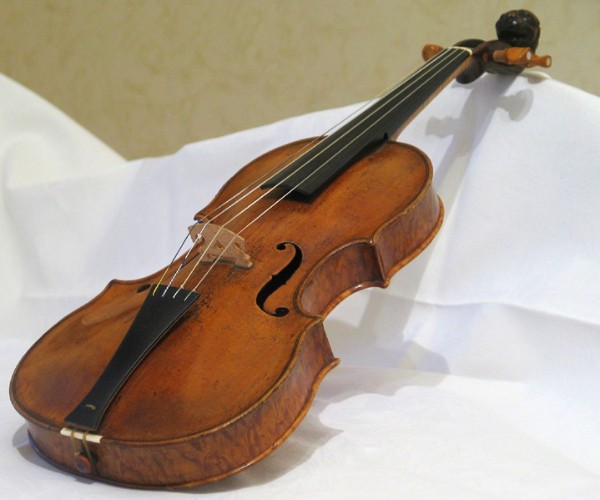
Leopold Mozart’s violin method illustration
The Mozart parents sent their two youngest boys, including Leopold, to a Jesuit school in Augsburg. They wanted Leopold to become a priest…and for a while he played along.
One friend later said that Leopold “was a great fellow. My father thought the world of him. And how he hoodwinked the clerics about becoming a priest!”
Leopold proved to be a talented student. He was hungry to study anything and everything: not only theology, but acting, logic, science, astronomy, and more.
However, his heart belonged to his music studies. He sang in a choir from an early age and learned how to play the violin and organ.
He graduated magna cum laude in 1735 at the age of sixteen.
Moving to Salzburg
In 1737, the ambitious Leopold decided to continue his education at the Benedictine University in Salzburg. (This was around the time he became estranged from his mother.)
Interestingly, he did not initially want to study music; he wanted to study philosophy and jurisprudence.
He earned a degree of Bachelor of Philosophy in 1738 but was expelled in 1739 for missing natural science classes.
It seems that he must have been focusing on his musical interests instead.
Leopold Mozart’s Toy Symphony
Leopold Mozart’s Early Career
In 1740, the year he turned twenty-one, he was hired as a violinist and valet for Johann Baptist, Count of Thurn-Valsassina and Taxis.
He also self-published six trio sonatas that year.
One of Leopold Mozart’s trio sonatas
The musical community in Salzburg took notice. In 1743, the Prince-Archbishop of Salzburg, Count Leopold Anton von Firmian, hired Leopold to work as a violinist, composer, and music teacher.
Marrying Anna Maria and Starting a Family
Having secured a job, in 1747, he married a woman named Anna Maria Pertl.
Her father had been an amateur musician and, like Leopold, had studied jurisprudence at the Benedictine University, but died in 1724. He’d left his wife and daughter in profound poverty, which Leopold helped to ease.
Anna Maria suffered from chronic health troubles and had even been bedridden in her late teens. However, it seems she recovered enough to meet and marry Leopold, and then survive multiple pregnancies and years of gruelling travel.
Between 1748 and 1754, Leopold and Anna Maria had six babies.
All of those babies except one – a little girl named Nannerl, born in the summer of 1751 – died as infants.
Then, in January 1756, they had a son named Wolfgang Amadeus Mozart.
The year Wolfgang was born, Leopold wrote a popular violin textbook, and in 1758, he earned a promotion to second violinist in the archbishop’s court.
His career was reaching new heights. But he found himself distracted by his two surviving children, who were both proving to be extraordinary prodigies.
Raising Two Prodigies
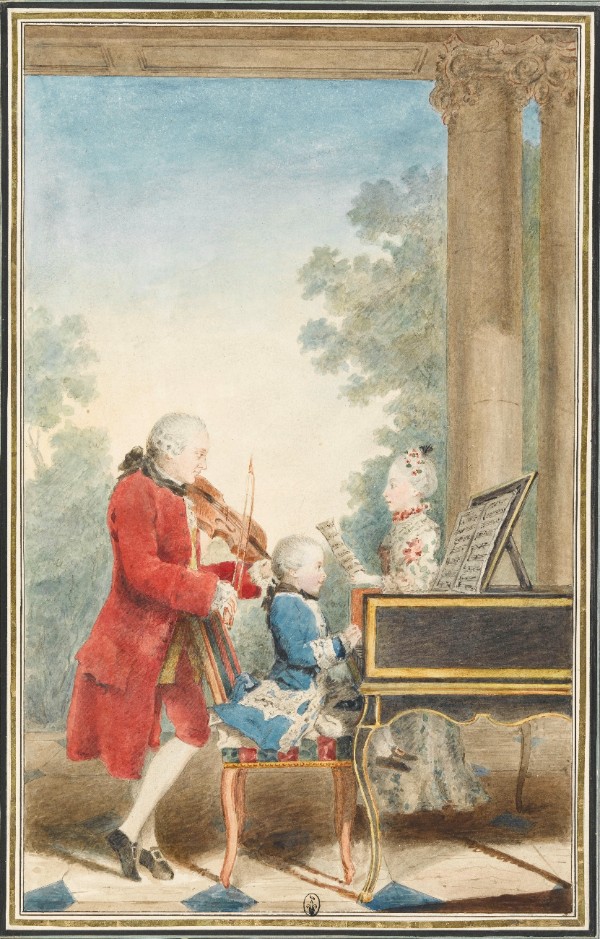
Leopold Mozart and his kids on tour
He began teaching Nannerl piano in early 1759, when she was seven.
Wolfgang was immediately intrigued by his older sister’s lessons and copied what she played, so Leopold began teaching him, too.
By the time he was five, Wolfgang was performing little pieces that Leopold wrote down.
Some of Wolfgang’s first pieces
Years later, Nannerl wrote that Leopold “entirely gave up both violin instruction and composition in order to direct that time not claimed in service to the prince to the education of his two children.”
He also took charge of the children’s non-musical education, too.
Going on Tour
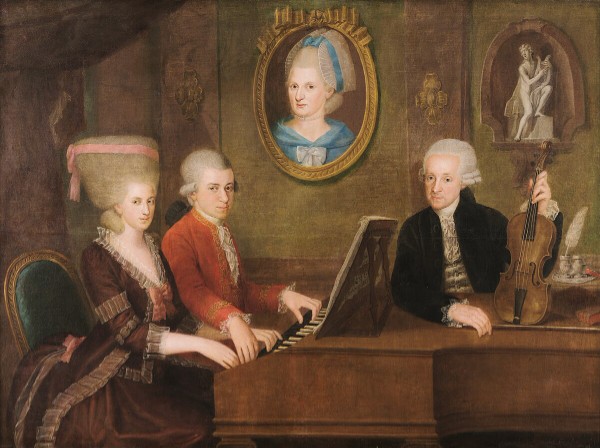
The Mozart family
Both Nannerl and Wolfgang advanced so quickly that in 1762, Leopold decided to shore up the family’s financial position and social standing by bringing them on tour.
He asked for leave from his job, which he was granted, and they set off.
It’s important to note that this tour wasn’t solely Wolfgang’s; it was originally a brother-and-sister act. In fact, in some early advertisements, Nannerl’s name was billed first.
Between 1762 and 1766, the Mozarts visited nearly two dozen European cities, including Vienna, Munich, Mannheim, Amsterdam, London, Paris, and Geneva.
Leopold nearly died in 1764 of illness in London; fortunately for his family, he pulled through.
During that illness, the children were instructed to stay quiet as their father rested. Unable to play or practice, an eight-year-old Wolfgang began writing his first symphony with some help from Nannerl.
Mozart’s Symphony No. 1
A Final Father/Son Tour
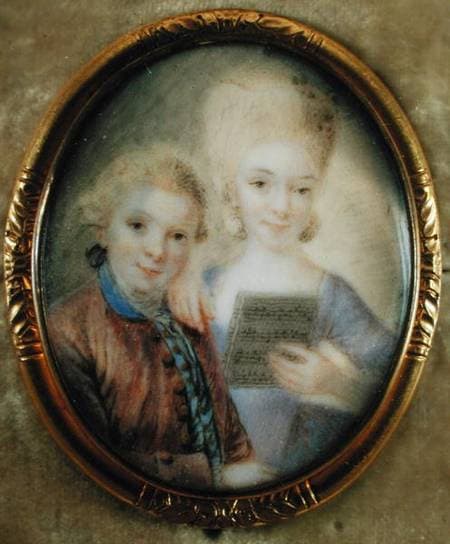
Wolfgang and Nannerl Mozart
By 1769, the Mozarts returned to Salzburg.
That was the year that Nannerl turned eighteen, meaning that she was now of marriageable age and no longer able to tour as a child prodigy.
At the same time, Leopold felt that 13-year-old Wolfgang would benefit from touring Italy and networking with Italian musicians.
He also harboured hope that he’d find a better position than the one they’d left behind in Salzburg.
So in December 1769, he and Wolfgang left the women of the family back home in Salzburg and set off to Italy together.
After a long and productive trip, they returned to Salzburg in early 1773.
Unfortunately, although Wolfgang learned a great deal in Italy, the Mozarts didn’t find a rich patron during the trip, so both were forced to start working again in Salzburg.
Conflict with the Archbishop, and Tragedy Strikes
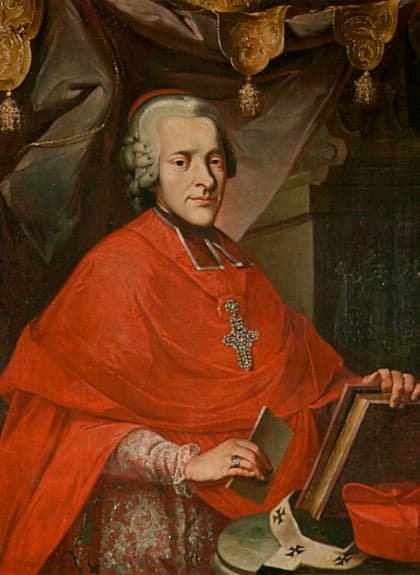
Hieronymus von Colloredo
The former Archbishop had died in December 1771, leading to the ascension of the strict and prickly Hieronymus von Colloredo.
Father and son kept traveling, once to Vienna in the summer of 1773 and another time to Munich in early 1775. Unfortunately, they still didn’t find the patron they were dreaming of.
Leopold stayed working for Colloredo, but Wolfgang bristled and baulked. In August 1777, Wolfgang resigned.
Because the family relationships with the archbishop had clearly deteriorated to the point where another Leopold’s absence would not be tolerated, Wolfgang and his mother began travelling looking for work in cities like Mannheim and Paris.
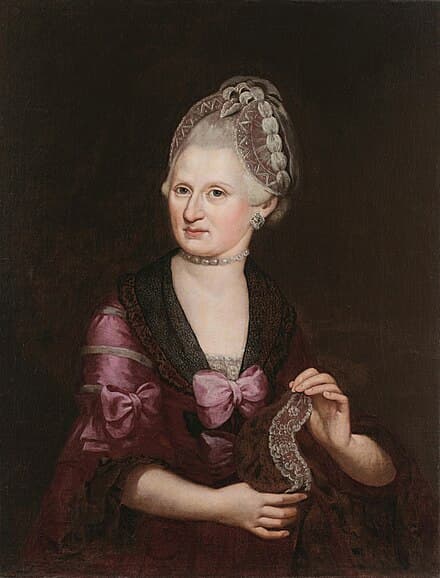
Anna Maria Mozart, Mozart’s mother
While Mozart and his mother were in Paris in the summer of 1778, she got sick and died.
The news of her death was a major blow to Leopold, even though Wolfgang tried to ease his father into the idea by sending a couple of letters hinting at it, instead of shocking him all at once.
Trying to Lure Wolfgang Back to Salzburg
Leopold managed to pull some strings and secure a position as court organist and concertmaster for Wolfgang, but Wolfgang resisted accepting.
He ultimately did come back home and worked at the court for two years, but by 1781, both he and the archbishop had had enough of each other.
Wolfgang had the opportunity to perform for the Emperor for a huge amount of money, but Colloredo vetoed the idea. Wolfgang was insulted and tried to resign. Colloredo didn’t let him.
The whole sorry affair ended in June 1781 when Colloredo finally agreed to let him go – but not before his steward gave Mozart “a kick in the arse” upon his dismissal.
Wolfgang Moves to Vienna and Marries
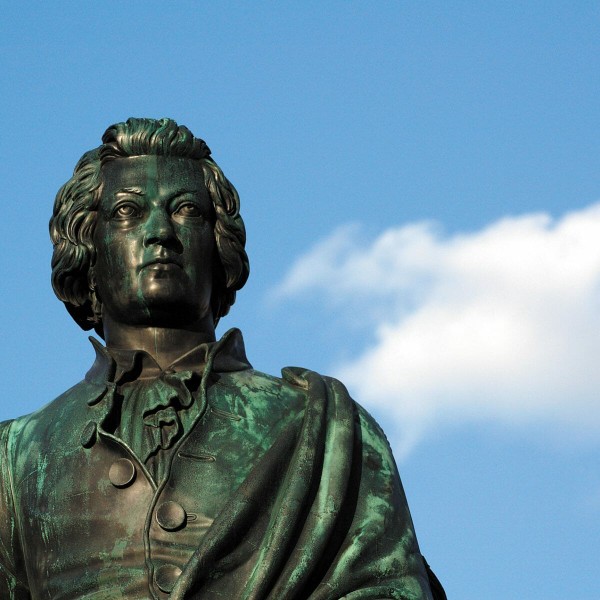
Statue of Mozart in Salzburg
After his dismissal, Wolfgang decided to move to Vienna to work as a freelance musician.
Leopold was not pleased; hoping to keep Wolfgang under his influence, he took Colloredo’s side in the conflict.
But it was no use. Wolfgang cemented his connections in Vienna, and the following summer, he married a singer there named Constanze Weber.
Leopold dragged his feet providing permission until Wolfgang bluntly informed him via letter:
“All the good and well-intentioned advice you have sent fails to address the case of a man who has already gone so far with a maiden. Further postponement is out of the question.”
In 1783, the newlyweds, now firmly ensconced in Vienna, made an awkward visit to Salzburg. Leopold and Nannerl were polite, but not particularly warm.
In part to prove how he was flourishing, and how talented his wife was, Wolfgang premiered his Mass in C-minor there, with Constanze as soprano soloist.
Nannerl’s Marriage and Raising Another Baby
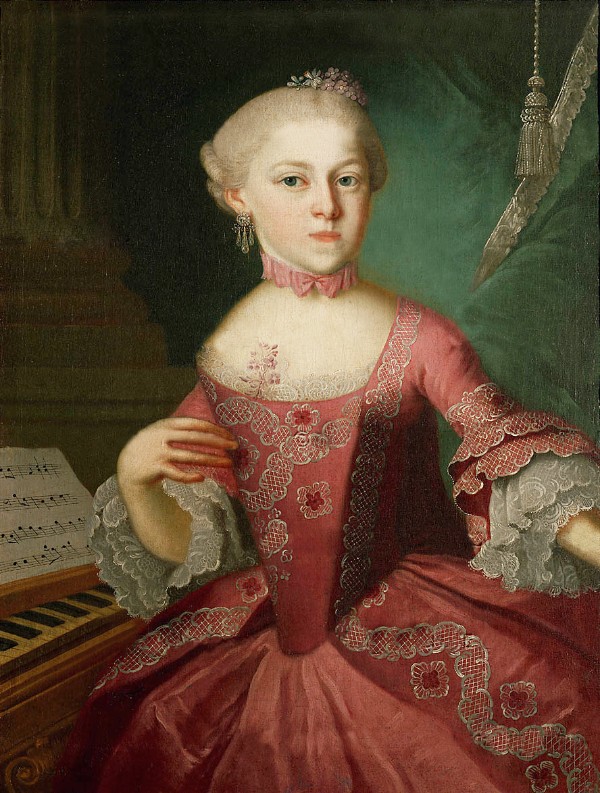
Nannerl Mozart
In 1784, Nannerl also got married. Her new husband was a wealthy widower named Johann Baptist Franz von Berchtold zu Sonnenburg, who had a large home in a little town six hours east of Salzburg.
She returned to Salzburg in the summer of 1785 to give birth to her first baby.
For reasons historians don’t entirely understand, Nannerl returned to her husband while Leopold raised her son.
Some historians have theorised that he wanted to raise another prodigy: basically, to have a redo of his life with Wolfgang, with whom he now had a strained long-distance relationship.
Leopold Mozart’s Death
Around this time, Leopold’s health began deteriorating. He died on 28 May 1787.
Wolfgang was unable to attend the funeral; the journey was too far from Vienna.
He wrote to a friend, “I inform you that on returning home today, I received the sad news of my most beloved father’s death. You can imagine the state I am in.”
Conclusion
It’s true that the thing Leopold Mozart will always be best remembered for is being the father of Wolfgang Amadeus Mozart.
However, his biography proves that he was also more than that: that he had his own complicated life path that frequently brought him into conflict with his son.
By learning more about Leopold, we gain a fuller and infinitely more human picture of Wolfgang, who wrote so much music we still love so dearly today…and who would have written none of it without Leopold’s early guidance.
For more of the best in classical music, sign up for our E-Newsletter