Listening to 20th-century music can be hard work. For audiences raised on tonal harmony, flowing melodies, and familiar formal signposts, the sounds of modernism often arrive without warning. Dense dissonance, fragmented gestures, and violent contrast seemingly confront the listener, leading to confusion or even irritation.
If listening to this music is challenging, writing about it can be even more so. There is a real danger that language ends up mirroring the difficulty of the music. In fact, writing meant to explain can easily become another barrier, reinforcing the impression that the music is only accessible to specialists.
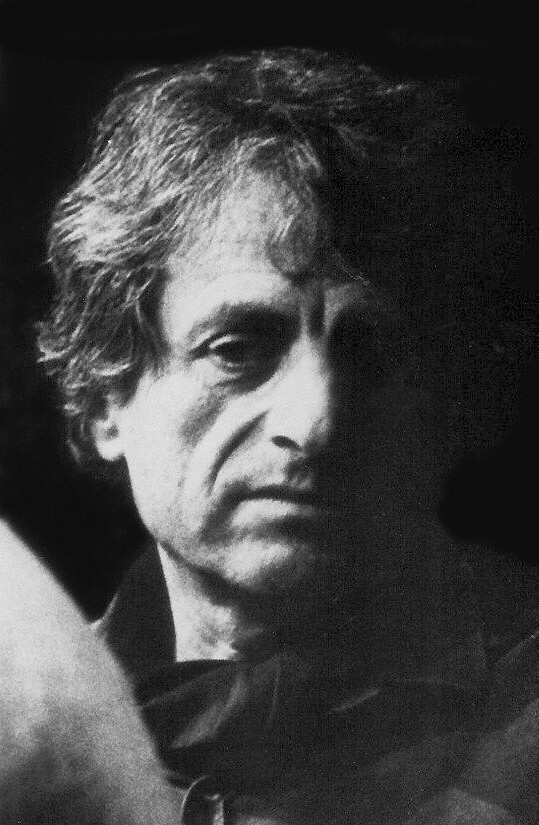
Iannis Xenakis in 1975
Let’s, for example, take Iannis Xenakis, who passed away on 4 February 2001. His music is frequently considered to be some of the most uncompromising. First encounters with his work can certainly be overwhelming. However, Xenakis’ compositional thinking was driven by a desire for clarity at a higher level.
To commemorate his passing on 4 February, let’s explore how Xenakis actually went about composing, focusing on the basic ideas and methods that shaped his music.
Iannis Xenakis: Rebonds B
Sonic Innovation
Iannis Xenakis (1922-2001), a French composer of Greek parentage born in Romania, was also an architect, engineer, and mathematician. He did not begin with traditional musical training. Instead, he brought ideas from mathematics, physics, and architecture directly into his compositional thinking.
Part of a pioneering generation of composers who revolutionised 20th-century music after World War II, Xenakis considered music as a sound phenomenon that could shape formal systems.
Replacing traditional musical thinking with radical new concepts of composition, his musical language had a strong influence on many younger composers in and outside Europe, “but it remained singular for its uncompromising harshness and conceptual rigour.” (Hoffmann, 2001)
Rethinking Musical Order
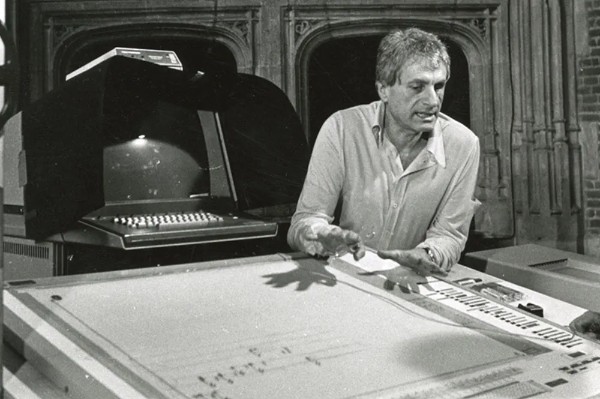
Iannis Xenakis
Xenakis came of age when composers questioned inherited musical language. Serialism, in particular, attempted to control every aspect of music through ordered series. Xenakis initially encountered these ideas while working as an assistant to the architect Le Corbusier in Paris.
Becoming part of the avant-garde musical scene, Xenakis quickly became dissatisfied with serial composition. He felt that attempting to organise every note through strict rules often led to music that sounded chaotic.
To Xenakis, this sounded like a contradiction. If the result still sounded like disorder, despite its underlying order, why pretend that it was the product of meticulous linear control? Instead of trying to control individual notes, he began to think about music in terms of large-scale sonic behaviour.
This shift in thinking became central to his approach. Rather than composing note by note, Xenakis focused on masses of sound, textures, and evolving sonic processes. As such, his compositions are better understood as the shaping of sound clouds.
Iannis Xenakis: Akrata
From Individuals to Masses
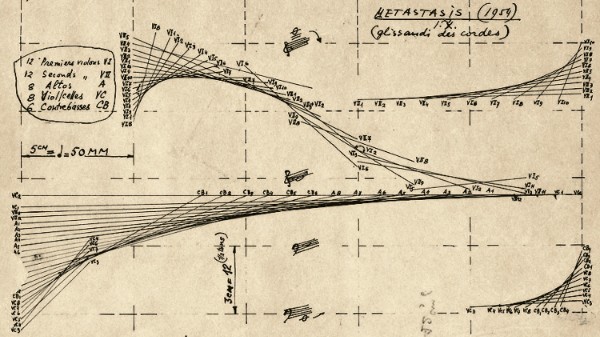
Iannis Xenakis’ Metastaseis
One of Xenakis’s most influential ideas was the concept of “sound mass.” This approach treats music as a collection of many individual sounds that together form a larger texture. Think of it like a swarm of insects or a crowd of people. Each individual element may behave unpredictably, but the overall mass follows a recognisable pattern.
In works such as Metastaseis (1953–54), Xenakis used this idea to dramatic effect. Instead of writing melodies for individual instruments, he designed sweeping glissandi that move independently yet collectively.
The result is a powerful sense of motion and transformation, sometimes called “an alien shard,” with music as a physical object being stretched, compressed, or bent. Just as architectural structures are designed by considering forces, materials, and space, Xenakis composed music by shaping sonic structures over time.
Xenakis regularly attended composition classes with Messiaen, who advised him to take advantage of being an architect and having studied advanced mathematics, and to take these ideas into his music. (Service, 2013)
Iannis Xenakis: Metastaseis
Shaping Randomness
With this type of thinking, the score becomes a kind of blueprint for sound, specifying trajectories and densities. And mathematics becomes the most important tool in this compositional method.
This does not mean that the music is cold or purely intellectual, but simply that mathematics is the practical tool for dealing with complexity. And since Xenakis wasn’t interested in phenomena that could not be controlled by simple linear systems, he turned to probability theory, particularly stochastic processes.
Stochastic processes are a term that sounds far more frightening than they really are. It simply means working with controlled randomness. Instead of deciding every single note in advance, Xenakis set up some general rules. For example, how dense the sound should be, how fast it should move, and how high or low it might go. The beauty is that individual details vary within those limits.
This actually means that Xenakis created music that felt organic and dynamic, while still being rigorously constructed. Works such as Pithoprakta (1955–56) are based on these ideas. Here, Xenakis used mathematical models derived from the behaviour of gas particles to determine how individual lines move.
Iannis Xenakis: Pithoprakta
Visual Music
Xenakis had a visual way of thinking about music and translating visual forms directly into musical parameters. He often began by drawing shapes, curves, and textures on paper. These drawings were not mere illustrations but integral to the compositional process.
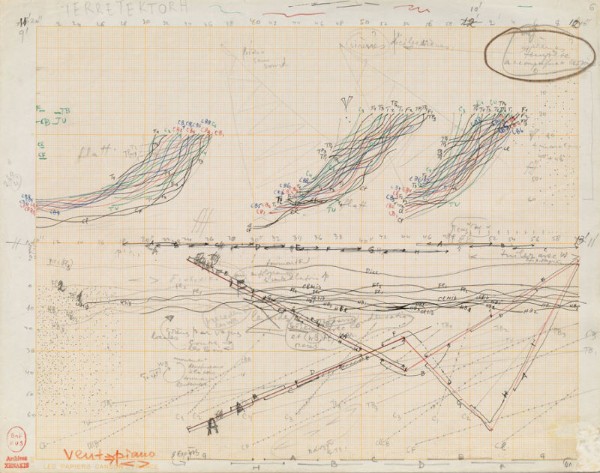
Iannis Xenakis’ handwritten score
His handwritten scores often resemble architectural sketches, and they reflect his belief that music unfolds in time much like a building unfolds in space. It’s a spatial way of thinking about sound rather than being sequential.
Rhythm played a crucial role in his music, as he thought of it as the distribution of energy over time. There are no regular beats but complex rhythmic structure derived from mathematical ratios and probability distributions.
In percussion works such as Rebonds or Psappha, rhythm becomes the primary structural element. Here, Xenakis explored how rhythmic intensity and density could create form without relying on melody or harmony. The music unfolds through contrasts of attack, silence, and accumulation. (Griffiths, 2001)
Iannis Xenakis: Psappha
Composing with Machines
Xenakis also embraced computers as compositional tools. He developed computer programs that allowed him to generate musical materials. In an early application of AI, he developed a system for automated composition, which could produce scores according to predefined rules.
One of the pioneers of algorithmic composition, Xenakis greatly influenced a field that continues to inspire contemporary music today. However, Xenakis never abandoned intuition.
He frequently emphasised that mathematical models were starting points, not guarantees of artistic success. If the result did not sound convincing, he would revise or discard it. (Xenakis, Formalized Music, Pendragon Press)
In that process, listening played a crucial role. Xenakis was deeply concerned with the physical impact of sound, of how it fills a space and how it affects the body. Think of it as a way of creating an immersive experience.
The Architecture of Music

The Philips Pavilion
Through his training as an engineer and architect, to this pioneering musical research, Xenakis consistently approached sound as a physical and structural phenomenon. Music was the construction of forces in time and space.
What makes Xenakis distinctive, however, is that his radical methods never lost sight of musical effect. Mathematical models, stochastic processes, and abstract structures were not ends in themselves.
And although his music may sound harsh, dense, or overwhelming, beneath that surface lies a strong sense of proportion, drama, and control.
By understanding how Xenakis composed, we begin to hear his music not as chaos. Rather, it is a different and compelling vision of musical order that vastly expanded the possibilities of composition.
For more of the best in classical music, sign up for our E-Newsletter