
During the Christmas season, streets glow with lights, homes fill with ornaments and wreaths, and the air carries the scents of pine, spices, and festive baking.
It is a season of abundance, of gatherings and generosity, of celebration and reflection. Yet beneath the glitter and bustle, Christmas also invites us to pause, to turn inward, and to consider what truly matters.

In this spirit, the Shaker song “Simple Gifts” offers a gentle, timely meditation. Written in 1848 by Joseph Brackett, it reminds us that joy, freedom, and presence need not be found in excess or display, but in simplicity, attentiveness, and the quiet delight of being fully present with one another.
“Simple Gifts”
A Song Shaped by Stillness
In a way, “Simple Gifts” resonates as both a musical and moral guide, suggesting that the most meaningful gifts of the season are often the simplest. To be sure, the Shakers were radical in their simplicity.
Committed to communal living, celibacy, equality between the sexes, and a rigorous ethic of work and worship, they believed that earthly order could mirror divine harmony. Their material culture was stripped of excess not for aesthetic reasons but for moral clarity.
The hymn “Simple Gifts” arises from this worldview. It is not a hymn of transcendence, nor a cry of anguish or ecstasy. Instead, it is a song of balance, of bodily motion and spiritual poise, grounded in the everyday gestures of turning, bending, and standing upright.
Joseph Brackett Jr.: Simple Gifts (arr. R. Ravenscroft) (Christopher Parkening, guitar)
Freedom Beyond Want
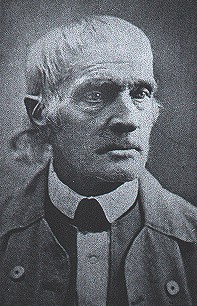
Joseph Brackett
The song’s opening line situates simplicity as a gift, not an achievement. This distinction is crucial. Simplicity here is not ascetic heroism or moral superiority, but it is something received rather than conquered.
To be simple is to be unburdened by excess desire, by the endless comparison and competition that complicate the soul. Freedom, then, is not the multiplication of choices, but release from the tyranny of wanting more than one needs.
When gift lists, festive events, and social obligations at Christmas time feel overwhelming, “Simple Gifts” offers a reminder that the truest gifts can be found in presence, connection, and love.
“Simple Gifts”
The Joy of Movement
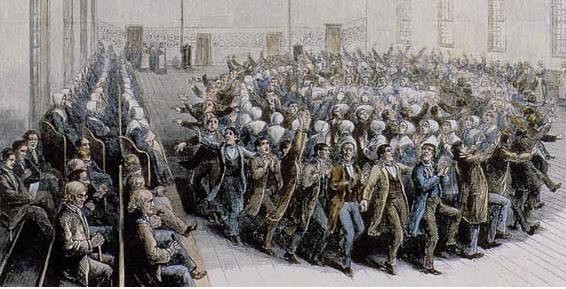
The Shakers dancing
Joseph Brackett writes, “To turn, turn will be our delight,” evoking the circular dances integral to Shaker worship. These dances were not spectacles for an audience, but communal rituals in which repetition and restraint became forms of devotion.
Christmas, too, invites a turning of sorts. It’s a turning toward reflection, toward gratitude, toward one another. In the midst of holiday chaos, we are reminded to move with intention and joy rather than rushing to fulfil external expectations.
The text is musically mirrored. The melody spans little more than an octave and unfolds in symmetrical phrases that feel inevitable rather than surprising. There is no harmonic tension seeking dramatic resolution, only a calm unfolding that invites participation.
This accessibility has allowed the tune to migrate across contexts with remarkable ease. Aaron Copland’s famous incorporation of the melody into Appalachian Spring reframed it as an emblem of American pastoral idealism, a sonic symbol of open land and moral clarity.
John Williams: Air and Simple Gifts (Anthony McGill, clarinet; Itzhak Perlman, violin; Yo-Yo Ma, cello; Gabriela Montero, piano)
Why Simplicity Matters
What makes “Simple Gifts” especially resonant in the holiday season is not nostalgia for a pre-industrial past. Rather, it is a quiet critique of modern excess. Contemporary life, especially the commercialised Christmas, can be marked by acceleration, saturation, and the constant pressure to optimise.
Against this backdrop, simplicity is often marketed as another lifestyle choice, another form of curated consumption. “Simple Gifts” points in a different direction. Its simplicity is not about style, but about orientation.
“Simple Gifts” offers something rare. It offers a vision of sufficiency without complacency, of freedom without conquest, of joy without spectacle. Sometimes the most enduring truths are spoken softly. Joy can be simple, freedom can be found in less, and the truest gift is presence itself.
For more of the best in classical music, sign up for our E-Newsletter







Merry Christmas and a Happy New Year!
I thank you for your very enjoyable magazine for Music lovers.