Marianna Martines was an extraordinary figure in the history of eighteenth-century Vienna.
She grew up with a great librettist as a father figure, studied with her neighbour Joseph Haydn, and played four-hand piano duets with Mozart.
And yet, despite her importance to Viennese culture of the time, there is so much about her that many music lovers don’t know.
Today, we’re looking at the life of Marianna Martines.
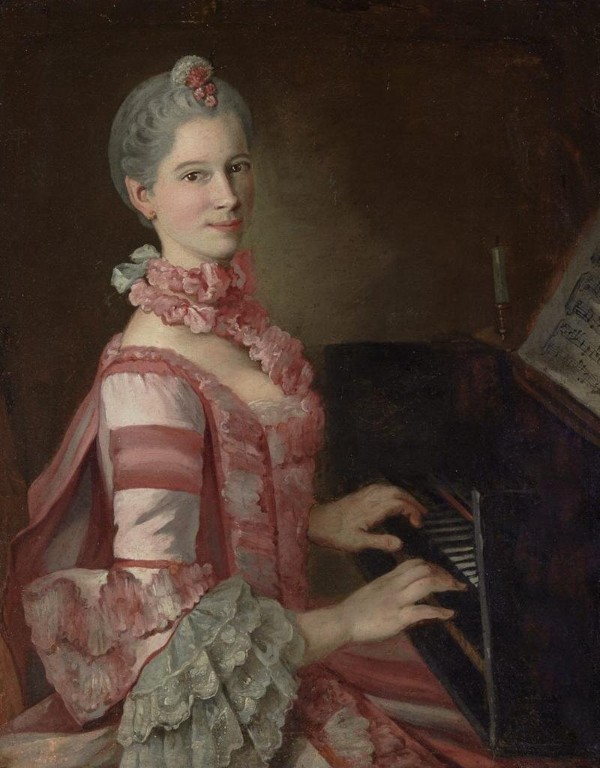
Marianna Martines
Nicolo Martines and Pietro Metastasio’s Friendship
Marianna Martines was born to a fascinating family.
Her father, Nicolo, was born around 1690 in Naples. As a young man, he served as a soldier, then in 1728 became the Pope’s ambassador to the Austrian Empire.
Arguably, the most important relationship of Nicolo’s life was with poet and librettist Pietro Trapassi, better known by his pen name, Pietro Metastasio. They befriended one another in 1718, when Nicolo was thirty and Metastasio twenty.
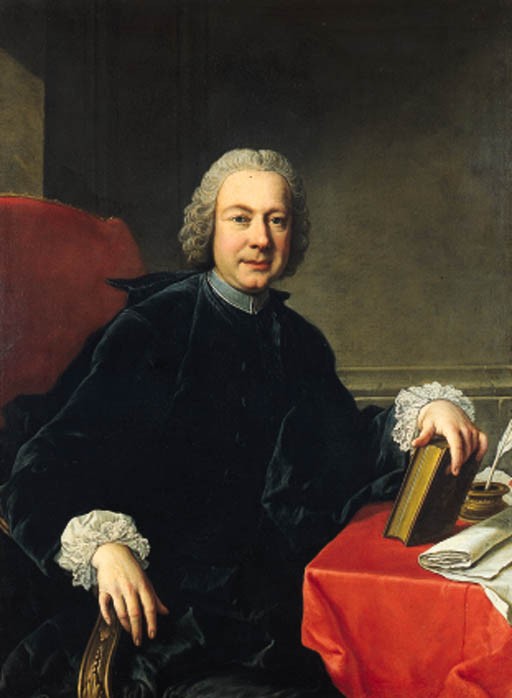
Pietro Metastasio
Soon after Nicolo accepted his position in Vienna, Metastasio was named Poet Laureate. After taking the job, Metastasio moved in with Nicolo, his wife, and their ever-expanding family.
Metastasio would remain at the Martines’ home for the rest of his life. (This would later become a salient fact in Marianna Martines’s biography.)
The Martines Home
The Martines family and Metastasio lived in a remarkable apartment building. It was a snapshot of the structure of the musical society of mid-eighteenth-century Vienna.
The dowager princess of the aristocratic Esterházy family lived on the lowest floor.
The Martines family lived above her in the middle of the building, together with Metastasio. Their neighbour was the operatic composer and singing instructor Nicola Porpora.
Then, at the top of the house, in the attic, lived a young composer by the name of Joseph Haydn!
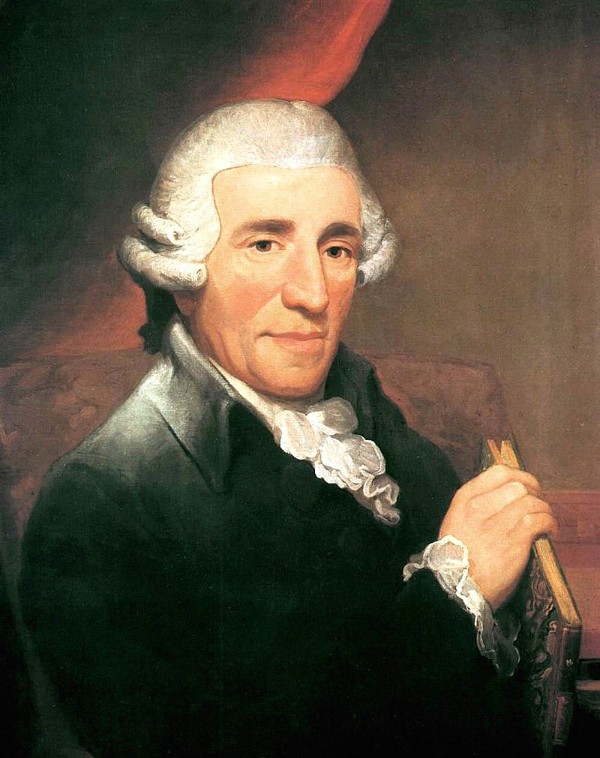
Joseph Haydn
Marianna Martines’s Siblings
Marianna had several older brothers, whose careers and accomplishments made clear that intellectual talent ran in the family.
Her oldest brother Giuseppe was born in 1729, making him fifteen years her senior. Giuseppe spoke no fewer than twelve languages and even tutored the royal children in Italian.
Another brother, Dionysius, became a mining engineer, while another became a war hero.
Marianna Martines’s Childhood with Metastasio
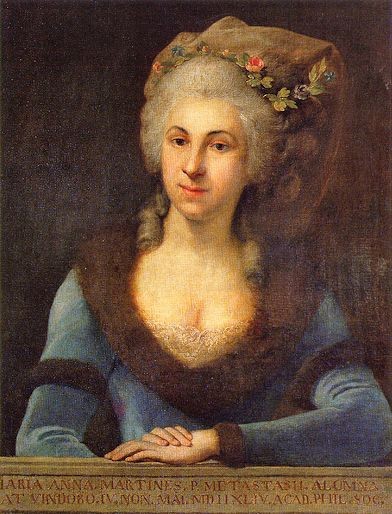
Marianna Martines
Marianna was born into this family of overachievers on 4 May 1744. She was baptised Anna Catherine, but ended up going by the name Marianna.
She was surrounded by her accomplished older brothers and especially adored by Pietro Metastasio, who turned into a kind of foster father or uncle figure.
Metastasio was very involved in the lives of all the Martines children, and Marianna was no exception.
He noticed her brilliance from an early age and took on the task of directing her studies generally, and her musical studies specifically.
Marianna Martines’s Keyboard Sonata in E major
Metastasio Oversees Marianna Martines’s Studies
When she was seven, she began taking keyboard lessons from the upstairs neighbour, nineteen-year-old Joseph Haydn. These lessons continued for three years.
When she was ten, Metastasio arranged for her to start studying with their other neighbour, Nicola Porpora. During these singing lessons, Haydn accompanied Marianna on the keyboard.
Her musical talent must have been considerable, because she also started taking composition lessons from composer Johann Adolph Hasse and Giuseppe Bonno, the Imperial court composer.
Metastasio made sure that she didn’t neglect her general education. Although we have no evidence she learned quite as many languages as her brother did, we do know she spoke German, Italian, French, and English.
The opening movement to Marianna Martines’s Piano Concerto in A-major
Marianna Martines’s Musicianship
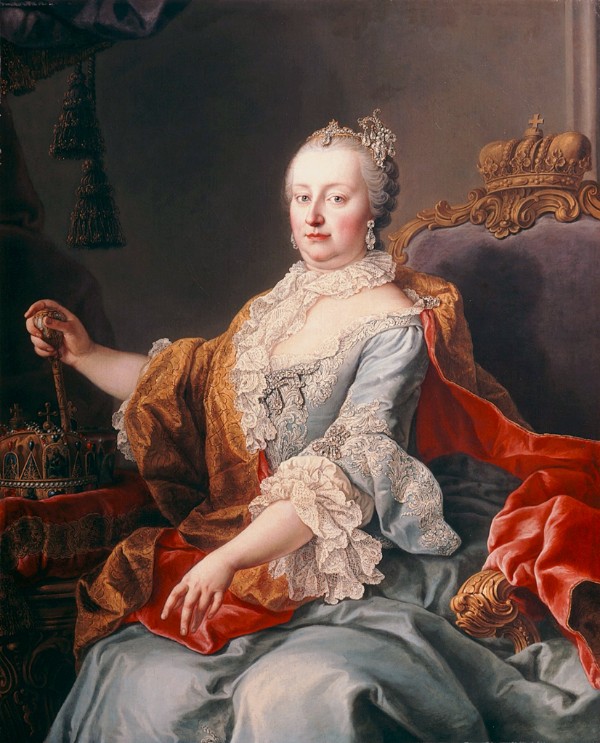
Empress Maria Theresa
During her childhood, Martines appeared at court as both a singer and an instrumentalist. She became a favourite performer of Empress Maria Theresa.
Historians have theorised that her vocal works may have been written for her own voice. Biographer Helene Wessely points out that they show a “predilection for coloratura passages, leaps over wide intervals and trills, indicating that she herself must have been an excellent singer.”
Marianna Martines’s aria “Perché, se tanti siete”
The Premiere of Her First Mass
The first public performance of one of her large-scale works occurred in September 1761, when she was just seventeen years old.
Her Terza messa in C was sung in the Michaelerkirche at the Mass for St. Michael.
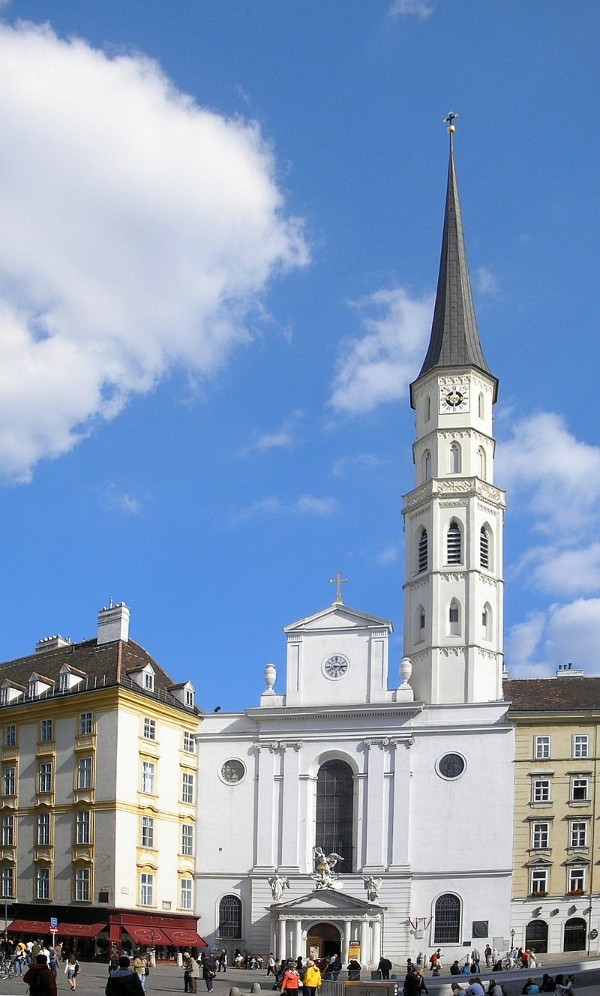
Michaelerkirche
One review remarked that “all the connoisseurs were amazed” at the work’s “excellence.”
Martines would go on to write four masses and two oratorios. However, she didn’t just write religious or religious-themed music: she also wrote a number of secular cantatas, as well as instrumental music.
Marianna Martines’s Mass No. 2 in G Major
A Growing Reputation
Over time, Martines would garner an impressive international reputation for any composer, but especially for a woman, and especially for a woman who never toured.
In 1773, she was honoured with admittance into the Accademia Filarmonica of Bologna. She was the first woman so honoured.
In 1782, her Italian oratorio Isacco figura del redentore was premiered by a large ensemble for the Tonkünstler-Societät. The Tonkünstler-Societät had presented works by many of the composers we consider today to be greats: men like Handel, Haydn, Mozart, and Beethoven.
Marianna was also extremely active in the private musical life of Vienna. She and her sister Antonia oversaw a weekly salon, at which the greatest musicians of the day would visit and perform. Haydn, of course, was always a valued guest. Mozart also swung by, and according to singer Michael Kelly, greatly enjoyed playing piano duets with her.
Marianna Martines’s Dixit Dominus
Why Wasn’t She Better Known?
So why wasn’t she as well-known as Haydn or Mozart? When thinking about the shape of Martines’s career, it’s important to keep in mind how her professional and economic motivations may have differed from those of male composers.
First off, it would have been considered unseemly for an upper-class woman to take a formal court position like Haydn eventually gained and Mozart hoped for. Besides, she already had the benefit of being a favourite of the Empress.
Her inherited wealth meant that she never had any obligation to publish for money or tour outside of Vienna to make a fortune.
She also never married, so there were never any children to provide for.
Marianna Martines’s Sinfonia
Marianna Martines the Caregiver
Neither Marianna nor her sister Antonia ever married. (Interestingly, one surviving account indicates that her sister also composed.)
Instead of having children of their own, they took on the role that many childless women end up taking on within their families: that of nurse and caretaker for older family members.
Her father died in 1764, and her mother died in 1775. It is believed the sisters were at hand to take care of both parents.
They also helped Metastasio as he aged. He died in 1782 at the age of 84.
He left his considerable estate to the Martines children. Marianna even inherited his harpsichord and music library.
A Final Cantata (Maybe)
The final piece of Marianna’s music that we know of is a chamber cantata called Orgoglioso fiumicello (Proud Little River).
It was dedicated to Victoria de Fries, the daughter of Count Moritz von Fries, a patron of Haydn and Beethoven. Beethoven would go on to dedicate his seventh symphony to him.
This is yet another sign that Martines was well-acquainted with the wider social circles as both of those great composers.
The cantata dates from 1786, the year she turned forty-two. She would live for over twenty years after this work, and there is no record of her giving up her life in music.
It is very possible that she wrote more works that have since been destroyed – or, more optimistically, are awaiting rediscovery in some archive.
One intriguing biographical sketch dating from 1826 claims that she wrote over thirty piano sonatas and 150-plus chamber cantatas. This is many, many more works than we currently know of.
Marianna Martines’s cantata “Berenice, ah che fai?”
Marianna Martines’s Mysterious Final Years
The last record we have of one of her public appearances is in 1808, when she attended a performance of Haydn’s oratorio Die Schöpfung conducted by Salieri.
This obviously indicates that she continued loving music throughout her life, and perhaps lends credence to the idea that there are more scores out there that have yet to be discovered.
She died on 13 December 1812, just two days after her sister Antonia, of tuberculosis. She was sixty-eight years old.
For more of the best in classical music, sign up for our E-Newsletter