
When Frédéric Chopin died in 1849 at the age of thirty-nine, it was a major blow to the musical world. His colleague and contemporary, Franz Liszt, was especially shaken.
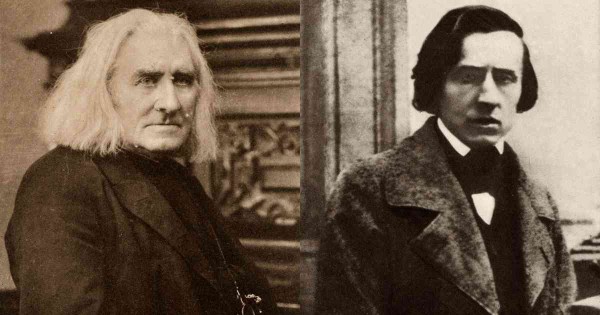
Frédéric Chopin and Franz Liszt © musthaveclassicalmusic.com
To process the loss, Liszt began writing a tribute to his late friend. It ended up being twenty-three pages long and was published in the journal La France musicale.
However, after finishing, Liszt felt that he still had more to say. He decided that he wanted to expand his article into a full-length book.
For assistance, he turned to his personal and professional partner, author Princess Carolyne von Sayn-Wittgenstein. Liszt was engaged in a multitude of musical and literary projects at the time, and she worked as his research assistant.
The first edition of Liszt’s Life of Chopin appeared in 1852.
A second edition, which included a rewrite done by Princess Carolyne, was published in 1879.
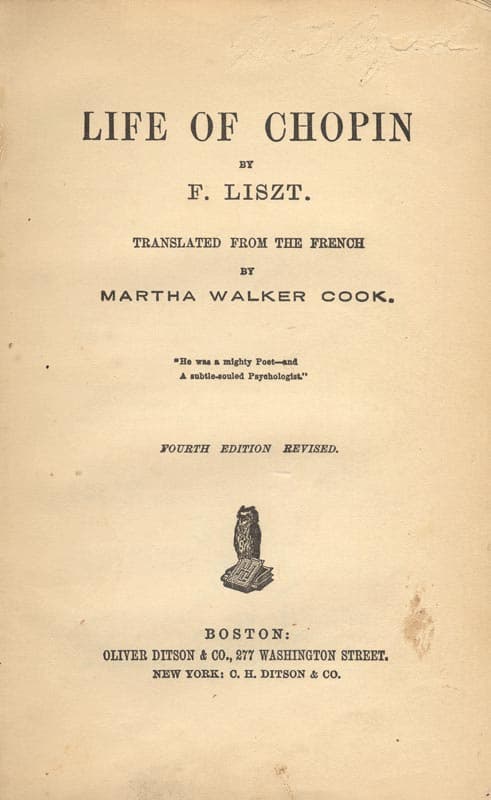
F. Chopin by F. Liszt
How can we interpret Liszt’s Chopin biography?
Not surprisingly, given its complicated background, this book is notoriously difficult to interpret.
Not only do readers have the issue of contradictions within the multiple versions to contend with, but we also have to acknowledge the series of stacking biases and motivations of both the author and the research assistant.
There are so many questions to ponder:
- How much of this book did Princess Carolyne ghostwrite?
- How much of this book was meant to be PR to enhance the reputation of Liszt and Chopin, as opposed to historical biography?
- How close were Liszt and Chopin in reality?
- What would Chopin have thought about this book?
Despite the difficulty of answering those questions, it’s impossible to deny that this book includes memories of Chopin, as recorded by arguably the greatest pianist of the nineteenth century. Given that, it seems foolish to throw the baby out with the bathwater.
So to help you decide if you want to plunge into this biography, today we’re looking at some of the most interesting ideas and moments in the book.
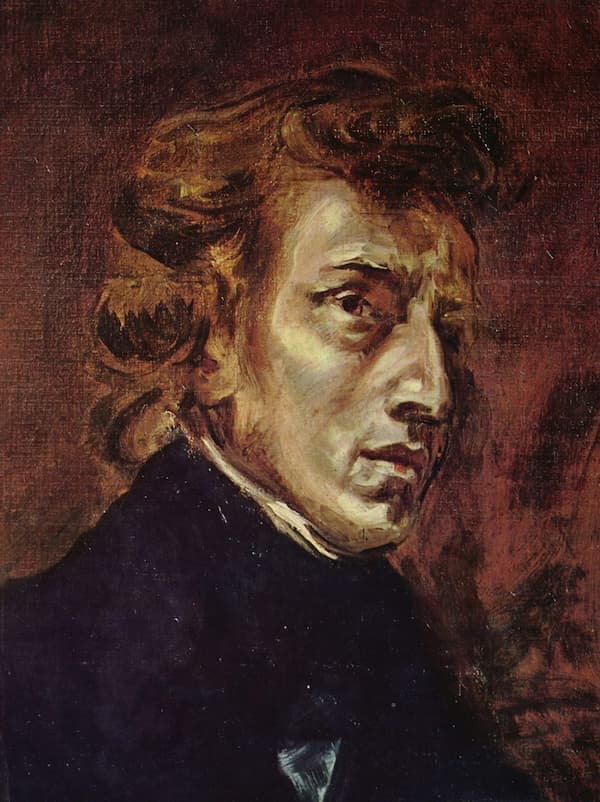
Portrait of Frédéric Chopin by Eugène Delacroix, 1838
Liszt admired the fact that Chopin largely stuck to writing for piano.
In the nineteenth century, it was commonly believed that great composers had to prove their genius by writing large works for orchestra.
Chopin was one of the exceptions. He gained a major reputation as a composer despite the fact that his most important works were written for solo piano.
Liszt writes extensively about this seeming paradox in his biography.
In limiting himself absolutely to the pianoforte, we think Chopin has proved that he possessed one of the most essential qualities of a composer, viz., a first appreciation of the form in which he felt he could excel…
What a firm conviction based on reflection must have been necessary to induce Chopin to confine himself to a field apparently so much less fruitful than the orchestra…
Liszt goes on to point out that visual artists don’t need to paint on massive canvases, and poets don’t need to write sprawling epic poems to be taken seriously, and he wonders why the criteria are different for composers.
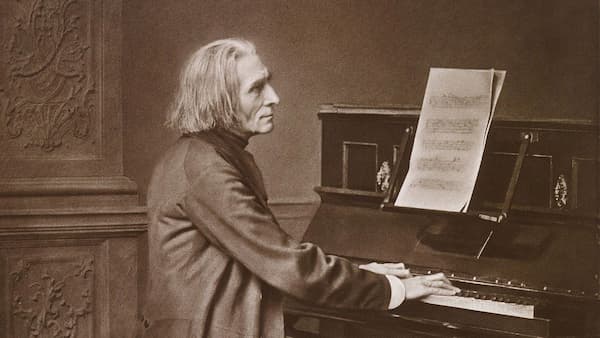
Carbon print circa 1869 by photographer Franz Hanfstaengl
It’s an interesting point, given that Liszt would go on to write many large-scale works himself.
We cannot doubt…that in music also we shall yet come to take into account the eloquence and ability with which thoughts and feelings are expressed, whatever may be the size of the composition in which they are developed or the means which are employed for their interpretation.
Liszt had reservations about Chopin’s sonatas and concertos.
Chopin: Piano Concerto in E minor, Op. 11
Liszt describes Chopin’s sonatas and concertos as being “imprisoned” by “classical fetters.”
His Concertos and Sonatas are, indeed, beautiful, but they reveal much more effort than inspiration.
His creative genius was imperious, fantastic, impulsive, and the beauties of his work were only fully manifested in absolute freedom.
We cannot help thinking that he did violence to the peculiar nature of his genius when he endeavoured to subject it to rules, to classifications, and to regulations not of his own making, and which he could not bend into harmony with the requirements of his own mind.
He was one of those original souls whose graces are only fully revealed when they have cut themselves adrift from all bondage and float on at their own wild will, controlled only by the ever-changing impulses of their own mobile natures.
Liszt believed that Chopin hid parts of his personality inside his music.
Chopin: Scherzo No. 2 in B-flat Minor
Throughout the book, Liszt portrays Chopin as someone who was aloof and difficult to get to know.
He claims that he never saw Chopin get deeply upset or angry, and theorises that he channeled those emotions into his music:
There are, in many passages of his writings, breathings of stifled rage and of suppressed anger; many of his studies and scherzos picture a concentrated exasperation and despair, which are at one time manifested in bitter irony, at another in intolerant pride.
These gloomy apostrophes of his muse have not been so well understood or attracted so much attention as his more tenderly coloured poems, and the personal character of Chopin no doubt had much to do with this general misconception.
Being kind, courteous, affable, and of tranquil and almost joyful manners, he would not allow those secret convulsions which tormented him to be even suspected.
Liszt recounts that Chopin attributed the melancholy in his music to the Polish concept of “Zal.”
Chopin: Mazurka in B-minor, Op. 33, No. 4
Liszt understood the hold that Chopin’s Polish roots had on him. “The feelings by which the creations of Chopin were inspired can only be fully comprehended by those who have visited the land which gave him birth,” he writes.
Liszt includes the following bittersweet anecdote:
One afternoon, there were only three people in the room, and Chopin had been playing for a long time.
In the small company was one of the most distinguished women in Paris, and she remarked that when he played she always felt more and more filled with a solemn resignation…
She asked him what caused that involuntary but sad veneration by which her soul was subdued…and what name he gave to that strange emotion which permeates his compositions?
Overcome by the appealing tears which moistened her lovely eyes, he replied, with a candour which was indeed rare with this artist, who was so susceptible upon all that related to the secrets of those sacred relics entombed in the gorgeous shrine of his music: —
“That her heart had not deceived her in the gloom which she felt stealing over her, for whatever his transitory pleasures may have been, he was never free from a feeling which might almost be said to form the soil of his heart, and for which he could find no fitting expression except a word in his own language, as no other tongue possessed a term which was the exact equivalent of the Polish word Zal!”
He repeated the word over and over again, as though his ear thirsted for the sound of that word, which expresses the entire range of emotions engendered by intense regret, through every shade of feeling from hatred to repentance.
Zal is a uniquely Polish term that refers to all of the varied emotions associated with regret, from sorrow to rage and everything in between.
Liszt took special note of Chopin’s use of rubato.
Chopin: Nocturne, Op. 27, No. 2
Anyone who listens to Chopin’s music is struck by the countless subtle tempo changes that occur within it.
Liszt explains it this way:
By his peculiar style of playing, Chopin imparted with the most fascinating effect this constant rocking, making the melody undulate to and fro like a skiff driven over the bosom of tossing waves…
All his compositions ought to be played with this accentuated and measured swaying and rocking, though it is difficult for those who never heard him play to catch hold of this secret of their proper execution.
Liszt recounts Chopin’s description of his own stage fright.
Liszt writes that he once heard Chopin say:
“I am not suited for concert-giving; the public frightens me; their looks, stimulated by nothing but curiosity, paralyse me; their strange faces oppress me; their breath stifles me.”
Liszt also suggests in the book that he dreaded playing in front of large audiences because he didn’t think they’d understand his music.
If we may be allowed to say so, we believe his concerts did not fatigue his physical constitution as much as his artistic susceptibility…
There were a few who understood him — did those few rightly understand him? A feeling of discontent gnawed at his heart and secretly undermined him, though he himself scarcely understood the cause of it.
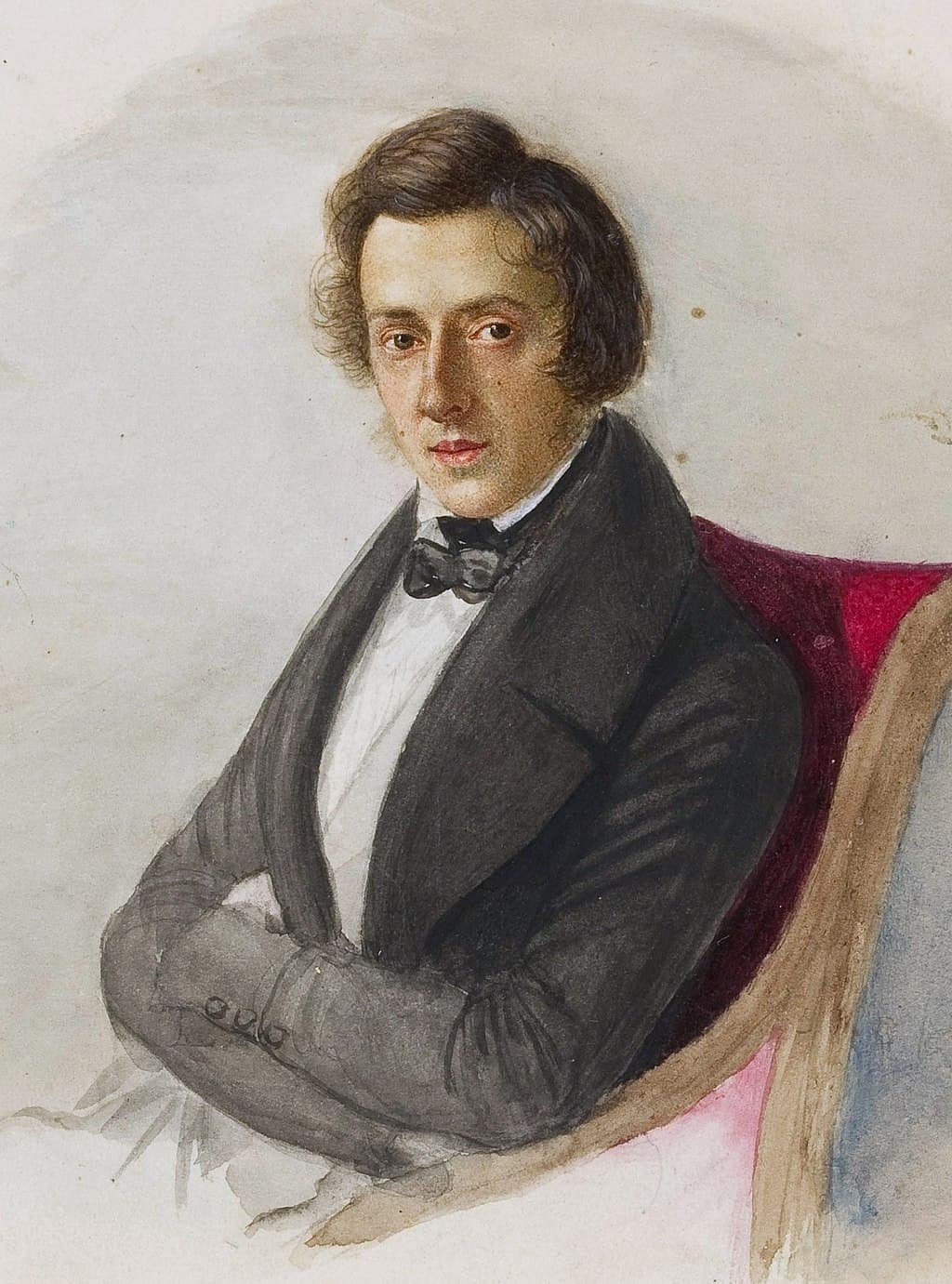
Portrait of Frédéric Chopin by Maria Wodzińska
Liszt remembered the appearance of Chopin’s apartment very clearly.
Liszt gives a flowery, but incredibly atmospheric, description of Chopin’s apartment:
His apartment, which was invaded by surprise, was only lit up by some wax candles grouped around one of Pleyel’s pianos, which he very much liked on account of their slightly veiled but silvery sonority and easy touch…
The corners of the room were left in obscurity so that all idea of limit was lost, and there seemed to be no boundary save the darkness of space around.
Some tall piece of furniture draped in white would reveal itself in this dim light — a form indistinct, lifting itself like a spectre to listen to the tones which had called it forth.
The light concentrated round the piano, and falling on the floor, glided on like a spreading wave until it reached and mingled with the fitful flashes from the fire, from which orange-lined plumes rose and fell, like shifting gnomes attracted to the spot by mystic incantations in their own language.
Liszt believed Chopin was an introvert.
Liszt seems fascinated by Chopin’s aloofness and desire for privacy, claiming that even close friends never felt like they knew large parts of him.
His most intimate acquaintance never penetrated as far as that lonely fortress where, shut out from his common life, his soul dwelt apart — a fortress which he so skilfully concealed that its very existence was hardly dreamed of.
In his relations and intercourse with others, it was what interested them which always seemed to occupy him; he took care never to draw them away from the sphere of their own personality lest they should intrude upon his.
He gave up to others but little of his time; yet that little was devoted to them unreservedly.
Liszt gave a vivid description of Chopin’s physical appearance.
His blue eyes were more spiritual than dreamy, and his bland smile never writhed into bitterness.
The transparent delicacy of his complexion pleased the eye, his fair hair was soft and silky, and his nose slightly aquiline; and his bearing was so distinguished and his manners were stamped with so much high breeding, that he was involuntarily always treated en prince.
His gestures were numerous and full of grace; his voice was in tone somewhat veiled, often stifled; he was of low stature, and his limbs were but slight.
He always put us in the mind of a convolvulus balancing its azure-hued cup upon a very slight stem, the tissue of which is so vaporous that the slightest contact wounds and tears the delicate corolla.
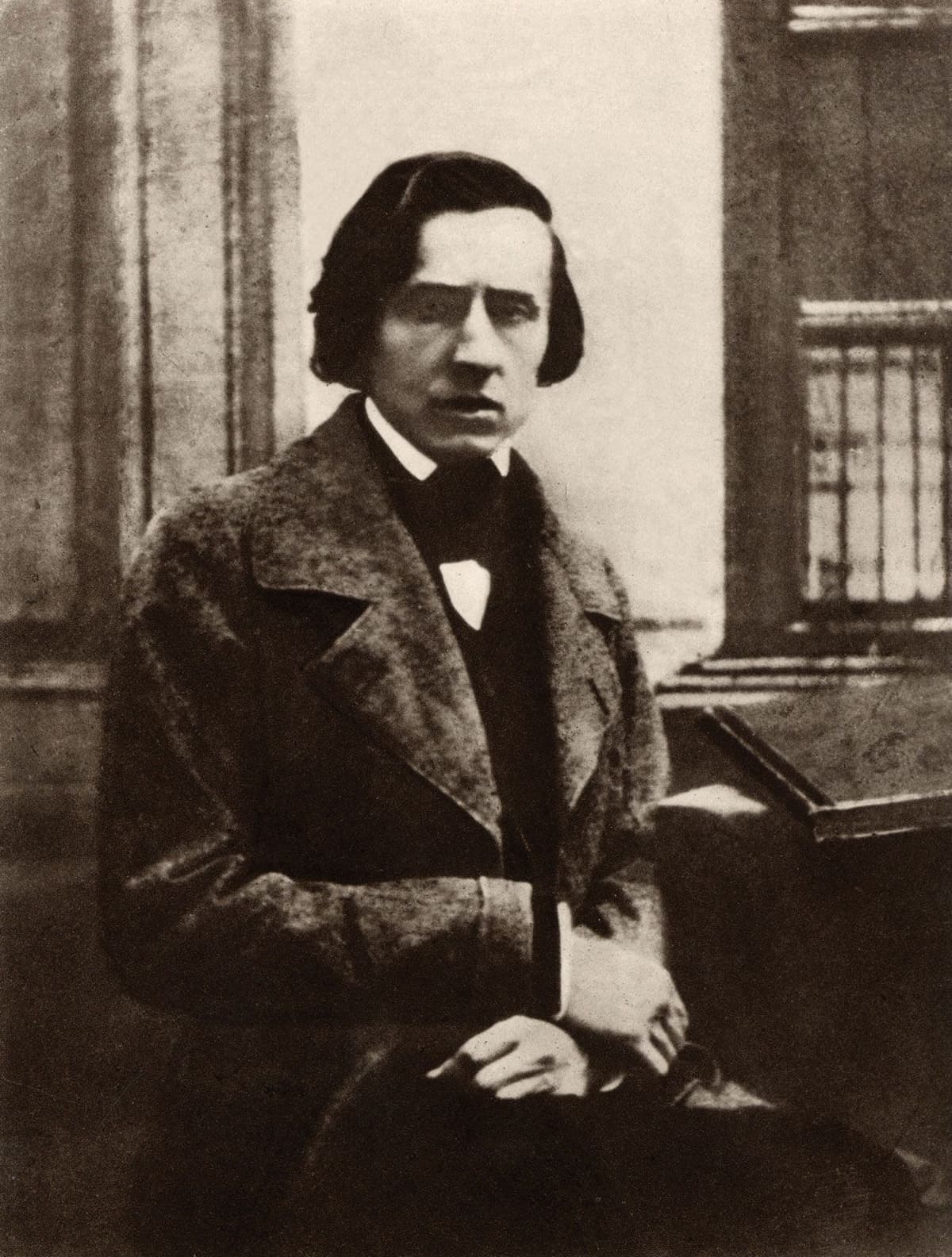
Frédéric Chopin
Liszt appreciated Chopin’s sense of humour.
Liszt: transcription of 6 Chants polonais de Frédéric Chopin, S.480
Liszt was especially taken by his sarcasm.
He was usually gay; his caustic spirit quickly appreciated the ridiculous, and he caught it far below the surface where it usually strikes the eye.
He also noted Chopin’s talent for mimicry:
In pantomime, he displayed a rich vein of drollery, and he often amused himself by reproducing the musical formulas and peculiar tricks of virtuosi in burlesque and most comical improvisations, imitating their gestures and movements, and counterfeiting their faces, with a cleverness which at once depicted their entire personality.
At such times, his own features were scarcely recognisable, as he could impose on them the strangest metamorphoses. But he never lost his own native grace while he was mimicking the ugly and the grotesque, and his grimaces were never such as to disfigure him.
His gaiety was the more piquant, seeing that he always kept it within the limits of perfect good taste, and held at a suspicious distance everything that could wound the most fastidious delicacy.
Chopin didn’t like writing letters.
With the members of his own family, he kept up a regular correspondence, but with no one else.
It was one of Chopin’s peculiarities that he would write letters to no one else, and it might have been supposed that he had vowed he would never write to strangers.
It was very curious to see him adopt all sorts of expedients to avoid writing only a short note.
Many and many a time has he walked from one end of Paris to the other to decline an invitation to dinner or to afford some trifling information rather than write a line or two which would have saved all this trouble and waste of time.
The great majority of his friends did not even know what his handwriting was like.
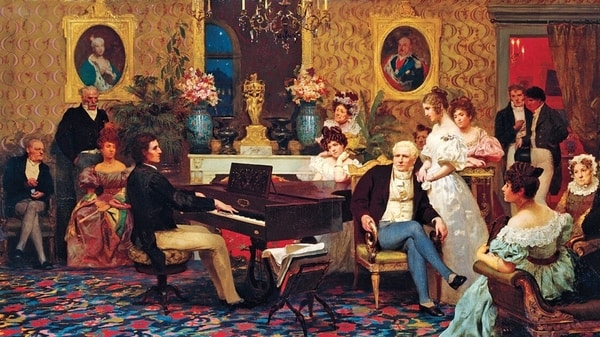
Henryk Siemiradzki: Chopin concert
In social settings, Chopin preferred the company of women and children to other men.
He did not wish that his time, his thoughts, or the course of his life should be in any way associated with or shackled by the pursuits of others, and he preferred the society of ladies as being less likely to force him into subsequent relations.
He would willingly spend whole evenings playing blind man’s buff with young folks, and would tell them little tales to make them break forth into that silvery laughter of youth which is sweeter than the nightingale’s song.
Chopin loved flowers, and the day after he died, his apartment was filled with them.
This is perhaps the most heartbreaking detail in the entire book:
His love for flowers was well known, and the next day [after his death] they were brought in such large quantities that the bed on which they had laid him, and indeed, the entire room, almost disappeared from sight, hidden by the varied and beautiful hues of these floral offerings.
He seemed to sleep in a garden of roses.
After death, his face regained its youthful beauty, its pure expression, and that serenity to which it had now long been unaccustomed.
His youthful loveliness, so long dimmed by bitter sufferings, was restored by death, and, among the flowers he loved, he slept his long, last, dreamless sleep!
For more of the best in classical music, sign up for our E-Newsletter






I would very much like to see all the performers and pieces be consistently identified in all videos, which are very beautiful and exquisitely selected.
Much appreciation for your wonderful newsletter!