Ever fall in love? It’s the best way to describe how we string players feel about our cellos, violins, violas, and basses. After all, we will spend much more time with our instruments than even our spouses. And often, it is love at first sound, as was the case with me. (Read more from “How My Cello Found Me”.)
When it comes to finding the instrument of our dreams, we do try to be practical. Price is certainly one important consideration, as is the condition of the instrument and the authenticity. But I think I can say that for most of us, the sound is the most important consideration: does it have deep sonorities, brightness, and qualities that reflect our voice? Does the instrument project in a hall?
We also need to make certain our cellos, violas, and basses are playable as far as the size and shape of the instrument. The dimensions of the violin were standardised before the lower strings, and the size, especially of violas and basses, can vary quite a lot. Violas vacillated between 381 mm (15 inches) to 444.5 mm (17.5 inches). A larger instrument, though, does not necessarily mean it has a bigger sound. It’s critical too that the instrument feels comfortable and responds quickly. The player should be wary of struggling to produce the sound or needing to coerce the instrument.
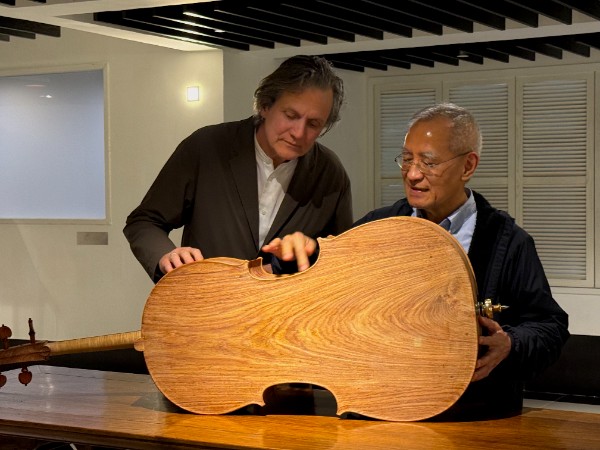
In the last article, we discussed the unveiling of the first huanghuali cello, made by expert luthier Robert Brewer Young of rare Chinese rosewood. Two cellists were the first to try the cello even before it had its final varnish coat applied: Hamzah and Maryam Zaidi.
They talked to me about how the cello felt as well as how it sounded. Hamzah is a cellist currently based in Japan, having studied with Alan Stepansky and David Geber at the Manhattan School of Music, Steven Doane and Rosemary Elliott at the Eastman School of Music and Felix Schmidt at the Royal Academy of Music in London. He acquired his Robert Brewer Young instrument in 2021.
“I was drawn to Robert’s cello. It’s well-balanced, with a bright, round sound and powerful projection, suited to a wide range of repertoire. This was after extensive searching through collections of both old and contemporary instruments, of course. In terms of measurements, the huanghuali cello is a Castelbarco model Stradivari, just like my instrument. The only difference is that the huanghuali cello has a flat back, while mine is the standard curved back and is made of willow.”
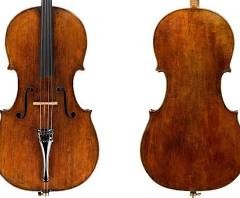
Castelbarco cello
The currently unvarnished huanghuali cello is being finished on-site at the Liang Yi Museum in Hong Kong. The low string height adds to the ease of playing, and the cello has a darker, husky voice. The response is slightly slower than mine. I’m curious to hear what it would sound like with gut strings as I feel that the instrument would suit baroque music.
Maryam also found the setup very comfortable. After Hamzah played Bach on each cello, Maryam commented:
“The sound as it is now, in comparison to Hamzah’s model, has tones that are earthy, while still a bit raw, I think. Hamzah’s cello is bright and round. It’s very interesting how the sound changes with the willow back as compared to the rosewood back. The huanghuali cello overall is darker, and the cellos speak very differently. I agree that hearing it in a baroque setting will be interesting, as the cello in that period played predominantly bass lines or continuo.”
Here are the two cellos. Hamzah plays the Sarabande from the Bach Solo Cello Suite No. 2 in D minor.
Hamzah Zaidi playing the huanghuali cello:
Hamzah Zaidi playing his Robert Young cello:
Let’s go back in time to the ideal. We cellists are indebted to Antonio Stradivarius, who, with exquisite artistry, handcrafted almost 80 cellos. Their expressiveness and powerful sound are unique. Today, there are 63 that are known to exist. Here are the whereabouts of a few of these!
The great cellist Jacqueline du Pré owned two extraordinary Strad cellos, the 1673 du Pré and the 1712 Davidoff. Lynn Harrell acquired the du Pré Strad, and after his death, it was purchased by a collector. It is now on loan. Yo Yo Ma plays on the Davidoff. Listen to the Bach Sarabande with Yo Yo on his Strad cello.
Johann Sebastian Bach: Cello Suite No. 2 in D Minor, BWV 1008 – IV. Sarabande (Yo-Yo Ma, cello)
My esteemed mentor János Starker played on the Lord Aylesford from 1950-1964, but he preferred and acquired a 1705 Goffriller cello. Here is a recording released during that time of Starker playing Mendelssohn Sonata No.2 in D major with György Sebök, pianist.
Felix Mendelssohn: Cello Sonata No. 2 in D Major, Op. 58, MWV Q32 – I. Allegro assai vivace (János Starker, cello; György Sebők, piano)
The Marquis Stradivarius cello from 1726 became the blueprint for the modern cello made by Stradivarius when he was in his 80s. Named after the French aristocrat Marquis de Corberon, it’s owned today by London’s Royal Academy of Music and is on long-term loan to cellist Steven Isserlis. He plays with gut strings, and here is a lovely example performing the Luise Adolpha Le Beau Cello Sonata in D major Op. 17 from 1878.
Luise Adolpha Le Beau: Cello Sonata in D Major, Op. 17 – I. Allegro molto (Steven Isserlis, cello; Connie Shih, piano)
Before then, cellos were larger, reflecting the musical style of the time, which was primarily playing continuo lines, that is, acting as another bass line. Later, some of these cellos were cut down to a more playable size.
William D Orcutt did extensive research on the instruments of the Gertrude Clarke Whittall Collection at the Library of Congress in Washington, DC **. He states that the Castelbarco cello ‘bears the Stradivari date of 1697 and was one of the three violoncellos of its period [i.e. pre-1700] which have not been reduced in size.’
“The two uncut cellos (in addition to the Castelbarco cello) are the 1690 Medici (Florence) and the 1696 Lord Aylesford, but the 1701 Servais here is also included; They are of nearly identical size but larger than the 1697 ‘grand pattern’ Castelbarco cello.” © Nicholas Sackman 2017, 2023
These three uncut cellos, the Medici, Lord Aylesford, and Servais measure in millimeters (Upper Bout, Lower Bout and length)
UB 364, LB 466, length 792 to 794
Whereas the Castelbarco measures:
UB 355, LB 453, length 774
As you can see, it is several millimetres narrower and shorter, but the Castelbarco cello is still larger than the Stradivarius later forma B cello.
In or around 1707, Strad made his greatest cello innovation the forma B, which measure approximately
UB 340, LB 435, length 758 (and with a narrower waist)
The 1711 Duport Strad, one of the forma B cellos, was played by Rostropovich for many years. This cello is named after the cellist Jean-Louis Duport, who, after a performance in 1812, unwittingly allowed Napoleon Bonaparte handle the cello. The small imperfection, a dent, due to Napoleon’s carelessness, is still evident. These photos of the Duport Strad were published in the October 1988 issue of The Strad Magazine in an article by Edward Sainati about the distinguished 19th-century French cellist Auguste Franchomme, who said this in a letter about the cello:
“What opulent wood! What magnificent varnish and what elegant, perfect workmanship! Its preservation is, I think, unique. Its tone is extremely full, pure, smooth and distinguished, and it has a surprising uniformity. How beautiful this Duport cello is!!’
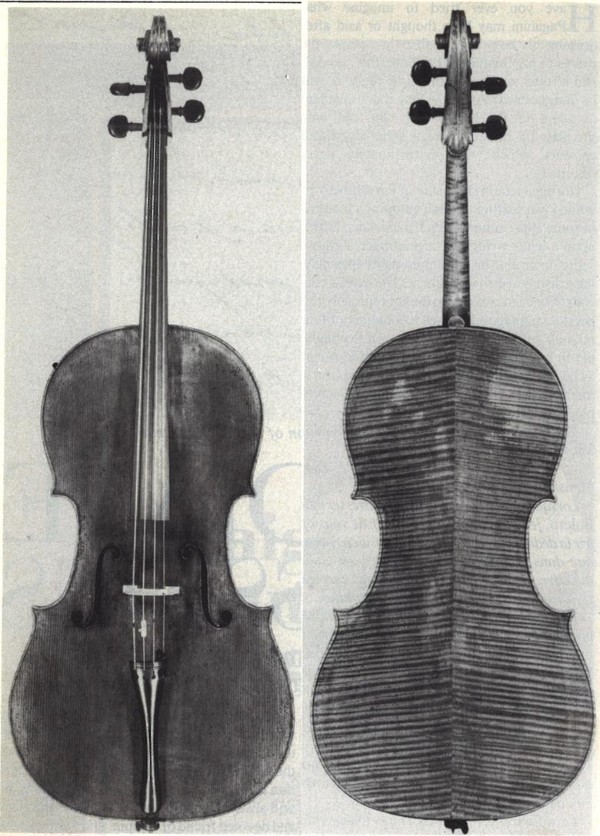
The Duport Strad (These photos were published in the October 1988 issue of The Strad in an article
by Edward Sainati about 19th-century French cellist August Franchomme)
There are two other coveted makers among cellists: Matteo Goffriller, who continued to make cellos of both larger and smaller patterns, and Domenico Montagnana, who made cellos with a wider model but with a somewhat reduced body length (740mm), resulting in his signature darker, richer, powerful sound.
What Strad’s alterations mean from a player’s standpoint is that the breadth of both the upper bout and lower bout is narrower by about 25.5mm (an inch) with a narrower waist. This reduces the string length, and the shoulders are easier to get around when playing in the uppermost registers, perhaps singlehandedly freeing up the range of the cello and transforming it into a solo instrument. The cellos still have an enormous bass and a singing sound with the vast array of colours now extending well into the range of the violin.
German-born cellist Jan Vogler spoke about his 1707 ‘Ex-Castelbarco, Fau’ Stradivari, an early example of the forma B model, and the sister cello to the Castelbarco in a Strings magazine article from December 2018.
“Stradivari cellos give you so much sound. In a great instrument, always, you get an offering of sound and colours that is overwhelming when you are unprepared for it… “OK, the cello has so much sound and so many colours, but where are they and how do I use them?” [Laughs.] …you realise that a Stradivari cello is a very, very professional tool, which needs a lot of masterful moves. I feel that ever since I [acquired] this cello, I’ve learned so much more about cello playing. I would say that it took me at least two years to feel familiar with it. After about four years, I started to feel really good about knowing its registers well and how to use them and when to use them. A cello like this is also a very strong partner that clearly shows you your own limits.”
Here is Vogler playing the beautiful aria by Purcell from Dido and Aeneas, Act III, that he transcribed for cello and orchestra.
Henry Purcell: Dido and Aeneas, Z. 626, Act III: When I am laid in earth (arr. J. Vogler for cello and orchestra) (Jan Vogler, cello; BBC Philharmonic Orchestra; Omer Meir Wellber, cond.)
The makers after Stradivarius had an established pattern to emulate. Although no one has been able to replicate his varnish, which is a significant factor for sound quality, there are excellent examples of antique cellos from Italy, Germany, and England. We must admit that we often covet an old instrument, as the ageing of the wood, like a fine wine, improves the sound over time, but today makers from Europe, the US, China, and elsewhere are producing first-rate instruments, and many of my wonderful colleagues play them professionally.
**(A short monograph about the Whittall instruments was written by William Dana Orcutt – The Stradivari Memorial at Washington, the national capital – and published in 1938 by the Library of Congress in partnership with the Gertrude Clarke Whittall Foundation.)
For more of the best in classical music, sign up for our E-Newsletter