Following on from her Essential Piano Technique Primers and Level 1, acclaimed pedagogue and pianist Professor Penelope Roskell continues this excellent series with Levels 2 and 3, aimed at Grades 1 to 2 and 3 to 4, respectively. These volumes develop many of the techniques explored in the earlier volumes, as well as introducing new techniques.
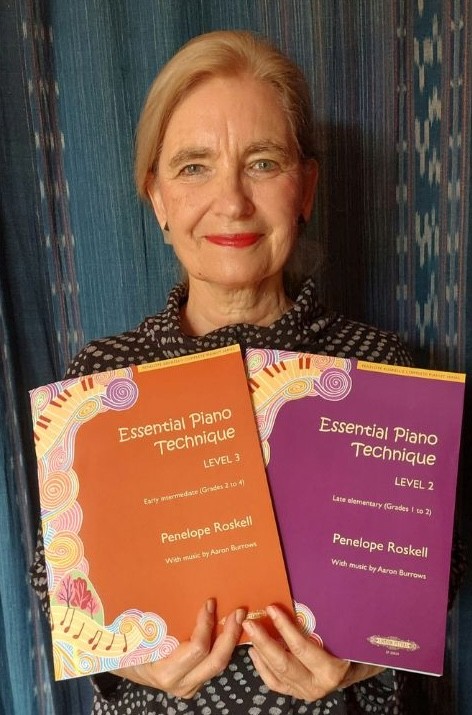
Penelope Roskell with her latest publications
Technique lies at the foundation of piano playing, and in these books, Roskell draws on the principles of The Complete Pianist to develop a strong foundation of healthy technique, helping young pianists to progress rapidly and confidently through the elementary stages of piano playing. More importantly, she demonstrates how technique serves the music, giving students not only the tools to play fluently and without tension, but also an awareness of piano sound and expressivity in piano playing.
As I wrote in my review of the first volumes in this series, when I was a child and teenager taking piano lessons in the 1970s and early 1980s, piano technique was barely mentioned by my teachers. My sense, looking back and having studied with Penelope Roskell as an adult returner pianist for six years, is that back in the 1970s, good technique was not considered very important for young piano students. Certainly, I was never taught about wrist and forearm rotation or how to utilise arm weight to create a particular articulation or sound. Today, teachers who are not teaching healthy technique from the get-go are doing their students a huge disservice; not only does good technique lead to expressive, fluent playing, it also guards against injury.
Essential Piano Technique Primer B: Page 12: Finger gym
As in the previous volumes, in Essential Piano Technique Level 2 and 3, each aspect of technique is put into practice using simple but attractive exercises, followed by studies and pieces, clearly showing how that particular technique works in practice in the music. There are arrangements of pieces by, for example, Mozart, Amy Beach, Schumann, Tchaikovsky, and Bartók, as well as new pieces written especially for these volumes by Aaron Burrows. There are even some 4-hand pieces for students to play with their teacher, or a more advanced player, perhaps a friend or family member. All of the music has been selected to be appealing to young players, and the progression through the volumes has been planned carefully to guide students through the challenges encountered. The approach throughout is supportive, encouraging and enjoyable. Penelope uses colourful descriptions for various aspects of technique or exercises, such as Itchy Leg, Stroking the Cat, Jellyfish Jumps and Snapping Crocodile, which will spark children’s imaginations and help them understand the particular technique being taught.
Essential Piano Technique Level 3: Page 64: Legato thirds
While these books are primarily aimed at children, working with their piano teacher, all of the techniques explored are applicable to adult students, and teachers may like to dip in and out of the volumes to find pieces which are applicable to the early and early intermediate adult learner. Each volume also includes useful teaching notes, explanations of learning objectives/outcomes, and further suggestions for related pieces, all of which can be supplemented by visiting the Roskell Academy. There are also selected videos by Penelope on the Faber Music channel, allowing teachers and students to see techniques demonstrated clearly and put into practice in music. The books are attractively designed with very clear engraving, infographics, tips and notes. Overall, these volumes represent another significant contribution to piano pedagogy and an invaluable resource for teachers and students.
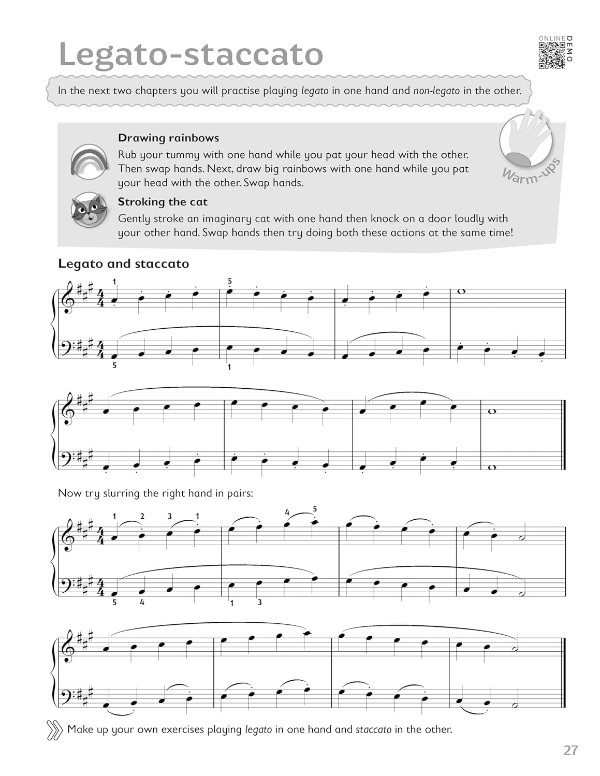
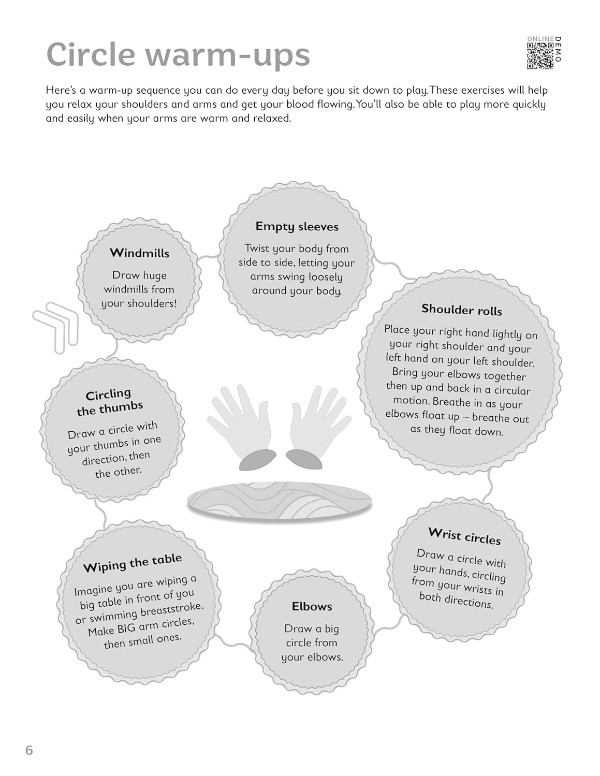
Excerpt on circle warm-ups
Excerpt on Legato-staccato
Essential Piano Technique by Penelope Roskell is published by Editions Peters/Faber Music and is available in both book and Kindle editions.
For more of the best in classical music, sign up for our E-Newsletter