With an intense, focused opening, violinist Paul Huang and pianist Helen Huang bring us immediately into the world of Francis Poulenc (1899–1963). His violin sonata, FP 119, was written during WWII, and then later revised.
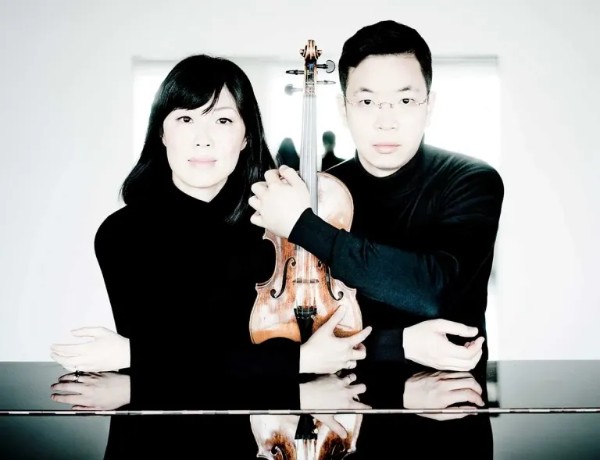
Helen Huang and Paul Huang, Photo: Marco Borggreve
During the War, Poulenc was trapped in occupied France and wrote his violin sonata in 1942 and 1943 as a response to the fascism that surrounded him and as a late memorial to the Spanish poet Federico García Lorca, who was shot by fascists during the Spanish Civil War in 1936. The sound moves between chaos and beauty, with occasional melodies of great beauty emerging out of the fog of war. The final movement ends not with a great bang, but with shrill ringing cries from the violin and piano, playing pizzicato.
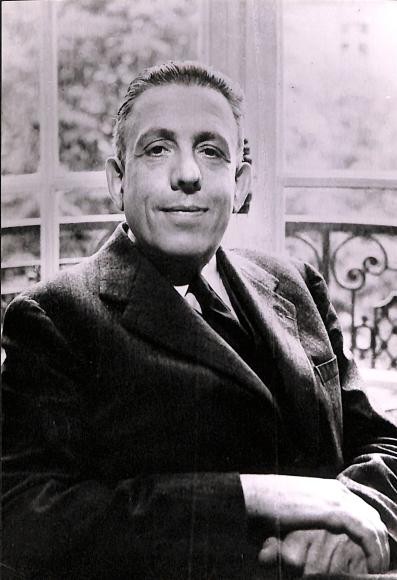
Francis Poulenc
Poulenc had started to think about the work in 1938, before the war even started, and created a piece where the sound of the guitar, representing Spain, has as much a melodic place as the violin.
The second major work on the album is Prokofiev’s Violin Sonata No. 1 in F minor, Op. 80, also written during this same period, but the works are separated by a work from the 1970s, Estonian composer Arvo Pärt, celebrating his 90th year in 2025, and his quietly reflective Spiegel im Spiegel (Mirror(s) in the Mirror). The work was written in 1978, shortly before Pärt left Estonia, while the country was still under Soviet rule. His compositional style at the time is referred to as ‘tintinnabuli’, where a melodic voice, playing diatonic scales, is in opposition to the tintinnabular voice, which plays triads on the tonic. It provides a point of stillness between the two ‘war’ pieces. The image of a mirror in a mirror refers to an infinity mirror where an image is reflected in facing mirrors to create an image that retreats into forever.
Sergei Prokofiev (1891–1953) was eight years older than Poulenc. Although out of the Soviet Union since 1918, first in the US, then in France, he returned to Moscow in 1936, never to leave again. With Prokofiev’s Violin Sonata No. 1, we return to a time and place of momentous movement.
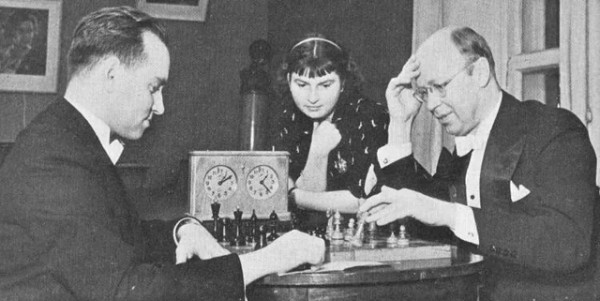
Prokofiev playing chess against David Oistrakh with violinist Liza Gilels watching
Written between 1938 and 1943, the work is jagged and angular. Elements of the work are musically upsetting, such as a section of the second movement where the opening 3-note motif returns, but with the two instruments now playing a half-step apart. Themes from earlier movements return but now demonically twisted. Prokofiev urged the performers for the premiere, David Oistrakh (violin) and Lev Oborin (piano), to play aggressively. Oborin said he was afraid of burying the violin’s sound, but Prokofiev responded that ‘It should sound in such a way that people should jump in their seat, and people will say “Is he out of his mind?”’ The premiere was given on 23 October 1946, with the performers coached by the composer.
Although he never said it was related to WWII, Prokofiev described the endings of the first and final movements as being like ‘wind passing through a graveyard’. The final movement is a wild combination of all that has gone before: sounds of battle, church bells, the whispering wind, and ends with a single note. Where are we going next, and what do we do with our chaotic history? The ending leaves questions for both performers and the audience.
The arch through this recording of two violin sonatas written during the War, separated by a work that is pure reflective thought, provides us with an interesting view of the development of 20th-century music. Although Pärt’s Spiegel im Spiegel was written only 40 years after the two violin sonatas, it’s a world and a war away from the chaos faced by the two composers, one in France and one in Russia.
The recording is big and bold, with a sound to match. Recorded in the Abeshouse Recording Studio Barn, South Salem, New York, the sound is echo-y and resonant. Paul Huang’s playing is confident and pulls the essence from each work. Helen Huang, on piano, is equally confident with a big voice to support the violin’s emotions.
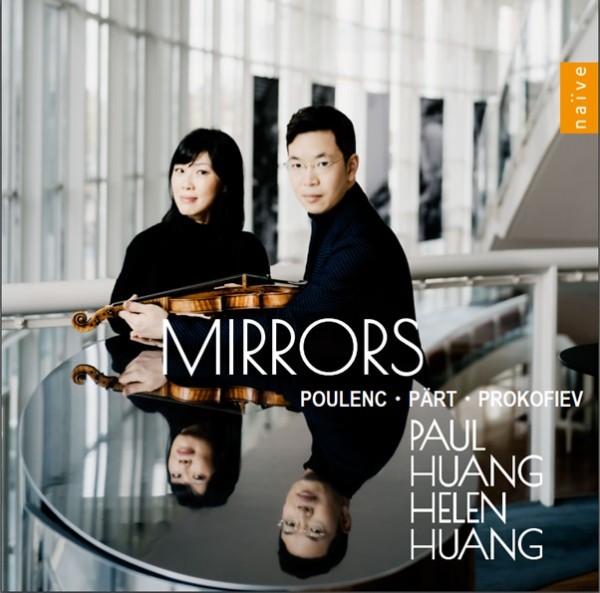
Mirrors: Works by Francis Poulenc, Arvo Pärt & Sergei Prokofiev
Paul Huang, violin; Helen Huang, piano
Naïve Records V8617
For more of the best in classical music, sign up for our E-Newsletter