During the first half of the 19th century, Gioachino Rossini was recognised as the greatest Italian composer of his time. No other composer enjoyed his prestige, popular acclaim and artistic influence in the world of opera.
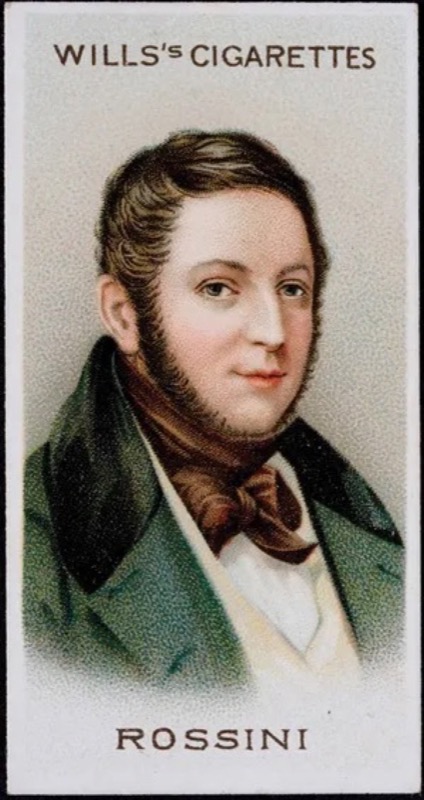
Gioachino Rossini cigarette trading card
It all started in Pesaro, a small city on the Adriatic. Both parents were musicians, and the Napoleonic wars brought the family to Bologna, where young Gioachino entered the Liceo Musicale in 1806.
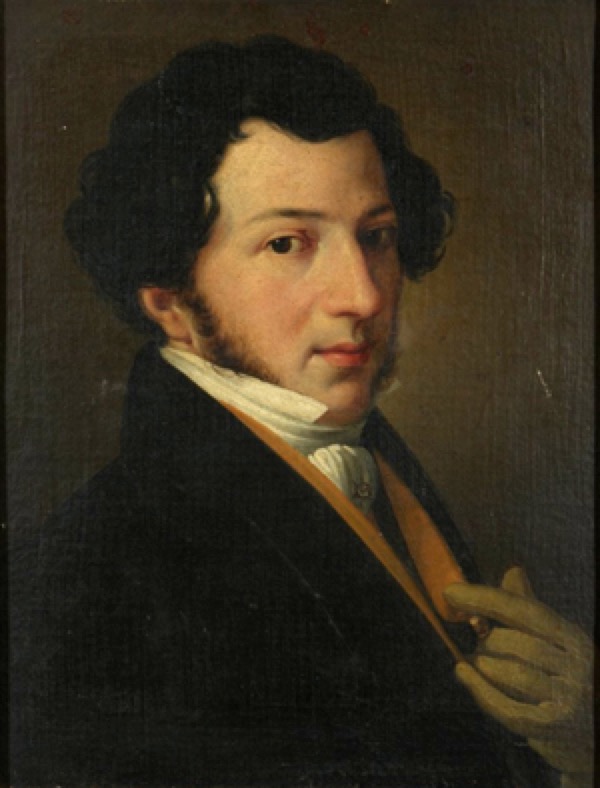
Young Gioachino Rossini, circa 1815
He took courses in singing, piano, the cello and counterpoint, and the Teatro San Moisè in Venice commissioned his first opera in 1810. La cambiale di matrimonio (The Marriage Contract) was Rossini’s first professional opera, written when he was 18.
Gioachino Rossini: La cambiale di matrimonio, (excerpts)
A Lucky Break
The opportunity had arisen because Giovanni Morandi and his wife Rosa Morandi, friends of Rossini’s parents, had been engaged at the Teatro San Moisè. When a composer withdrew from a commission, Morandi recommended the young Rossini to the theatre management.
This was a fantastic opportunity, as Rossini was given an existing libretto by Gaetano Rossi, who based his version on a 1791 play by Camillo Federici and an earlier libretto by Giuseppe Checcherini, written for an 1807 opera by Carlo Coccia.
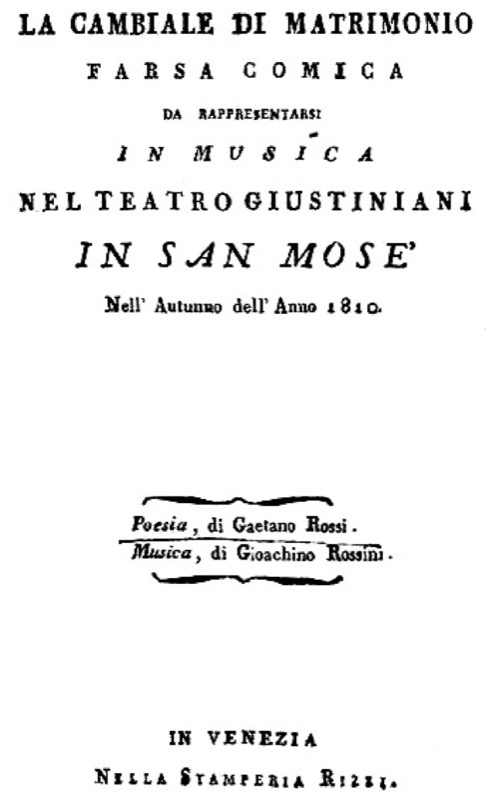
Title page of the libretto of La cambiale di matrimonio, Venice 1810
Of course, there was a catch. The opera had to be produced very quickly, and apparently he wrote the entire work in just a couple of days. Composing at blazing speed would become characteristic of his professional life, as he often raced against tight theatrical deadlines.
Rossini had a bit of a head start, however, as he adapted the overture from a symphonic work he had written in 1809. A funny anecdote recounted by musicologist Alexandra Amati-Camperi relates that singers complained during rehearsal that the orchestra was frequently overwhelming their voices. Apparently, Rossini was so distressed by their criticism that he went home in tears.
Gioachino Rossini: La cambiale di matrimonio, “Overture”
One Marriage Contract & Plenty of Trouble
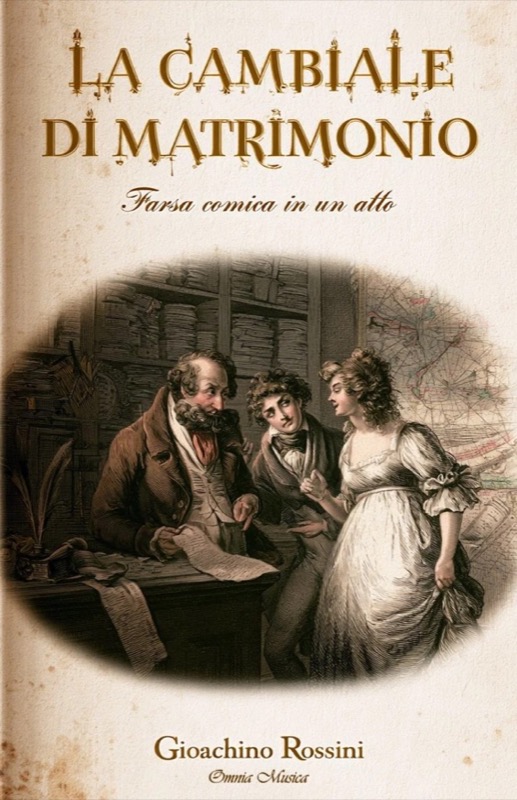
Rossini: The Marriage Contract
This one-act operatic farsa comica is set in the chambers of the English merchant Tobias Mill in 18th-century London. Mill (bass) receives a blank matrimonial bill of exchange from Mr. Slook (bass), an eccentric Canadian businessman. Although he is suitably surprised, he announces to his servants Norton (bass) and Clarina (mezzo-soprano) that he will accept the document on behalf of his daughter Fanny (soprano).
Fanny is hardly overjoyed, and together with her penniless lover Edoardo Milfort (tenor), vows to fight the situation. When Slook arrives, he is rather surprised by the elaborate nature of his reception and by Mill’s prompt desire to enact the bill.
Slook addresses Fanny in a duet that soon expands as Milfort joins in, forming the opera’s pivotal ensemble. Milfort’s message is that if Slook values his safety, he should take the first boat home. Deciding that he has landed among a bunch of lunatic strangers, Slook offers to pull out of the contract, whereupon Mill challenges him to a duel.
Gioachino Rossini: La cambiale di matrimonio “Grazie, grazie, troppo presto”
A Promising Future
This is all too much for Slook, who prepares to leave at once, though not before he has settled the marriage bill by making Milfort his heir and signing Fanny over to him. Fanny sings an eloquent aria of thanks, which includes phrases Rossini reused later for Rosina in Il barbiere di Siviglia.
During the roaring finale, Slook smokes a pipe of peace while Mill, who does not yet know of the settlement, rages belligerently about the house before all is revealed. Slook finally convinces Mill to allow the couple to marry, and all ends happily.
As Richard Osborne writes, the opera reveals a tolerable technique, “a vivid sense of invention, a sharp ear and a fine sense of pace. More astonishingly, it reveals a precocious mastery of the long single-act structure, with eight carefully marshalled numbers including a multi-movement introduction and finale and a carefully placed central ensemble of crisis and confusion.”
Gioachino Rossini: La cambiale di matrimonio, “Vorrei spiegarvi il giubilo”
From Venice to Bologna
The opera premiered on 3 November 1810, in a double bill with Giuseppe Farinelli’s Non precipitare i giudizi. It had a respectable number of performances during its initial run, and it received a favourable response.
It earned Rossini a commission to write a comic opera for the Teatro del Corso in Bologna, and the resulting opera, L’equivoco stravagante (The Extraordinary Misunderstanding), premiered on 26 October 1811, with Rossini himself involved in the production.
For more of the best in classical music, sign up for our E-Newsletter