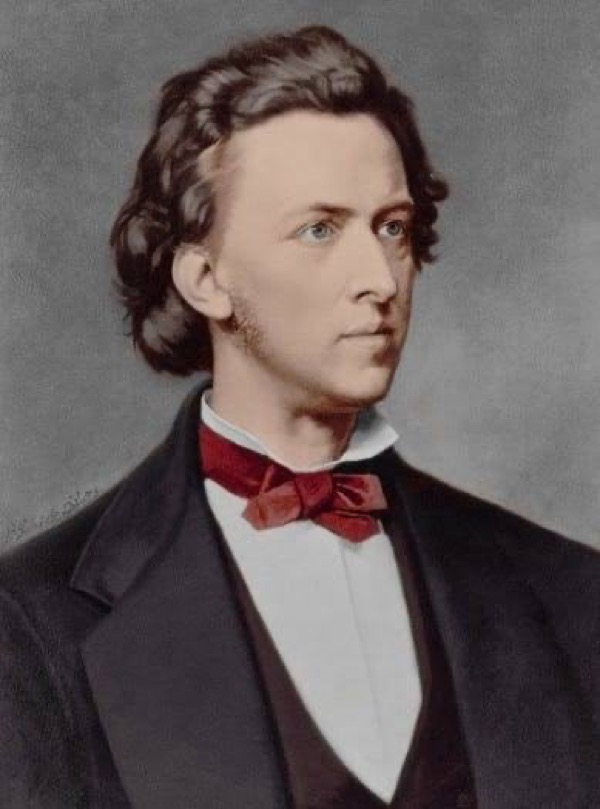
In 1837, the year Frédéric Chopin published his Études, Op. 25, the piano etude had begun to mean more than a collection of exercises.
In fact, Chopin himself had helped to transform the genre in his earlier Études, Op. 10, showing that music designed to develop a particular technical skill could also be creative and expressive. In Op. 25, he pushed that idea even further.
Today we’re looking at each of Chopin’s Études in Op. 25 and the stories behind each one.
Etude No. 1 in A-flat major
Nickname: Aeolian Harp or The Shepherd Boy
Date of composition: 1836
Technical challenges: Arpeggios, dexterity, and voicing
- The etude uses fast and dreamy arpeggios to traverse through different shades of the key of A-flat major – finding its way to A major before returning to the home key.
- Robert Schumann was dazzled by this etude, describing it as “a poem rather than a study.” He also nicknamed it “Aeolian Harp.”
- Polish pianist and journalist Jan Kleczyński once claimed that Chopin told a pupil the music portrays a shepherd boy playing his flute in a grotto during a thunderstorm – but there’s no supporting evidence for this interpretation.
Etude No. 2 in F minor
Nickname: The Bees
Date of composition: 1832–1836
Technical challenges: Right-hand dexterity and polyrhythms across both hands
- The second etude is linked to the first via its key: F minor, the relative minor to the first etude’s A-flat major.
- It requires pianists to play eighth-note triplets in the right hand at the same time as quarter-note triplets in the left hand – all at a remarkably fast tempo requiring extraordinary precision.
- It earned the nickname “The Bees” for sounding like buzzing bees travelling from flower to flower.
- Pianist Alexander Dreyschock once tried to impress Franz Liszt by playing the left hand of Chopin’s Revolutionary Etude in octaves. Liszt responded by playing the right hand to this etude in octaves – at speed.
Etude No. 3 in F major
Nickname: The Horseman or The Knight
Date of composition: 1836
Technical challenges: Rhythms across both hands and voicing
- The etude earned its nickname The Horseman because of its rhythm: a repeating pattern of a sixteenth note followed by a dotted eighth note. The result sounds like a trot or gallop.
- In addition to making sure the rhythms are precise, the etude features four voices that have to be carefully balanced to avoid muddiness.
Etude No. 4 in A minor
Date of composition: 1835–1837
Technical challenges: Syncopation, staccato, and huge left-hand leaps
- The most notable element of this etude is its bouncy syncopation, calling to mind a polka.
- The left-hand leaps are massive, stretching across a tenth, at a quick tempo.
- Both fifth fingers are asked to do something extraordinary here. The left-hand fifth finger has to bounce off the lowest notes accurately, and the right-hand fifth finger has to play a legato melody while the other fingers in the hand play staccato.
Etude No. 5 in E minor
Nickname: Wrong Note
Date of composition: 1837
Technical challenges: Voicing
- This etude relies on minor seconds: i.e., two notes next to each other on the keyboard. Players often play them accidentally when they don’t place their hands exactly on a key. Here, though, Chopin uses them deliberately.
- These notes are why the etude gained the nickname “Wrong Note.”
- The first part of the etude consists of a theme tinged by the minor seconds, followed by a new melody “cleaned up” of the seconds.
- This is the only time – aside from the tenth etude in Op. 25 – where Chopin uses a minor-key main theme and a major-key second theme.
Etude No. 6 in G-sharp minor
Nickname: Double Thirds Etude
Date of composition: 1832–1836
Technical challenges: Double thirds
- This etude focuses on rapidly played double thirds (i.e., a hand position where the second and fourth fingers depress a note, followed by the third and fifth, then alternate quickly back and forth).
- On top of that, pianists are also asked to control the dynamics.
- As if all that wasn’t enough, Chopin also adds in a mysterious-sounding melody to be played around the trilling thirds.
- It is one of the hardest etudes Chopin ever wrote.
Etude No. 7 in C-sharp minor
Date of composition: 1834
Technical challenges: Voicing in a slow tempo
- After the demanding virtuosity of the sixth etude, this seventh one focuses on songfulness. The melodic line recalls an operatic aria more than a piano etude.
- Chopin experiments throughout with striking harmonies inserted into a structure that is by and large very rhythmically predictable. This contrast lends it interest.
- The melody also moves between hands, and it takes a skilled pianist to know which voice to bring out at any given time.
Etude No. 8 in D-flat major
Date of composition: 1832–1836
Technical challenges: Parallel sixths
- This etude focuses on notes that are a sixth apart. Melodies usually aren’t played in sixths for extended periods, which makes this piece sound unusual.
- Many are played with the first and fourth fingers, along with the second and fifth fingers.
- The etude also uses triplets in cut time that give the music a rocking, dance-like quality.
Etude No. 9 in G-flat major
Nickname: Butterfly
Date of composition: 1832–1834
Technical challenges: Switching articulations and wrist flexibility
- The main challenge of this etude is switching rapidly between staccato (i.e., brief and crisp) and marcato (i.e., louder and more accented) playing styles – in octaves. The pianist’s articulation gives the etude its sense of shape and momentum.
- The piece was nicknamed “Butterfly” because of its flitting, wandering nature. (Arthur Friedheim pushed back, calling the nickname “inadequate.”)
- It is the shortest Chopin etude.
Etude No. 10 in B minor
Nickname: Octaves
Date of composition: 1835
Technical challenges: Octaves
- This etude is structured unusually. It features a first theme in B minor, a second theme in B major, and then develops into a variation of the first theme.
- The first theme is marked forte or fortissimo; the second theme is to be played quietly.
- The fearsome, martial octaves call to mind the bravura style of Liszt – the dedicatee of his Op. 10 etudes. (Liszt’s mistress, Marie d’Agoult, received the dedication of the Op. 25 set).
- Interestingly, given its position after the brief ninth etude, this is one of the longer Chopin etudes, clocking in at over four minutes.
Etude No. 11 in A minor
Nickname: Winter Wind
Date of composition: 1836
Technical challenges: Right-hand dexterity and left-hand leaps
- This etude begins with a simple hymn-like opening, repeated twice, before all hell breaks loose, with impassioned filigree all around that main theme. Chopin added this introduction later at the suggestion of his friend Charles A. Hoffmann; originally, the work began without that famous opening contrast.
- The leaps required in the left hand are staggering, up to three or four octaves in width. Meanwhile, the right hand plays a crazed selection of scales and arpeggios at rapid-fire tempo.
- Critic James Huneker wrote of the eleventh etude, “Small-souled men, no matter how agile their fingers, should avoid it.”
- One gets the sense that Chopin is working his way up to a grand finale.
Etude No. 12 in C minor
Nickname: Ocean
Date of composition: 1836
Technical challenges: Arpeggios and general stamina
- The final etude in the set is the twelfth, nicknamed “Ocean” for its quality of depth, vastness, and rolling waves of sound.
- The theme travels through multiple keys, lending the work a voracious, frantically searching quality.
- Different notes are accented in the score versus how pianists have historically played them, demonstrating the influence of the aural tradition in the piano community.
- This is among the most difficult of all his etudes – not only in Op. 25, but of all the etudes Chopin wrote.
Conclusion
Chopin’s Études, Op. 25, reveal just how misleading the word “etude” can be. Yes, these works demand extraordinary technical command, but technique is never their sole point.
Taken together, Op. 25 and the earlier Op. 10 establish Chopin’s Études as far more ambitious than a collection of dry pedagogical exercises. They were expressive miniature masterpieces, each one containing a whole world, and they changed what a piano etude could be.
For more of the best in classical music, sign up for our E-Newsletter