The second of Frances Wilson’s essays celebrating Wigmore Hall.
Wigmore Hall today
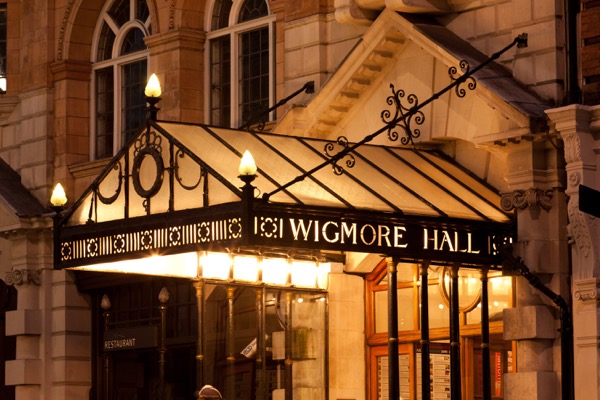
Wigmore Hall entrance
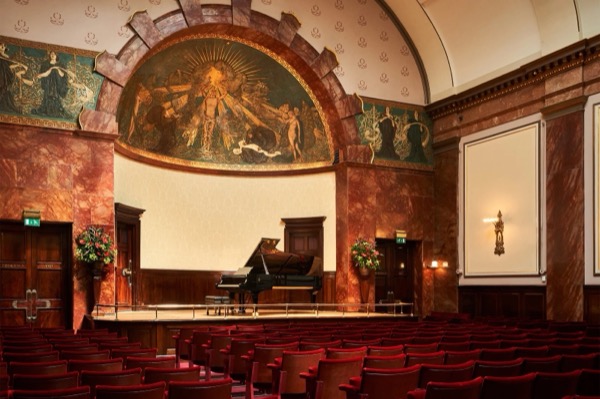
Wigmore Hall today
Nestling unobtrusively just a stone’s throw from the bustle of Oxford Street, within a row of tall Edwardian façades, Wigmore Hall enjoys a position of pre-eminence not only in London but across the international classical music scene, and a debut at Wigmore Hall is the long-held dream of many young and up-and-coming performers. While other, newer or more modern concert halls may boast state-of-the-art acoustics, the acoustics of Wigmore Hall remain one of the best and most beloved. No matter that the distant rumble of tube trains can be heard during performances (the underground lines run right under the street where the hall is located), one feels cocooned from the outside world in that special red-and-gold space.
“I have never been fortunate enough to perform there, but have wonderful memories of being in the audience. Every note sparkles.” (Lucy Melvin, violinist)
“It’s the only hall I know where the best seats (from the listening point of view) are in the balcony. Judging by the conversations I’ve had up there, quite a lot of people know this.” (Orlando Murrin, author)
Katharina Konradi & Joseph Middleton – Tchaikovsky, Serenade
The hall and its audience
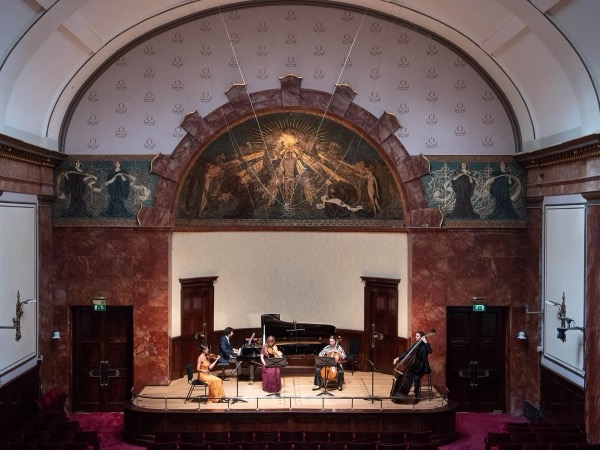
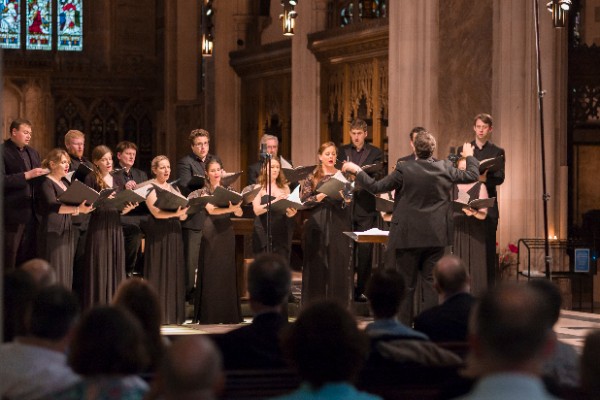
Kaleidoscope Chamber Collective at Wigmore Hall
Alongside its reputation for chamber music of the highest quality, the Wigmore’s audience is famous for its loyalty, intelligence and discernment. It is considered by many musicians to be one of the most demanding audiences of any concert hall, which brings its own unique set of pressures, and many performers will play a programme in regional venues and for local music societies before “doing a Wigmore”.
But the hall holds a special place in the affections of many performers, who regard it as their artistic home in London. There are no rough edges in this beautifully proportioned hall, no jarring modern architectural details to confuse and distract. The tread of the thick crimson carpets is complemented by the red Verona marble frieze, the noise and litter of Oxford Street and the West End forgotten in the spacious vestibule and elegant green room. Whether playing at the Wigmore or in the audience, one feels a sense of history and heritage, for the Wigmore inhabits a different era and ethos from other concert venues in London. All the time, one is aware of the great performances that have taken place in the hall, and the walls of the green room are lined with photographs of musicians and composers, attesting to the hall’s heritage.
“…the place is so full of musical ghosts.” (Caroline Swinburne, author)

Wigmore Hall
As a member of the audience, attending a concert at the Wigmore has its own special rituals from the moment one steps through the glass doors. For many of us who are regulars at the “sacred shoebox” (Vikram Seth, author), it feels like our musical spiritual home. The richly carpeted vestibule is a place where people meet, queue for tickets, and buy programmes, CDs or gifts. Sometimes, if you arrive early, you might hear the soloist warming up or the piano being tuned, which can lend a special frisson to the evening, a glimpse of what is to come.
Downstairs, the bars and restaurant hum with pre-concert chatter, and sometimes, when you visit, you might spot a “musical celebrity” – Steven Isserlis, Alfred Brendel, Julian Lloyd Webber, or Stephen Kovacevich. I like to arrive in good time for drinks and chat with friends before the bell summons us to the hall, when we sink into the plush comfort of the crimson seats. In the auditorium, in the moments before the concert begins, one senses the audience’s collective breath of expectation.
“The restaurant is great for socialising with fellow concert goers, and of course, as it is so popular with other musicians, you always see someone you know there, but mostly it is the sense of intimacy and history which, combined with wonderful acoustics wherever one sits, makes it unique.” (Lorraine Banning, pianist & piano teacher)
Franz Schubert: Nachtstück, Op. 36, No. 2, D. 672 (Ian Bostridge, tenor; Julius Drake, piano)
People, usually those who have never set foot in the Wigmore, let alone enjoyed a concert there, grumble about the audience’s age or claim it is overly highbrow, snobbish or elitist. But get talking to the person next to you (spying my reporter’s notebook is usually enough to start a conversation) and you will find that the average Wigmore audience member is none of these things, simply someone who really enjoys and appreciates live classical music.
And the management of Wigmore Hall really does “know their audience”. No trendy marketing to attract the elusive “yoof audience”; instead, stylish, understated brochures announcing the new season and a clear identity across its social media. So confident is Wigmore Hall, and such is the loyalty of its core audience, that it does not need to resort to gimmicks to attract and retain its audience. It knows exactly how to cultivate and nurture, and, importantly, to trust its audience (and indeed many others in the hall’s ecosystem) – something many other venues and concert organisations could learn from.
For more of the best in classical music, sign up for our E-Newsletter