Frédéric Chopin is famous for writing primarily for the piano, often in relatively compact forms such as études, nocturnes, polonaises, and mazurkas.
Most of these works clock in at under ten minutes – often under five – but Chopin’s briefest compositions are his preludes, many of which last under a minute.
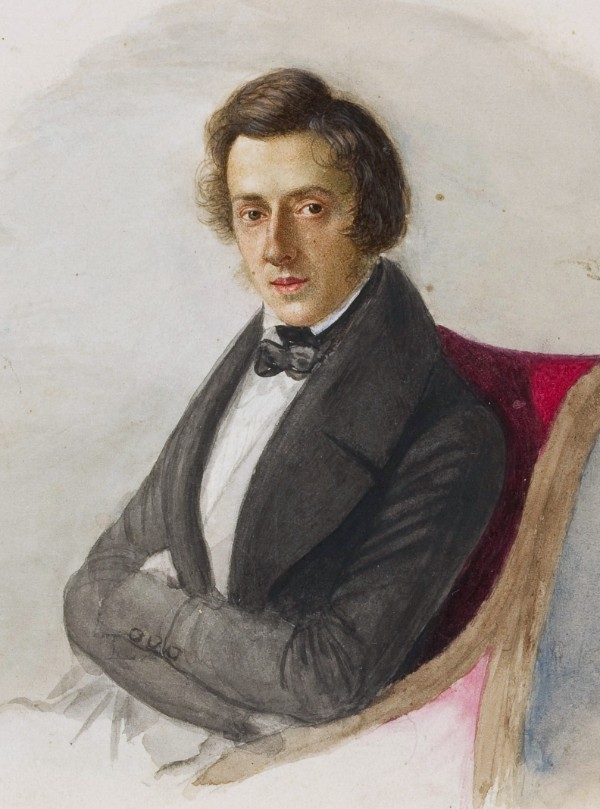
Maria Wodzińska: Frédéric Chopin, 1836 (Wasaw: National Museum)
Despite their brevity, these shortest preludes are far from fragmentary. They distill Chopin’s musical language and emotional impact into potent, concentrated forms.
Chopin composed his 24 Preludes, Op. 28, between 1835 and 1839. The name suggests that they’re meant to serve as introductions to other works, but they actually stand on their own as complete and emotionally affecting musical statements.
Today, we’re looking at seven of the shortest preludes from Chopin’s Op. 28 set, ordered from longest to shortest. We’ll also explore what makes each one distinctive despite – or in some cases, because of – its brevity.
Prelude in G-minor, Op. 28, No. 22
(44 seconds)
One of the most forceful miniatures in the cycle, this prelude wastes no time establishing its theatrical character.
Built from sharply articulated chords and brusque rhythmic gestures, it comes across as grandiose and orchestral, despite its compact length.
Chopin manages to suggest an entire concerto’s worth of drama and defiance in just a few phrases, proving how little material he needed to make a strong impression.
Prelude in A-major, Op. 28, No. 7
(41 seconds)
This prelude is among Chopin’s most deceptively simple works.
Its contemplative mood and lilting rhythm evoke the character of a mazurka, with wistful grace and a deeply ambiguous emotion.
Is this prelude happy? Sad? Somehow it sounds like both at the same time, especially under the hands of a great pianist.
It is astonishing how effective – and memorable – Chopin makes a few simple harmonies and a subtle rhythmic sway.
Prelude in C-major, Op. 28, No. 1
(39 seconds)
The opening prelude of the set is also one of its shortest.
It features cascades of notes rolling up and down the keyboard in breathless fashion, creating a sense of perpetual movement throughout its 39 seconds.
One gets the sense of someone telling an exciting story after having run up a flight of stairs.
Despite its speed and concision, the piece feels complete. It sets the tone for the entire collection, while also disappearing almost as soon as it arrives.
Prelude in B-major, Op. 28, No. 11
(38 seconds)
Lyrical, light, and understated, this prelude offers a moment of warmth amid the more dramatic entries of the set.
Its flowing melody and gentle accompaniment give it the character of one of Mendelssohn‘s Songs Without Words, works that were being composed around the same time. (Mendelssohn and Chopin were friends and colleagues.)
Chopin’s gift for melodic economy is especially evident here. The piece sings briefly, beautifully – then seems to vanish into a mist.
Prelude in E-flat-minor, Op. 28, No. 14
(33 seconds)
That warmth evaporates entirely in the E-flat-minor prelude, whose severity and immediate intensity are startling.
Among the starkest works Chopin ever wrote, this one begins by oozing up from the bass of the piano like lava.
Its tightly compressed drama makes it one of the most memorable miniatures in the set: a study in controlled tension and restraint that ends in an abrupt and distinctly unsettling way.
Prelude in D-major, Op. 28, No. 5
(32 seconds)
Brilliant and energetic, this prelude sparkles with virtuosic quicksilver motion and playful rhythmic turns.
These thirty seconds sound more like an étude than a traditional prelude.
Chopin compresses virtuosic flair into just a handful of bars, demonstrating how even his shortest works can demand all manner of precision, clarity, and finesse from the performer.
The prelude ends with two triumphant, satisfied chords.
Prelude in C-sharp-minor, Op. 28, No. 10
(28 seconds)
This prelude is over almost before it has begun: it is the shortest in the set.
Yet over these fleeting twenty-eight seconds, Chopin creates a striking contrast between the murmuring left hand and the expressive right-hand gestures above it.
It consists of four flurries of notes scurrying from the upper reaches of the keyboard down to the lower. Each flurry has its own unique colour and meaning.
Its brevity heightens its impact: the prelude feels like a sudden, intense thought — contemplated, stated, then vanished.
Conclusion
These seven preludes demonstrate how Chopin could compress his musical imagination into extraordinarily small spaces.
Remarkably, each one functions as a complete musical statement with its own atmosphere, character, and narrative.
Throughout his Op. 28, Chopin proves that a prelude doesn’t need to prepare the listener for anything else. It can simply arrive, speak with total authority, then disappear – and leave a complete emotional world behind.
For more of the best in classical music, sign up for our E-Newsletter