Spanish artist Salvador Dalí (1907–1989) took the art world of the 20th century and changed it forever. Starting with his studies of Impressionism, he progressed to Cubism and the avant-garde movements, creating worlds of new imagination.
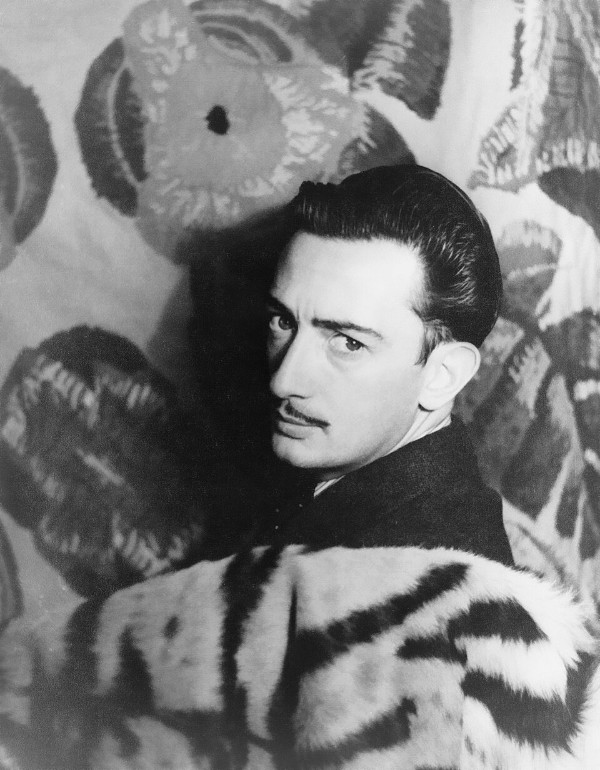
Carl van Vechten: Salvador Dalí, 1939 (Library of Congress: cph.3c16608)
His art may have been surreal, but it was backed by technical skill and precise craftsmanship. Although he started his work in the late 1920s, it wasn’t until 1940, when he moved to the US, that he started to achieve commercial success. It wasn’t until 1948, after the war, that he returned to Spain.
Name any field in the arts, and Dalí was there: painting, sculpture, film, graphic arts, animation, fashion, and photography saw his efforts. He also wrote fiction, poetry, essays, and criticism. In both art and writing, he saw himself as a subject, through self-portraits (the first in 1919) and autobiographies. Often, his ostentatious public behaviour was more famous than his artwork, such as when he took his anteater for a walk in Paris.
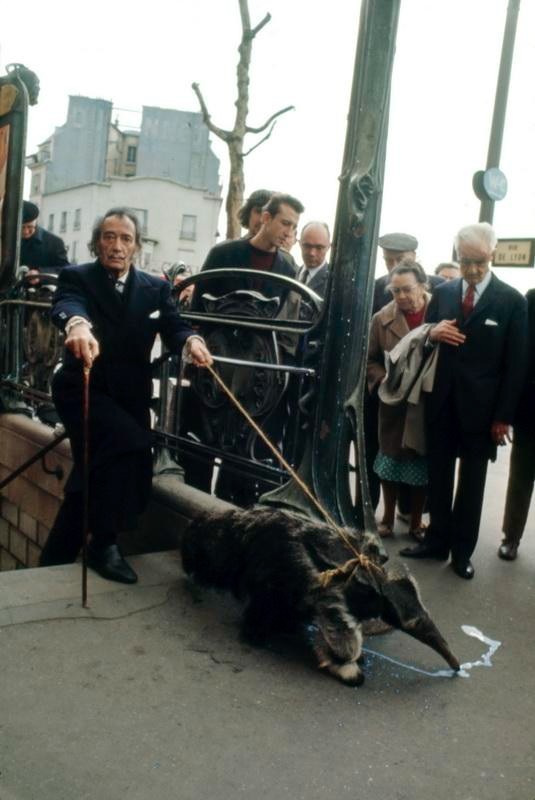
Dalí walks his anteater in Paris, 1969
He made his first trip to Paris in 1925, when he met one of his artistic heroes, Pablo Picasso. The Catalan painter Joan Miró had mentioned Picasso to him and introduced him to the idea of Surrealism. Even as Dalí developed his own style, he made visual reference to both Picasso and Miró in his work.
He grew his first moustache in the mid-1920s (as seen above), but later, his moustache grew to magnificent proportions, almost becoming an icon of the icon. Dalí referred to this version as his ‘very aggressive’ moustache.
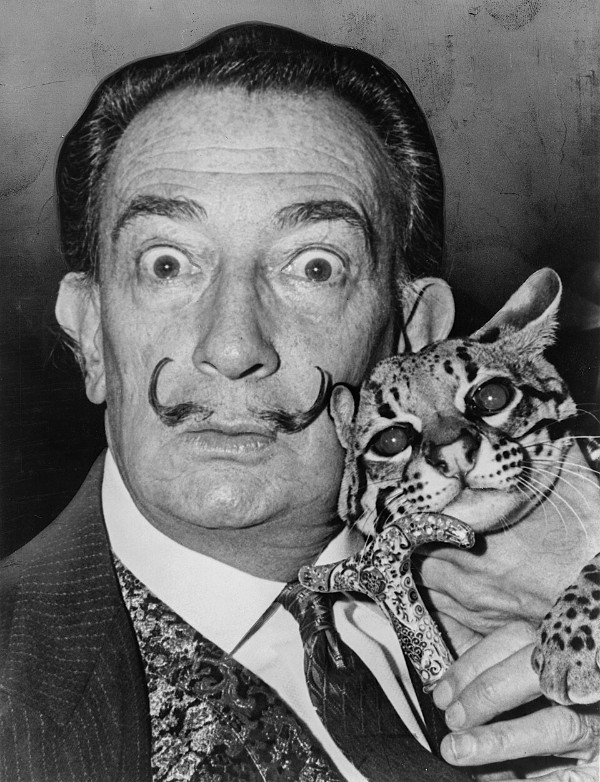
Roger Higgins: Salvador Dalí and his ocelot Babou, 1965 (Library of Congress: cph.3c14985)
His most famous work, The Persistence of Memory, was completed in 1931 but seems new for each generation. The melting watches get us to think about the rigidity of time and whether it’s real. Behind the focus on the watches, the landscape expands out to sea.
The image reverses reality: hard objects lie limply curved, ants are attracted to a metal watch case, and yet in the background are the very realistic cliffs from Dalí’s native Catalonia coast. The figure draped along the ground isn’t a horse but rather Dalí’s own face in profile, with his long eyelashes carefully presented.
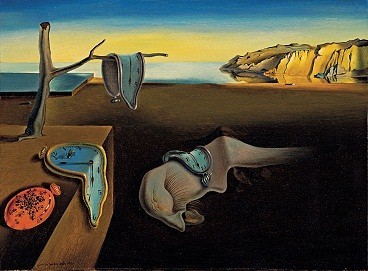
Dalí: The Persistence of Memory, 1931 (New York: Museum of Modern Art)
This painting, in turn, has inspired many different composers. Spanish composer Javi Lobe has woven a melancholic story in his piano piece.
Javi Lobe: The Persistence of Memory (Javi Lobe, piano)
English composer Richard Causton, on the other hand, uses the imagery of Dalí in combination with a memory of a strange sound phenomenon he encountered in India. Ill and confined to bed, he heard the sounds of the world around him but in a strange and altered timescape. Workers on the rooftops of factories around his room would strike the hours by banging on slats and pieces of metal. As the composer drifted in and out of wakefulness, time expanded and contracted – did 4 am really come before 2 am, or was that the fever bending time?
Richard Causton: The Persistence of Memory (Birmingham Contemporary Music Group, Ensemble; Gerry Cornelius, cond.)
Composer and pianist Jeffrey Jacob focuses on musical memory in his work, noting that it explores the impact of the past upon the present through the juxtaposition and combination of older and contemporary musical styles. Set in a haunted landscape that seems quite close to Dalí’s imagined setting, he alternated between the past and the present. Each movement starts us in a different world.
Jeffrey Jacob: The Persistence of Memory – I. — (Jeffrey Jacob, piano; Cleveland Chamber Symphony; Edwin London, cond.)
The second movement takes us through three different periods of musical time. We start with the percussive drive of Bartok, before wandering back in time to Schubert. The composer has taken an accompaniment pattern from a Schubert song and created a ‘misterioso’ piano sonority around it. Finally, we’re in the late 19th century, experimenting with Impressionism with a soaring melody. In each section, melody is the driving element.
Jeffrey Jacob: The Persistence of Memory – II. — (Jeffrey Jacob, piano; Cleveland Chamber Symphony; Edwin London, cond.)
That’s only one of the many paintings and works that Dalí created that were an inspiration for the composer. The database of Music based on Pictures (Musik nach Bildern) lists dozens of works based on Dalí’s images. Not many have been recorded, but it gives a view of how popular and inspirational his surrealism has been in the imagination of composers everywhere.
The Finnish composer Uljas Pulkkis (b.1975) put together three Dalí works in his 2002 work, Symphonic Dalí: Three paintings for orchestra. Dali’s 1954 painting The Colossus of Rhodes was behind the first movement. The Colossus of Rhodes was one of the seven wonders of the ancient world. The tallest statue of the ancient world was a statue 33 m (108 feet) high of the sun god Helios that stood in the city of Rhodes. Built in 280 BC, it collapsed in the earthquake of 226 BC; after the collapse, although parts of the statue were preserved, it was never rebuilt, and the final remains were destroyed in AD 653.
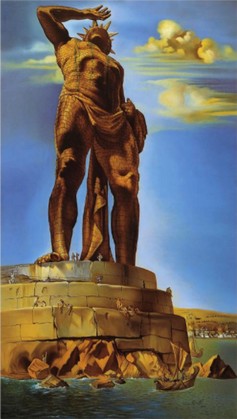
Dalí: The Colossus of Rhodes, 1954 (Bern: Kunstmuseum)
The second movement was inspired by Shades of Night Descending, from 1931. It seems to be set in the same landscape as The Persistence of Memory.
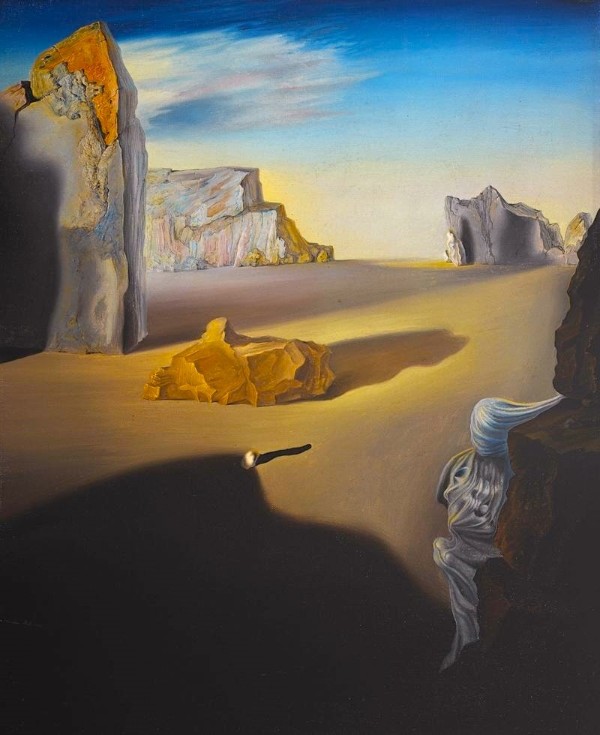
Dalí: Shades of Night Descending, 1931(St. Petersburg, FL Salvador Dali Museum)
The third movement, Dawn, is an explosion of colour, literally, because Dalí loaded a gun with snail shells filled with ink and fired them at his lithography stone.
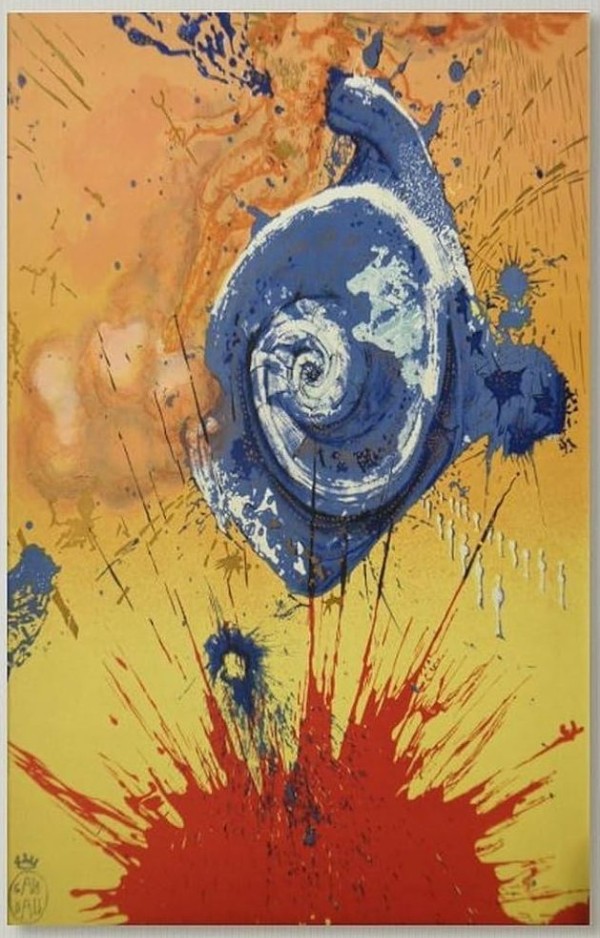
Dalí: Dawn from Pages Choisies de Don Quichotte de la Mancha, 1957
Uljas Pulkkis: Symphonic Dali: 3 Paintings for Orchestra – I. The Colossus of Rhodes (Stavanger Symphony Orchestra; Susanna Mälkki, cond.)
The Polish composer Joanna Bruzdowicz (b. 1943) made her own pictures at an exhibition, but based them on an exhibition of the works of Dalí. Her selection included many different styles of Dalí’s works, ranging from his early works of 1927 to 1970. She, of course, did a movement on The Persistence of Memory, but let’s look instead at his 1929 painting Portrait de Paul Élouard
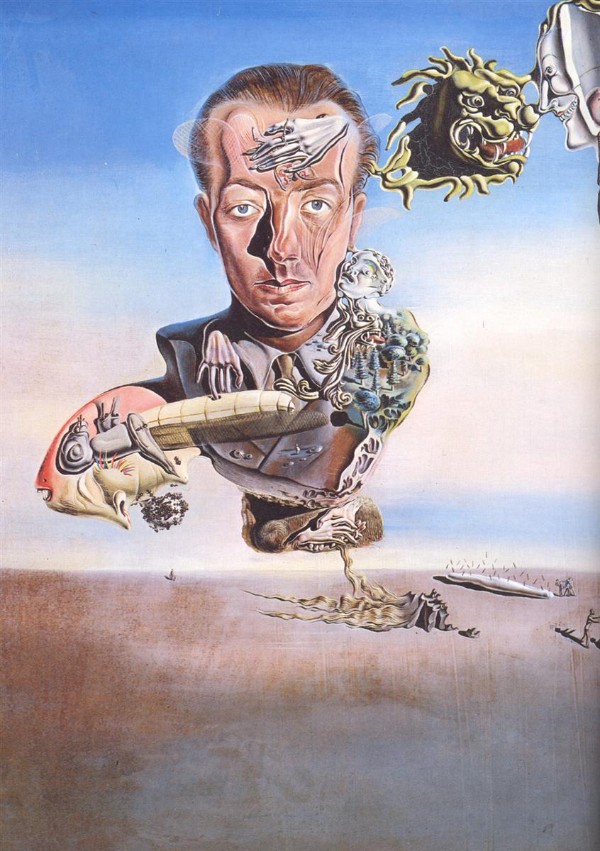
Portrait de Paul Élouard, 1929 (Figueres, Spain: Dalí Theatre and Museum)
This surrealist portrait of French surrealist poet Paul Éluard, who was married to Helena Diakonova, aka Gala, who left him in 1929 for Salvador Dali, marrying him in 1934. In the portrait, the poet is ‘dissected’ by the painter – the Zeppelin may indicate modernism as does the fact that everything in the painting is in the same plane. It’s a dreamscape with many different elements juxtaposed.
In her piano work, Bruzdowicz opens with a busy world, always in motion. A point of reflection quickly spins back everything into the movement of the opening section.
Joanna Bruzdowicz: Szesnaście obrazków z wystawy Salvadora Dali (16 Pictures from the Salvador Dalí Exhibition) (excerpts) – III. Portrait of Paul Eluard (Joanna Maklakiewicz, piano)
Spanish composer Cristóbal Halffter (b. 1930) created his work for chamber orchestra, Daliniana, on three Dalí paintings: Relojes blandos (Soft watches), El sueño (The Dream), and El nacimiento de las angustias líquidas (The birth of liquid anguish). Relojes blandos refers to the melting watches of The Persistence of Memory, while El sueño is another of the dreamscapes.
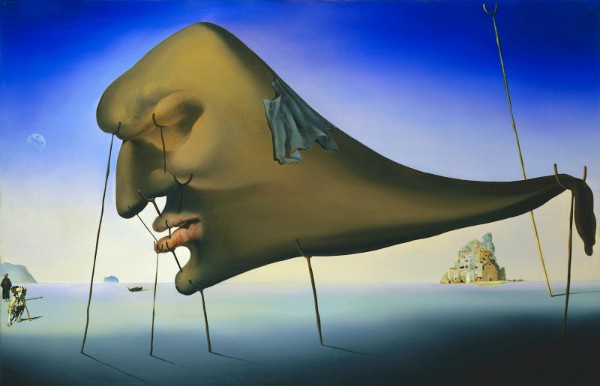
Dalí: El sueño
A pseudo-self-portrait set on fragile supports exists in a sleeping world (note the shadowy sky and the moon hanging on the left side). These are the kinds of poles used to support fruit trees when they’re heavily laden, and are a strong reference to the countryside. The massive head rests uneasily in space.
Halffter’s world seems equally fragile and disjointed.
Cristóbal Halffter: Daliniana – El sueno (Madrid Symphony Orchestra; Pedro Halffter-Caro, cond.)
The final work in the set is based on El nacimiento de las angustias líquidas, an image of instability and anxiety – a solid is converted to liquid, a common Dalí theme.
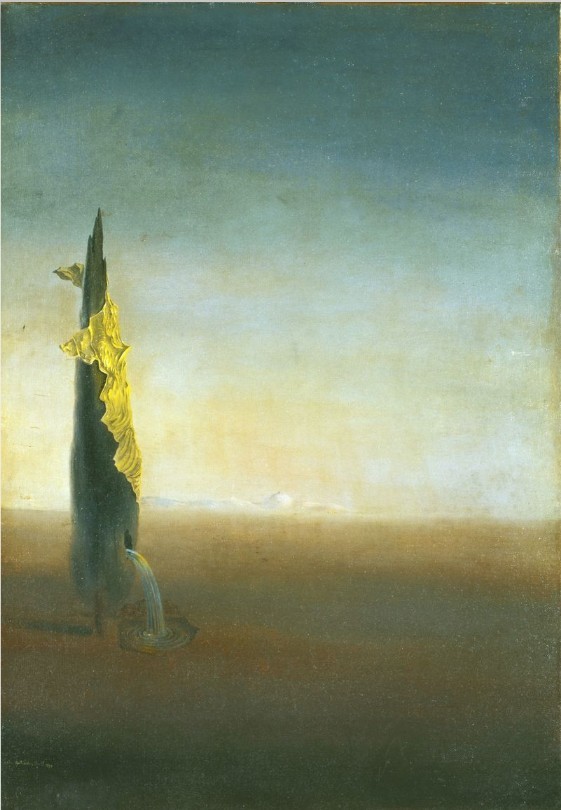
Dalí: El nacimiento de las angustias líquidas, 1932 (Figueres Fundació Gala-Salvador Dalí)
Dalí’s complex image Plaisirs illuminés (Illumined Pleasures) from 1929 is the basis for a double concerto for violin, cello, and chamber orchestra by Francesco Coll.
Created to illustrate the shooting script for Un chien andalou when it was published in the journal La Révolution surréaliste, the painting is filled with a number of shadow boxes representing the disjunctions between reality and illusion as experienced in a movie theatre. Note the two heads in the sky that also appeared in similar form in the Portrait de Paul Éluard. This collage of dreams and anxieties, both personal and universal, includes Dalí’s disembodied head in the middle box. Some very surrealist images are in each box: rows of bicyclists with lights on their heads, a hand with a bloodied knife, and an egg-like object in front of a church wall. And, at the back right, what might be another of those watches.
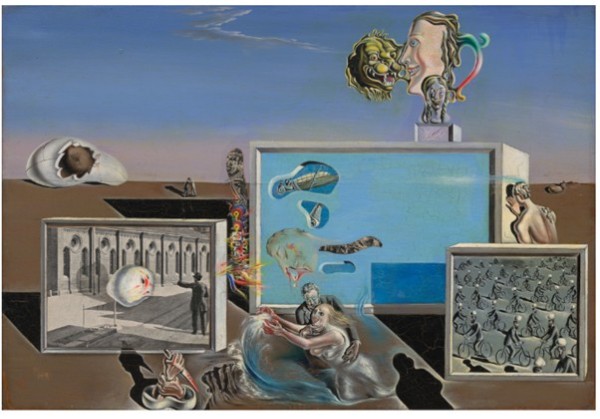
Dalí: Plaisirs illuminés (Illumined Pleasures), 1929 (New York: Museum of Modern Art)
Francesco Coll (b. 1985) studied trombone at the Joaquín Rodrigo Conservatoire of Music in Valencia and the Madrid Royal Conservatory, graduating with honours. He then went to the Guildhall School for a degree in composition, also achieving honours. His reputation is for pushing music to its extremes, and it is known for its surrealistic juxtapositions. It was as composer-in-residence with the Camerata Bern that he wrote Les Plaisirs Illuminés, a double concerto for violin, cello and chamber orchestra, for Patricia Kopatchinskaja and Sol Gabetta as soloists.
Francisco Coll: Les plaisirs illuminés – IV. Lamento – Epilog (Patricia Kopatchinskaja, violin; Sol Gabetta, cello; Camerata Bern, Ensemble; Francisco Coll, cond.)
Avant-garde French composer Igor Wakhévitch (b. 1948) worked with Dalí in 1974 on an ‘opera-poem’ entitled Être Dieu (To Be God), with a libretto by Spanish writer Manuel Vázquez Montalbán.
The music is a surrealistic mix of speaking voice, choral singing, and a little bit of everything in the world. The work, in 6 parts, ‘Dalí as God, Brigitte Bardot as an artichoke and Catherine the Great and Marilyn Monroe do a striptease’.
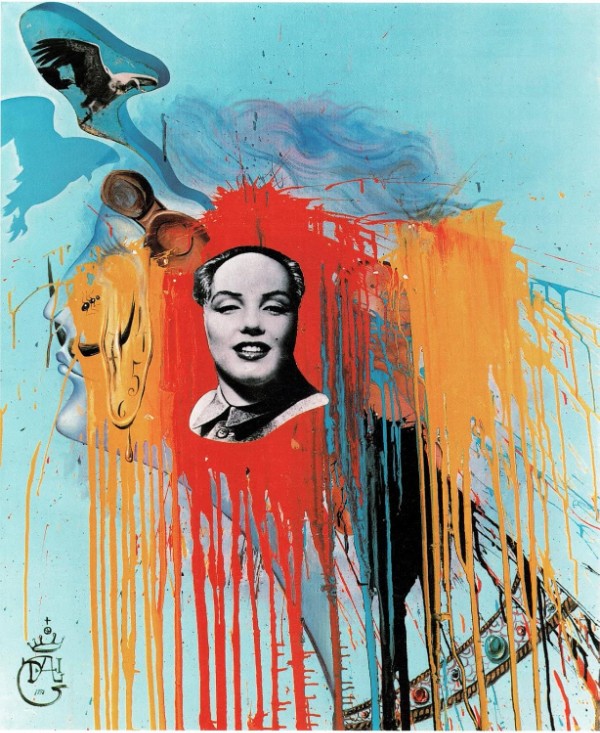
Dalí: Self-portrait, 1972
Dalí created a self-portrait, which was combined with ‘the famous “Mao-Marilyn” that Philippe Halsman created at Dalí’s wish’. Note Dalí’s signature in the bottom left, crowned, with an orb and cross, as if royalty…or God. In his self-portrait, his signature moustache is prominent.
Igor Wakhevitch et Salvador Dalí – Etre dieu (1974)
Dalí, of course, has the last word on his work in the world. Often viewed as a madman for his images, he calmly noted that ‘The difference between a madman and me is that I am not mad’.
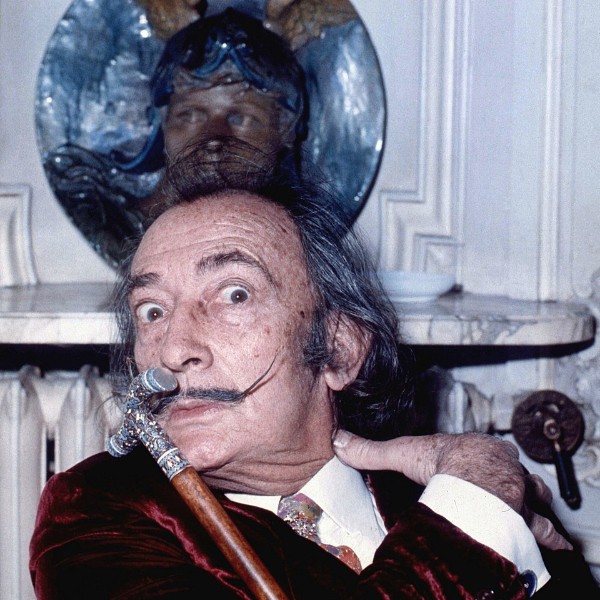
Allan Warren: Salvador Dalí, 1972
The excesses in his images, be it of liquid watches or giant figures from the past or even of himself, can only drive our own imaginations forward.
For more of the best in classical music, sign up for our E-Newsletter