Only the second woman in history to lead a major American orchestra, Nathalie Stutzmann is currently the Music Director of the Atlanta Symphony Orchestra. In fact, she has extended her tenure through the 2028-2029 season.
In addition, she will become the Artistic and Musical Director of the Orchestre Philharmonique de Monte-Carlo from the 2026-2027 season. Previously, she had been Principal Guest Conductor of the Philadelphia Orchestra, and she developed a close and ongoing connection with the Bayreuth Festival.

Nathalie Stutzmann © Daniele Ratti
For many music connoisseurs, Stutzmann is probably best known for her work as conductor and soloist in her own chamber orchestra, the disbanded Orfeo 55. For her birthday on 6 May, however, let’s revisit her career as an interpreter of German Lieder, specifically Schubert’s Winterreise, recorded with Inger Södergren in 2004.
Nathalie Stutzmann sings Bach: “Erbarme dich”
Despair and Resignation
The first twelve poems of Wilhelm Müller’s “Die Winterreise” appeared in print in 1823, and Schubert set them to music in February 1827. He subsequently discovered the full series of poems in an 1824 edition. Schubert’s original group of settings therefore closed with the dramatic cadence of “Irrlicht,” “Rast,” “Frühlingstraum,” and “Einsamkeit,” and his second sequence begins with “Die Post.”
Dramatically, the first half is the sequence from the leaving of the beloved’s house, and the second half depicts the torments of reawakening hope and the path to resignation. And it all concludes with the “Leiermann,” a disturbing picture of remoteness, often interpreted as a symbol of death or utter isolation.
The poems immediately present an image of utter alienation, portrayed in terms of real human emotions. These psychological states are viewed in existential terms, as the man is not only rejected by the girl but by the world as well. Instead of a dramatic curve, the “Winterreise” presents a succession of psychological states encompassing the whole gamut of emotions.
Franz Schubert: Winterreise, Op. 89, D. 911 – No. 1. Gute Nacht (Nathalie Stutzmann, alto; Inger Sodergren, piano)
Franz Schubert: Winterreise, Op. 89, D. 911 – No. 4. Erstarrung (Nathalie Stutzmann, alto; Inger Sodergren, piano)
Franz Schubert: Winterreise, Op. 89, D. 911 – No. 6. Wasserflut (Nathalie Stutzmann, alto; Inger Sodergren, piano)
Beyond Gender
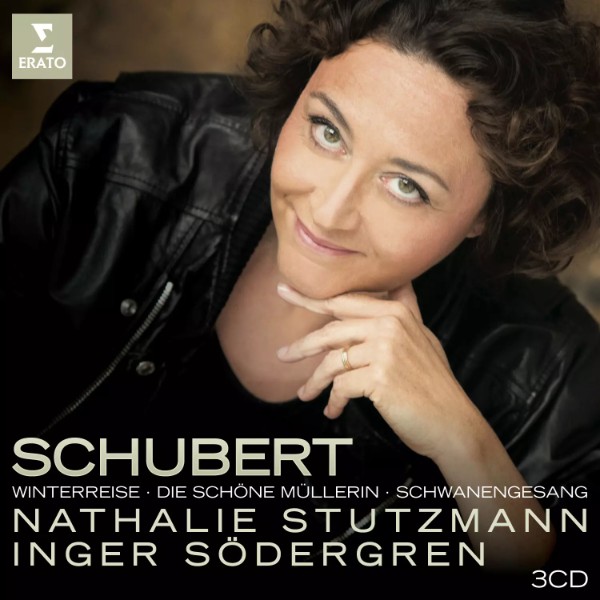
The speaking persona of the poetry is clearly male, yet it is not uncommon to hear the cycle performed by a woman. Recorded versions go back to Lotte Lehmann and include, among others, Christa Ludwig, Mitsuko Shirai, Alice Coote, Brigitte Fassbaender, and Joyce DiDonato.
Clearly, Winterreise deals with basic human insights, which are not gender-specific. When it is sung by male singers, the singing voice primarily operates in a space below the upper voice of the piano part.
Female voices, on the other hand, sing in the notated octave register, and thus in the same register as the piano part or above. In this sense, a completely different sonic relationship emerges.
Franz Schubert: Winterreise, Op. 89, D. 911 – No. 7. Auf dem Flusse (Nathalie Stutzmann, alto; Inger Sodergren, piano)
Franz Schubert: Winterreise, Op. 89, D. 911 – No. 11. Fruhlingstraum (Nathalie Stutzmann, alto; Inger Sodergren, piano)
Franz Schubert: Winterreise, Op. 89, D. 911 – No. 12. Einsamkeit (Nathalie Stutzmann, alto; Inger Sodergren, piano)
Psychology in the Lower Register
Nathalie Stutzmann, of course, is a true contralto with a deep and resonant lower register. After many years of contemplation, Stutzmann took on the cycle with her long-time pianist partner, Inger Södergren.
Stutzmann brings a powerful sense of narration and psychological engagement to the cycle, and every song is carefully fashioned. Yet, a number of lieder sound truly spontaneous and highly individual.
Her lower register is rich in colour, and she effectively uses it to illuminate individual phrases. However, as has been noted, she uses her voice in a decidedly postmodern and ultra-expressive way. Frequently stripped of vibrato and sliding to notes, the vocal effects occasionally distract from textual clarity.
Franz Schubert: Winterreise, Op. 89, D. 911 – No. 14. Der greise Kopf (Nathalie Stutzmann, alto; Inger Sodergren, piano)
Franz Schubert: Winterreise, Op. 89, D. 911 – No. 17. Im Dorfe (Nathalie Stutzmann, alto; Inger Sodergren, piano)
Divided Opinions
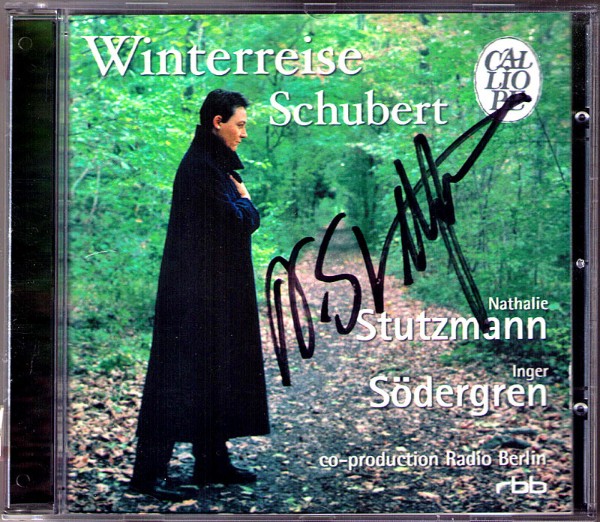
Seemingly, a great deal of mannerism renders the cycle rather slow and gloomy. Some lieder almost become studies in stasis, while others are taken briskly enough to compromise the articulation of the text.
Critical reaction was decidedly mixed, as commentators could not see a coherent narrative concept of the cycle as a whole. It is true that in song after song, we find a kind of predictably unpredictable manner that contributes to a structural instability.
Schubert’s masterpiece is capable of bearing many interpretative viewpoints. Stutzmann’s rendition might not always align with my preferred style of Schubert singing; however, it ensures that this glorious setting never becomes familiar or routine.
For more of the best in classical music, sign up for our E-Newsletter
Franz Schubert: Winterreise, Op. 89, D. 911 – No. 20. Der Wegweiser (Nathalie Stutzmann, alto; Inger Sodergren, piano)
Franz Schubert: Winterreise, Op. 89, D. 911 – No. 24. Der Leiermann (Nathalie Stutzmann, alto; Inger Sodergren, piano)