Felix Mendelssohn (1809–1847) and his older sister Fanny Mendelssohn Hensel (1805–1847) shared an extraordinary musical bond.
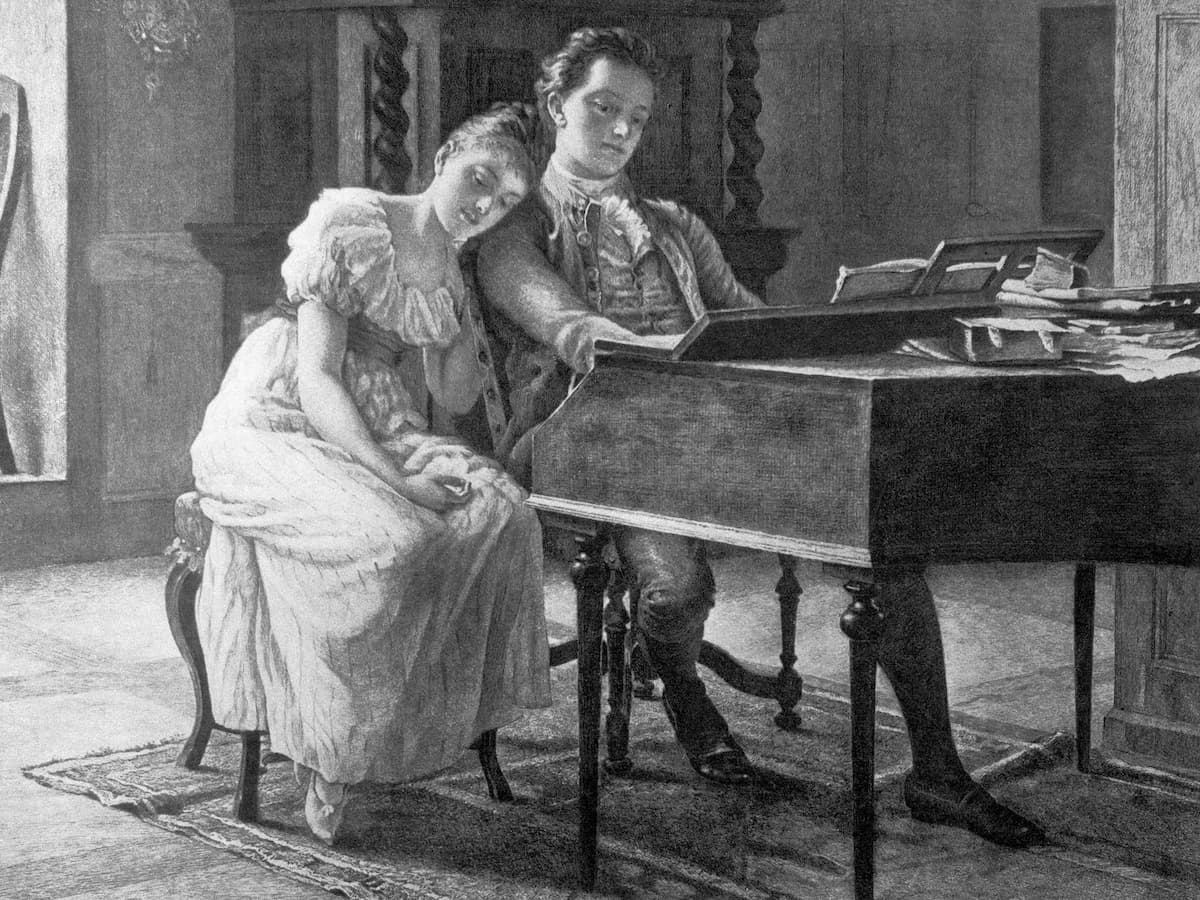
Fanny and Felix Mendelssohn © Bettmann/Corbis
Trained together in childhood by the same teachers, the two prodigies developed strikingly similar foundations.
As musicologist Angela Mace Christian told smithsonian.com in 2017, “They had all the same teachers as kids…so their styles actually merged. They knew each other’s work, note by note, before it ever hit paper.”
This closeness fostered a lifelong creative dialogue between the siblings, even as societal norms imposed very different public roles upon their music-making.
In 1820, when she was a teenager, their father infamously told Fanny, “Music will perhaps become his [Felix’s] profession, while for you it can and must be only an ornament.”
So, despite the fact that they were arguably equally gifted, while Felix enjoyed an internationally celebrated career, Fanny’s output of over 450 works remained largely unpublished in her lifetime.
If her work was played at all, it was almost always done within the context of the private sphere: in salons and family homes.
In spite of these gendered constraints, the Mendelssohns’ musical paths intertwined in fascinating ways.
This article explores five pairs of comparable works – spanning songs, piano sonatas, overtures, piano trios, and string quartets – to illuminate the biographical context and stylistic interplay between Felix and Fanny.
Felix and Fanny Mendelssohn – 12 Gesänge, Op. 8 (1824–1827)
Felix Mendelssohn: 12 Gesänge, Op. 8: No. 6. Fruhlingslied (Andrea Folan, soprano; Tom Beghin, fortepiano)
Felix Mendelssohn: 12 Gesänge, Op. 8: No. 10. Romanze (Andrea Folan, soprano; Tom Beghin, fortepiano)
This set of twelve songs was written between 1824 and 1827.
Fanny wrote the second, third, and twelfth songs in the collection (although she remained uncredited in the published version), while Felix wrote the rest.
Their compositional voices were deeply aligned in this collection.
Queen Victoria, a devoted amateur singer, loved these works. When Felix visited her during a British tour, they played some of his music together.
The Queen confessed that her favourite song of Felix’s was “Italien”…which was one of the three songs in the set that Fanny had written.
Fanny Mendelssohn: Italien
Fanny and Felix’s musical dialogue was so natural that nobody suspected Felix had a co-writer in this collection.
It wouldn’t be the last time one of Fanny’s works was mistaken for one of Felix’s.
Felix Mendelssohn – Piano Sonata No. 3 (1827)
Felix Mendelssohn: Piano Sonata in B-Flat Major, Op. 106, MWV U64 (Sontraud Speidel, piano)
In the late 1820s, both Mendelssohn siblings were experimenting with large-scale forms for solo piano.
Felix’s Piano Sonata No. 3 in B-flat-major (published posthumously as his Op. 106) was completed on 31 May 1827, when he was only 18.
It was the last of his three published piano sonatas. He dedicated it to Carl Friedrich Zelter, the music teacher who had taught both him and Fanny.
We wrote about Felix Mendelssohn’s overlooked piano sonatas and why more people should listen to them here.
Fanny Mendelssohn-Hensel – Easter Sonata (1829)
Shortly after Felix wrote his third piano sonata, Fanny became inspired to write her own solo piano sonata. She was between 22 and 23 years old at the time.
She came out with a daringly structured, quasi-programmatic work that portrayed the death and resurrection of Christ.
Interestingly, the second movement contains a fugue, which suggests that Bach’s famous keyboard fugues were likely on her mind at the time.
There were multiple generations of Johann Sebastian Bach fans in her family, and her brother had just given the first “modern” performance of the St. Matthew Passion that March. In fact, Fanny sang alto in the 158-voice chorus under her brother’s direction!
In the finale, she includes a fantasy on the Lutheran chorale tune “Christe, du Lamm Gottes” (“Christ, thou Lamb of God”).
The manuscript of this strikingly original work was signed “F. Mendelssohn” and forgotten for decades. It was rediscovered in 1970 and attributed to Felix.
Astonishingly, it was only in 2010 that Fanny’s work was finally attributed correctly to her.
Felix Mendelssohn – The Hebrides Overture (1830)
Interestingly, both Mendelssohns tried their hand at standalone orchestral overtures in the early 1830s.
Felix’s famous concert overture The Hebrides, Op. 26 (also known as Fingal’s Cave), was inspired by his 1829 tour of Scotland. (Fanny, being a woman, was not permitted to go on the same Grand Tour that Felix was.)

Entrance to Fingal’s Cave, 2004
Even as adults who were geographically far apart, Felix kept Fanny involved in his creative process. He wrote to her from the island of Staffa, enclosing the opening theme of the overture in a letter.
“In order to make you understand how extraordinarily the Hebrides affected me, I send you the following, which came into my head there,” he told her.
Fanny Mendelssohn-Hensel – Overture in C-major (ca. 1830–1832)
Shortly afterwards, Fanny composed what would be her only purely orchestral work, the Overture in C major (c.1830–32).
Women of the era didn’t often write for orchestra not because they weren’t capable, but because it was so difficult for women to get their orchestral works performed.
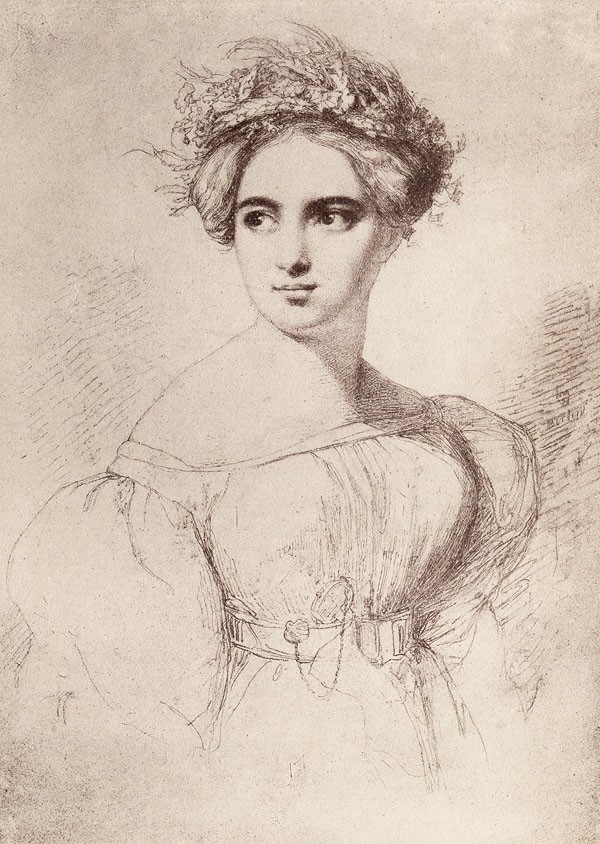
Fanny Mendelssohn-Hensel
Fanny likely wrote it for her Sunday musical gatherings in Berlin, where she had an amateur orchestra of talented friends at her disposal. She conducted the overture herself at its debut in 1832.
Her overture doesn’t have any kind of programmatic element attached to it as her brother’s does, but it is deeply engaging and thrilling nonetheless.
Felix Mendelssohn – Piano Trio No. 2 (1845)
In the mid-1840s, Felix and Fanny each produced a piano trio that would become a cornerstone of their chamber music output.
Felix’s Piano Trio No. 2 in C-minor, Op. 66 was completed in 1845, six years after his popular first piano trio.
The finale has a religious element to it. Partway through the agitated finale, Felix introduces the Lutheran chorale “Gelobet seist du, Jesu Christ” (“Praise be to You, Jesus Christ”) – first softly, then in a powerful fortissimo near the end.
Of course, this calls to mind Fanny’s youthful experimentation with incorporating a Lutheran chorale tune in her 1829 Easter Sonata.
The fact that the siblings both did this in different works in different ways is a reminder of the religious background they shared after they were baptised into the Lutheran faith in 1816, at the ages of eleven and seven.
Fanny Mendelssohn-Hensel – Piano Trio (1846–1847)
Fanny Mendelssohn-Hensel: Piano Trio in D Minor, Op. 11 (Atlantis Trio, Ensemble)
Fanny’s Piano Trio in D-minor, Op. 11 was composed slightly after Felix’s, between 1846 and early 1847.
It was written as a birthday present for her and Felix’s younger sister Rebecka, underlining how her compositional efforts were often tied to family members and intimate settings.
Tragically, it became one of her last works. Fanny died of a stroke in May 1847, shortly after finishing the trio. The night she died, she was conducting a choral rehearsal of one of her brother’s works.
The context of this trio is frustrating and heartbreaking in equal measure. In 1846, at age 41, after years of being pressured to treat her talent as a mere ornament, she had begun to defy her family’s reservations and sought to have her music published. (It took Felix a while to agree, and he didn’t do so very enthusiastically.)
Who knows what else she would have written, had she had the chance to publish her work, receive feedback and hear more performances of it?
Felix felt the loss of his sister acutely. In a letter written shortly after her death, he lamented: “I could never experience any happiness without thinking how she would share it… Never in all the world will I become inured to it.”
Felix Mendelssohn – String Quartet No. 6 (1847)
Felix was so distressed by Fanny’s death that he became ill himself. Shockingly, just a few months later, he died of a stroke, just as she had.
A couple of months before her death, he tried to make sense of his grief by composing a chamber music work he subtitled “Requiem for Fanny.” The result was his sixth string quartet.
This is widely considered to be one of Felix’s most outwardly emotional works. The despair and disbelief are palpable.
Fanny Mendelssohn-Hensel – String Quartet in E-flat-major (1834)
Fanny had also written a string quartet: one in E-flat-major, fourteen years earlier, in 1834.
For whatever reason, she was feeling adventurous while writing this quartet. One noteworthy trait about it is that the order of movements goes slow, fast, slow, fast. She also played with harmony in the opening, waiting a full sixty bars before arriving in E-flat-major.
Felix criticised the latter choice. She started to doubt herself, too.
She wrote back to him:
“It’s not so much a certain way of composing that is lacking as it is a certain approach to life, and as a result of this shortcoming, my lengthy things die in their youth of decrepitude; I lack the ability to sustain ideas properly and give them the needed consistency. Therefore, lieder suit me best, in which, if need be, merely a pretty idea without much potential for development can suffice.”
She didn’t write another large-scale work until her piano trio, fourteen years later.
Conclusion
Across songs, sonatas, overtures, trios, and quartets, Felix and Fanny Mendelssohn’s intertwined musical lives reveal a creative partnership unlike any other in classical music history.
Though Fanny’s opportunities were limited by the societal expectations of her time, her voice was every bit as valuable as her brother’s.
Studying their works in parallel reveals how deeply the two siblings influenced one another. Their fascinating exchange of ideas, critiques, emotions, and more reveals a lifelong artistic conversation that blurred boundaries between influence and collaboration.
Classical music lovers, by listening and loving their works, are still taking part in that conversation today. The Mendelssohn siblings’ legacy should rightly be remembered as a shared one.
For more of the best in classical music, sign up for our E-Newsletter