Songs from a Circle – Video Trailer
Songs from a Circle, a ritualistic drama for one, is a composition by Onur Türkmen for vocalist-violinist Diamanda La Berge Dramm. Recently released by Diatribe Records as part of the Diatribe Stage celebrations at New Music Dublin 2026, Songs from a Circle is a multivalent creation wherein stage lighting, physical gesture, speech, and poetry are as integral as musical figuration. In performing Türkmen’s earlier work Sailing to Byzantium, La Berge Dramm noticed a concordance between her interest in using voice and violin as a dyad and Türkmen’s ongoing compositional practice. She requested that he write for her, expecting a work that expanded her practice and “fit like a glove,” in her own words. The result, Songs from a Circle, surpassed all possible expectations, and La Berge Dramm found joy and renewed meaning in each of the sixteen times she performed it in January 2018 across multiple venues.
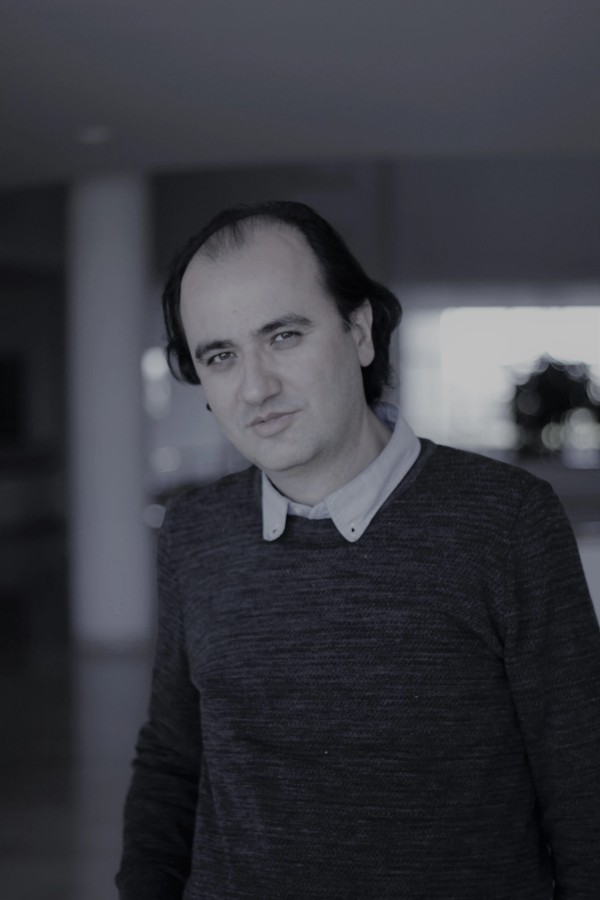
Onur Türkmen © onurturkmencomposer.com
It is stated explicitly in the album’s accompanying booklet that La Berge Dramm does not inhabit a character on stage. She appears as herself to confront each time anew what Türkmen calls the “overtones of Melancholy,” allowing the work and its central ideas to be forever re-made and re-negotiated in performance. Nonetheless, as the music starts, we are transported to a shiveringly otherworldly place. La Berge Dramm summons us into her strange realm, speaking in a tone of utmost translucent clarity: “The heart is revived without you; so it is time you come back.” For the duration of the piece, La Berge Dramm becomes a kind of ancient and immortal guide through textual meditations spanning centuries and cultural faultlines. She inhabits, with equal conviction and intensity, poetry by 14th-century Persian lyric poet Hafez, Shakespeare, Percy Shelley, and Türkmen himself (with inspirations from the 4th-century ‘Jiu Ge’ by Qu Yuan). Türkmen’s use of high-contrast stage lighting and his gravitation towards ethereal sounds and extended technique in the violin only serve to strengthen this impression of La Berge Dramm as an apparition. This does nothing, however, to undermine the humanity of the work, or the depth of its engagement with felt experience of melancholy – this is still music of introspection and guttural emotion.
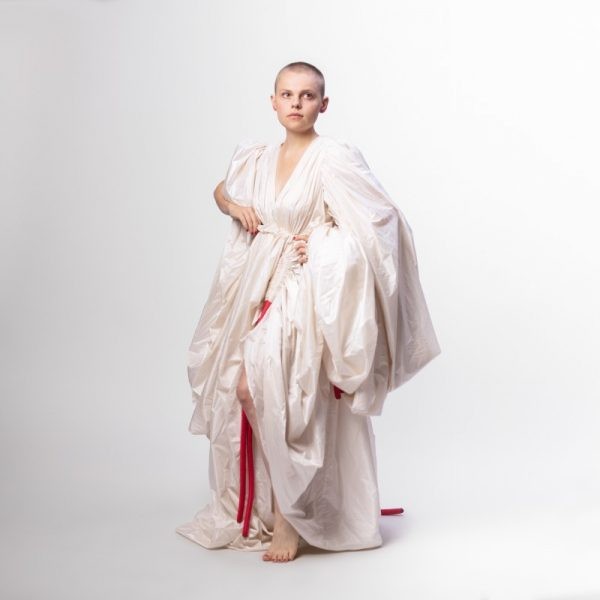
Diamanda La Berge Dramm © Juri Hiensch
The dynamic that unfolds between the violin and La Berge Dramm’s voice is unusual. The stable relationship between an accompanying, subordinate instrument and a foregrounded solo part has been challenged, subverted, and deconstructed heavily in new music in a tradition that arguably stretches back to the Lieder of Schubert. Diatribe describe the work as a space where “voice and instrument coexist as equal agents of expression… the violin is not accompaniment, nor is the voice narrative.” The violin sound profile strikes me as animalistic and creature-like, with scurrying lines, flared crescendi, and sinuous moves from harmonics to overpressure, creating freneticism and urgency. Amid all this, the voice progresses in a more stately way: the lines are spoken, snarled, whispered, droned, sung in drooping glissandi, and occasionally pitched forth in long, clear tones. A particularly lovely moment comes in the setting of Shakespeare’s Sonnet 33, when La Berge Dramm’s perilously mid-air suspended pitch on “now” is taken and finished in a gestural flourish by the violin, functioning as a single organism.
Also of particular effectiveness are La Berge Dramm’s trancelike, low-voiced declamations and whispers of the words to little or no violin sound. Türkmen uses this effect throughout. In other places, the sound profile is pleasantly folky, multi-string pizzicato, creating a rhythmic background for brief snatches of more traditionally melodic-contoured delivery. In the deeply visual and movement-filled song ‘The Purple Flower,’ the violin functions like violent punctuation, ricocheting and building up scratchy tremolo between and with the voice’s nasal hums and quick upward shrieks. A powerful moment comes in the middle of the line “I… can’t see my home,” where we hear the glottal stops and gasps of pain that cannot be articulated.
After the very changeable material of the first three songs, the continuous arpeggiation in the violin in ‘The Sea and Darkness’ creates a welcome sense of forward motion. This arpeggiation is constantly mediated by harmonics, sul ponticello, and unpredictable dynamic swells and fades, a treatment of strings that calls to mind Saariaho. We return to unpredictability in the first song of the third movement, where I read a kind of word-painting or illustration in both violin and voice. To bring to life the lines “The everlasting universe of things / Flows through the mind, and rolls its rapid waves,” we have wailing, vibrato double stops punctuated by short marcato gestures, the voice rising in insistent, sarcastic complaint. The effect created is a sense of physicality – “thingness” – and a sense of unmitigated, chaotic “flow.” It is here where we see the new dimensionality afforded by mutating this poetry into voice and instrument, as this immortal line takes on a delightful shrillness and clutter, renewing the groundbreaking sentiment behind the veneer of distancing elegance afforded by history and canon. The vocal part of the song ends with an accusatory shriek of the question “Who shall put forth on thee, / Unfathomable Sea?”
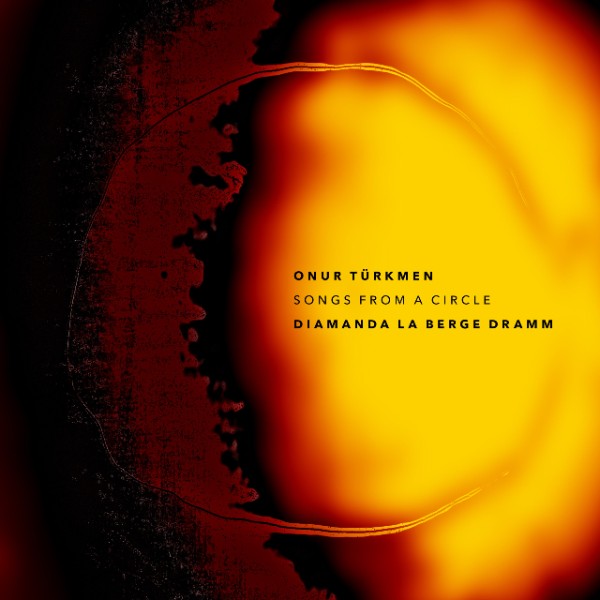
The CD booklet accompanying the release, with designs by Max Franosch, is beautifully presented, swimming with terracotta, burgundies, and inky blacks. Alongside the texts are fascinating snapshots of the score, where lighting cues appear alongside musical directions like “durations to be determined according to the phenomenology of dynamic changes.” In sum, this release is a testament to the fact that Diatribe Records maintains its ongoing commitment to championing and making available the most intriguing and powerful new music.
The best image I can summon to communicate my experience of Songs from a Circle is thus: we are allowed a momentary glimpse into the twilit desert rose garden of the gods and shades. The goddess Melancholy exists here, eternal and privy to all the poetry and thought of human creation. She whispers, speaks, croons, and sings, exploring her internality in an endless ritual…
For more of the best in classical music, sign up for our E-Newsletter