Polish composer Paul Caro (1859–1914) came from a background in the metals industry: his grandfather had started an iron and wool trading company, his father was the founder of the Hermina ironworks, he and his two brothers worked in the business. Another brother worked as a lawyer and writer in Vienna. Paul was the sole musician in the family.
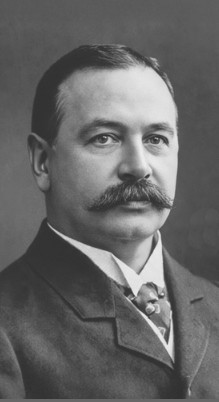
Paul Caro
He was born in Wrocław, which had an active music culture on both the concert and theatrical stages in the 19th century. The Singing Academy opened in 1925, the Municipal Theatre opened in 1841, and in 1862, the first orchestra, the Wrocław Orchestral Association, was founded by Leopold Damrosch. The Concert House was established in 1878, which gave the orchestra a permanent home. Brahms conducted the opening concert at the new house. The regular director was conductor and composer Bernhard Scholz, who became Caro’s music teacher.
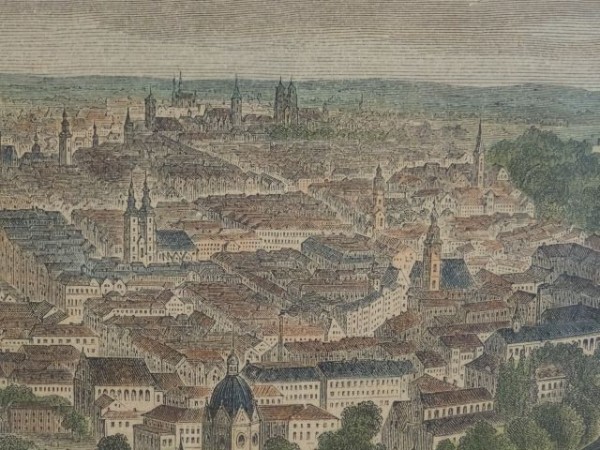
Wrocław in 1880
Scholz was probably behind the move of Paul to Vienna in 1880, where he studied at the Konservatorium der Gesellschaft der Musikfreunde. Bruckner became his composition teacher, and many of Caro’s early compositions were found in Bruckner’s collection, given to him by his grateful student.
Paul returned to Wrocław in 1893, and from 1899 onwards, he was in the city directories as a composer. He married the Viennese soprano Ottilie Böhm, with whom he had 3 children. He joined his two brothers as co-owner of the family metallurgical company. The family wealth meant that he could do his music out of the public eye – he didn’t need to stage concerts or festivals – and so he worked privately for his own interests.
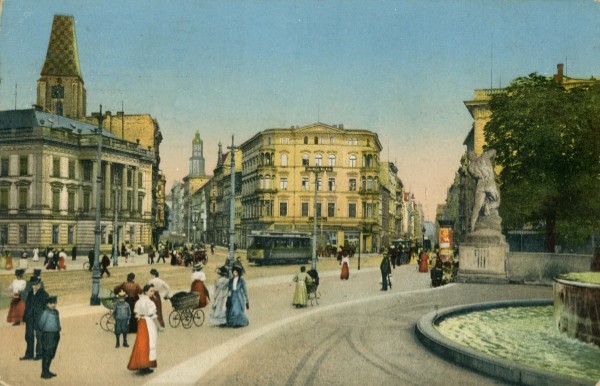
Wrocław ca 1910
Much of his music is held in the Austrian National Library in the form of around sixty musical manuscripts of operas, symphonies, and symphonic poems. His smaller works were published by publishers in Vienna, paid for by Paul. We can see his disregard for the budgeting problems of opera when we consider that his first opera had 113 performers and his second opera had over 120 performers.
What Caro took from his studies with Bruckner are ‘transparent form, musical language rooted in expansive major-minor tonality, and clear melodic narrative’. The influences of other contemporary composers such as Reger, Brahms, and Grieg are also present.
He wrote two string quintets, which are preserved in manuscript only. The String Quintet in F major was written in 1893, the year he left Vienna to return to Wrocław.
The first movement is in standard sonata-allegro form, with a wandering, pleasant first theme.
Paul Caro: String Quintet in F Major – I. Allegro moderato (Joanna Kasperczyk-Adamek, violin; Aleksandra Maria Steczkowska, violin; Zuzanna Dröws, viola; Weronika Strugała, cello; Jan Kalinowski, cello)
The drama picks up in the second movement, Adagio, with pizzicato in the violins to contrast with the more mellow middle melody.
Paul Caro: String Quintet in F Major – II. Adagio (Joanna Kasperczyk-Adamek, violin; Aleksandra Maria Steczkowska, violin; Zuzanna Dröws, viola; Weronika Strugała, cello; Jan Kalinowski, cello)
The cellos come to the fore in the Scherzo, leading a merry dance for all instruments. The Trio changes character completely to a much more melodic section.
Paul Caro: String Quintet in F Major – III. Scherzo: Prestissimo – Trio: Meno mosso – Allegro moderato, sempre con sentimento (Joanna Kasperczyk-Adamek, violin; Aleksandra Maria Steczkowska, violin; Zuzanna Dröws, viola; Weronika Strugała, cello; Jan Kalinowski, cello)
The Finale isn’t the up-tempo Allegro we’re expecting, but opens with a rather meditative Andante religioso Introduction. The following Allegro vivace remains quiet and melodic to the end.
Paul Caro: String Quintet in F Major – IV. Finale: Introduction: Andante religioso – Allegro vivace (pastorale) (Joanna Kasperczyk-Adamek, violin; Aleksandra Maria Steczkowska, violin; Zuzanna Dröws, viola; Weronika Strugała, cello; Jan Kalinowski, cello)
Twelve years later, in 1905, Caro wrote his second String Quintet, now in the more dramatic key of E minor. We can hear his decade of improvement as a composer, both in his choice of key and the dramatic elements that he infuses in the first movement.
Paul Caro: String Quintet in E Minor – I. Allegro non troppo (Joanna Kasperczyk-Adamek, violin; Aleksandra Maria Steczkowska, violin; Zuzanna Dröws, viola; Weronika Strugała, cello; Jan Kalinowski, cello)
The second movement, Adagio, again with highlighting pizzicatos at the beginning, continues the melodic ideas of the first movement.
Paul Caro: String Quintet in E Minor – II. Adagio (Joanna Kasperczyk-Adamek, violin; Aleksandra Maria Steczkowska, violin; Zuzanna Dröws, viola; Weronika Strugała, cello; Jan Kalinowski, cello)
The Scherzo is now much more active than it was in his earlier work. The jumpy, short rhythms do much to propel the whole work forward, if in perhaps jumpy steps. The contrasting trio seems to bring us to a kind of folk dance idea.
Paul Caro: String Quintet in E Minor – III. Presto: Scherzo (Joanna Kasperczyk-Adamek, violin; Aleksandra Maria Steczkowska, violin; Zuzanna Dröws, viola; Weronika Strugała, cello; Jan Kalinowski, cello)
Picking up on the gypsy theme idea that prevailed in so much music of the late-19th and early-20th centuries, Caro closes with an Allegro vivace alla Zingarese.
Paul Caro: String Quintet in E Minor – IV. Allegro vivace alla Zingarese (Joanna Kasperczyk-Adamek, violin; Aleksandra Maria Steczkowska, violin; Zuzanna Dröws, viola; Weronika Strugała, cello; Jan Kalinowski, cello)
These were the only two string quintets Caro wrote and they were never published. The manuscripts are in the Austrian National Library. As a semi-professional composer with an independent income, Caro never had the need to sell his music to support himself. The downside of this is that his music exists in a quiet backwater – proficient and of quality, but never in the public eye.
In an interesting way, composers such as Paul Caro provide us with an alternative aspect of music-making in the 19th century. Caro’s non-public existence was echoed by a number of women composers at the same time: training at the highest level until marriage, when social norms forced a cessation of their public personas. Caro could write at a top standard, but without performances and publications (he largely only funded the publication of his piano music), he remained outside the common musical circles of the day.
In looking at these two string quintets, we also have the opportunity to see how a composer continues to develop and hone his craft, developing more dramatic and interesting ways of creating a string quintet. His Neo-Romantic style fits the needs of the string quintet as a performance medium.
In the 19th century, Wrocław had a new musical culture and the buildings to support it, but Caro stayed out of the limelight and produced music that has remained largely unheard from his day until now.
For more of the best in classical music, sign up for our E-Newsletter