Viktoria Mullova’s recordings of Johann Sebastian Bach’s Six Solo Sonatas and Partitas for violin occupy a special place in the discography of Baroque violin performance. Her 2009 Onyx recording, in particular, is widely regarded as a modern benchmark.
This isn’t simply a question of technical mastery, but an attempt to feature stylistic insight and personal transformation.
To celebrate Mullova’s birthday on 27 November 1959, let’s explore her approach in terms of tone production, articulation, freedom of line, and historically informed bowing.
Viktoria Mullova performs Bach: Partita for Violin No. 2, BWV 1004 “Chaconne”
A Journey to Stylistic Freedom
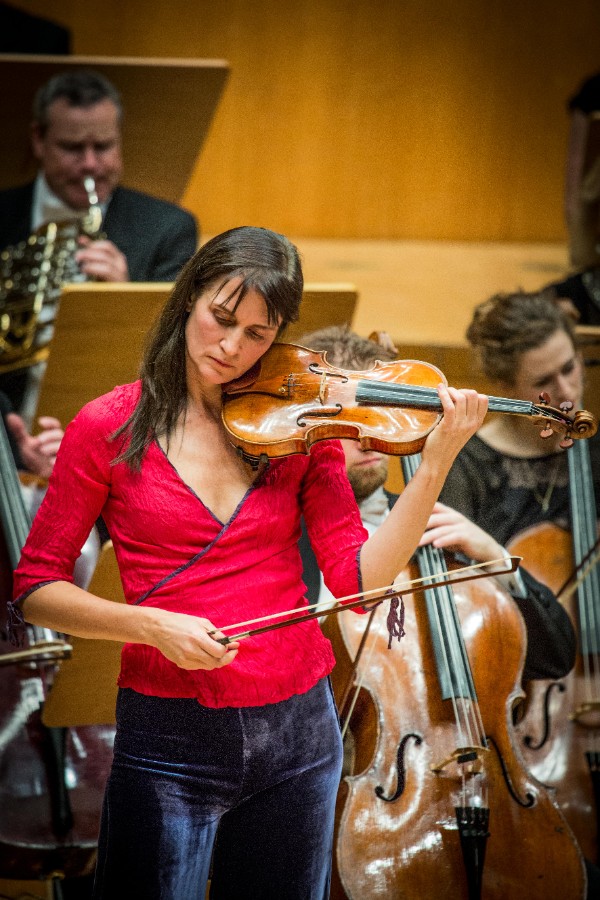
Viktoria Mullova
Mullova’s journey toward her seminal Bach interpretations was not immediate, as she began her career primarily on modern instruments, trained in the rigorous Soviet conservatory tradition.
She reflected on her earlier conservatory training, stating, “we were taught to use standardised, beautiful sound, broad, uniform articulation, long phrasing and continuous and regular vibrato on every single note.”
This approach, according to Mullova, “made Bach feel stiff and monotonous. I didn’t understand the harmonic relationships, which are fundamental to a feeling of freedom.”
This self-awareness drove her to explore Baroque technique more deeply. She started to embrace gut strings, lower tuning, and a Walter Barbiero Baroque bow. This was part of a genuine stylistic reorientation, as she was no longer just interpreting Bach, but started to inhabit his musical world.
Johann Sebastian Bach: Violin Partita No. 1 in B Minor, BWV 1002 (Viktoria Mullova, violin)
Authentic Sound, Contemporary Spirit
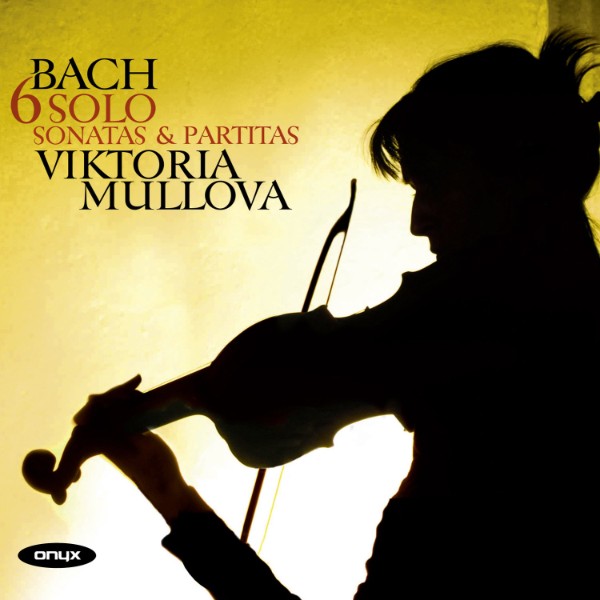
One of the most immediately striking features of Mullova’s 2009 recording is the purity and clarity of her tone. The use of gut strings and lower tuning results in a warmer, more resonant sound than modern steel strings tuned to A=440.
Yet, Mullova combines this with a modern expressive sensibility. As one reviewer puts it, she sustains “an impeccably punctuated, modulated and compelling dialogue through Bach’s counterpoint with seemingly effortless intimacy and charm.”
On her Onyx disc, the Guadagnini’s voice is singing and alive, but not sentimental. MusicWeb-International notes her “rather aggressive rhythmic dotting… enjoying the hard edges that Bach offers,” but balances it with tenderness in slower movements.”
This duality, fusing authentic instrument sound with an emotionally present interpretation, is central to why her recordings resonate. She neither sacrifices Baroque authenticity for modern polish nor reduces the work to an academic exercise.
Johann Sebastian Bach: Violin Sonata No. 1 in G Minor, BWV 1001 (Viktoria Mullova, violin)
Voices in Dialogue
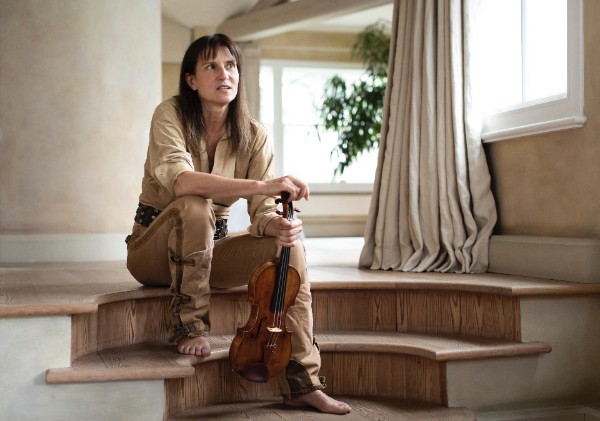
Viktoria Mullova
Bach’s solo sonatas and partitas are intensely contrapuntal works. To make their voices intelligible, a violinist must articulate in such a way that each line remains clear, yet the whole remains cohesive.
In live performance, critics have praised Mullova for precisely this. In a concert review from Freiburg, Bachtrack’s Nicholas Reed wrote that Mullova “presented each individual voice… with clarity… some phrases appearing to come from a far-distant plain, others astonishingly forthright and present.”
In recording, her articulation remains equally masterful. She draws out the baroque dance characters through “hard edges, rhythmic vitality, and deft double stops.” The way she shapes each phrase, balancing detachment and legato, and demarcating fugal entries without heavy dramatisation, gives the music both structure and flow.
Johann Sebastian Bach: Violin Sonata No. 2 in A Minor, BWV 1003 (Viktoria Mullova, violin)
Musical Architecture in Motion
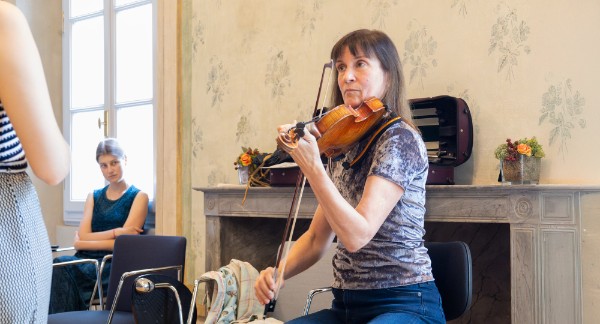
Viktoria Mullova
Mullova’s interpretation is not rigidly bound to a metronomic beat or to an overly scholarly reading. Instead, she allows freedom of line, flexible rubato, and expressive nuance. Critics highlight her “spontaneous sense of freedom,” and Mullova emphasises that understanding the harmonic relationship in Bach is essential for truly expressive performance.
Her rhythmic choices are not arbitrary as she uses subtle tempo variances, phrasing decisions, and rhythmic shaping to bring out the architecture of each movement without distorting its integrity.
Mullova carefully balances measured rubato with forward motion in an approach that treats the music as a living argument, not a static monument.
Johann Sebastian Bach: Violin Partita No. 3 in E Major, BWV 1006 (Viktoria Mullova, violin)
Entering Bach’s World
Using a Baroque bow is more than a change of equipment as it profoundly affects phrasing, articulation, and sound. Her Walter Barbiero Baroque bow allows her to produce lighter, more articulated strokes than what is typical with modern Tourte-style bows.
Yet, Mullova doesn’t strive to be obsessively authentic as she exploits phrases in a way that is both historically sensitive and emotionally compelling.
Mullova’s Bach recordings stand out because they are not simply exercises in historical correctness, nor are they romantic reinterpretations. They are deeply informed, personally invested, and musically compelling. As a critic wrote, “she carries us into Bach’s world not as a curator but as a sympathetic companion.”
For more of the best in classical music, sign up for our E-Newsletter
Johann Sebastian Bach: Violin Sonata No. 3 in C Major, BWV 1005 (Viktoria Mullova, violin)