There’s nothing that signals the coming of Autumn as the falling leaves that crunch underfoot. Above, the colours have been changing, and the various greens have become yellows and reds, intense and then just a memory. There’s always one leaf that clings on long after its companions have flown away.
A breath of wind catches a leaf and away it spins.

The leaves in the wind
Paul Chihara: Bagatelles (Twice Seven Haiku for Piano) – Part I: No. 1. Like falling leaves… (Quynh Nguyen, piano)
Finnish composer Selim Palmgren sees the falling leaves as dancing. It’s a slow build-up until the woodwinds pick up the idea and the swirl of colour starts. Imagine yourself in the middle of a clearing with the leaves falling around you, caught up by the wind and waltzing in circles together
Selim Palmgren: Kuvia Suomesta (Pictures from Finland), Op. 24, “Vuodenajat” (The Seasons) – III. Varisevien lehtien tanssi (Dance of the Falling Leaves) (Oulu Symphony Orchestra; Rumon Gamba, cond.)
Once autumn is truly underway, the world seems carpeted in colour. The air is sharp, and there’s a certain tang in the air. The colours fall on the green grass and make a kind of natural oriental carpet of both life and death.
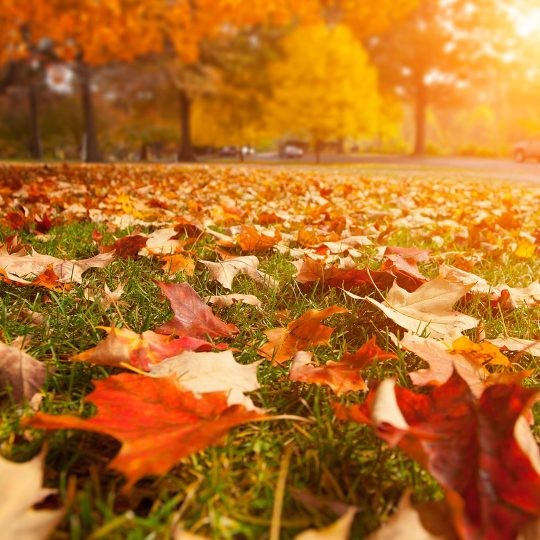
Fallen Leaves
Rudolf Leberl: Fallende Blatter (Falling Leaves), Op. 56 – No. 3. Ernst (Fabian Hinsche, guitar)
Joseph Kosma captured the parallel between falling leaves and fallen love in his pop song Autumn Leaves (or Les Feuilles Mortes, as it is in its original French), setting the poem by Jacques Prévert. Brought to fame in French by Yves Montand, it was then given English words by Johnny Mercer and brought out by Nat King Cole and Frank Sinatra, among many others.
Joseph Kosma: Autumn Leaves (Les feuilles mortes) (Philippe Jaroussky, counter-tenor; Thibaut Garcia, guitar)
Joseph Kosma: Autumn Leaves (arr. D. Rojaz for violin and piano) (Emily Sun, violin; Andrea Lam, piano)
In his song cycle of unrequited love, Winterreise, our lover looks at the trees around him and sees bright leaves still adding colour to the landscape. He focuses on one particular leaf and pins his hopes to it: If it falls, his hope for return to his beloved falls with it. He watches as it is caught by the wind, and it trembles in response…and then falls to the ground, dashing his vain hopes in what was always inevitable.
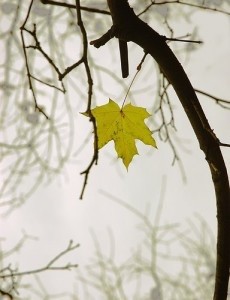
The Last Leaf on the Tree (photo by Steve Ridgley)
Franz Schubert: Winterreise, Op. 89, D. 911 – No. 16. Letzte Hoffnung (Christian Gerhaher, baritone; Gerold Huber, piano)
Painting images with his music, composer Barry Mills uses a guitar duo for his falling leaves imagery: first percussive, is it rain or the sound of leaves hitting the ground? There’s something indefinite about this music. The leaves come down, and then they’re finished, but it’s all a gradual process.
Barry Mills: Falling Leaves (Jon Rattenbury, guitar; Brian Ashworth, guitar)
Autumn is the gateway to change. Winter is coming, but the sun still shines bright to warm us. The nights get darker, and there’s a whisper of leaves moving as they’re driven by the winds that are suddenly blowing colder. It can be a melancholic time or a time for preparing for the future. Autumn is also when school starts and new ideas are being fashioned.
For more of the best in classical music, sign up for our E-Newsletter