Thanks to the precision of his compositional technique, the work of Maurice Ravel has been compared to that of “a Swiss watchmaker.”
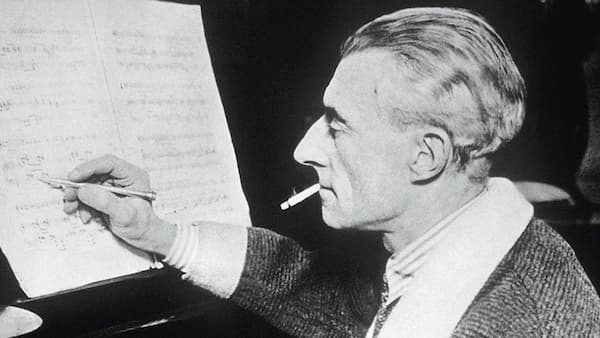
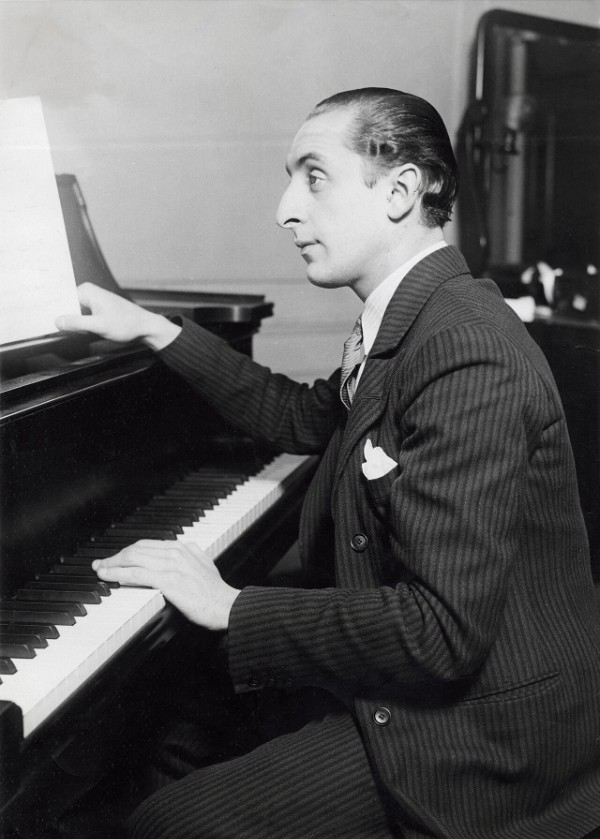
Maurice Ravel in 1928 © Fototeca Gilardi / akg-images
The descriptor is even more accurate than it seems at first glance. Maurice’s father, Pierre-Joseph, was indeed Swiss, as well as an engineer and inventor…who came up with (and then executed) a variety of wildly dangerous ideas!
The father’s love of invention clearly impacted the son. So today we’re going to look at the life of Maurice Ravel’s father and his crazy inventions, as well as how his father’s passion may have influenced Maurice’s music.
The Life of Pierre-Joseph Ravel
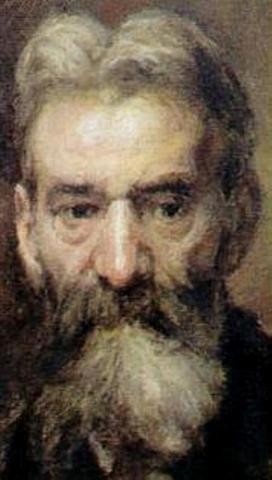
Pierre-Joseph Ravel
Pierre-Joseph Ravel was born in 1832 just outside of Geneva, Switzerland. He began a lifelong love affair with music as a child, but chose not to become a musician, opting to go into civil engineering instead.
One of his first jobs out of school was building a railway in Spain. There he fell in love with a Basque woman named Marie Delouart, whom he married in 1873.
Their first son was Maurice Ravel, born in 1875, just miles away from the Spanish border.
A few years later, in 1878, they had their second and final child, a son named Édouard.
After Maurice’s birth, the Ravels moved to Paris. While they lived there, Pierre-Joseph enjoyed taking his boys to see local factories so they could all observe the machinery.
Édouard shared his father’s fascination with tinkering and followed him into a civil engineering career. Meanwhile, Maurice became a composer, channeling his fascination with craftsmanship into his notoriously precise music.
A Very Early Automobile
“The Whirlwind of Death” or “The Vortex of Death”
Pierre-Joseph Ravel began inventing years before his marriage.
In 1868, he earned a patent for a “steam generator heated by oil, applied to locomotion” – in other words, something surprisingly similar to the modern automobile engine.
He actually built an automobile and drove it in the suburban areas of Paris, but sadly, the machine was destroyed in 1870 during the Franco-Prussian War.
An Acetylene-Powered Engine
“The Whirlwind of Death” or “The Vortex of Death”
But Pierre-Joseph was nothing if not persistent, and he didn’t let the loss of the steam engine stop him from his tinkering.
In 1880, the year that Maurice turned five, Pierre-Joseph devised and constructed another engine, this one powered by acetylene.
Acetylene had been discovered in 1836 and proved to be most useful as a fuel. Combusting acetylene and oxygen results in a flame that reaches over 3300° Celsius, or over 6000° Fahrenheit.
Not surprisingly, acetylene is extremely flammable, and while working on this engine, it blew up. The resulting explosion was so violent that it broke the neighbours’ window panes.
But even this didn’t keep Pierre-Joseph from hanging up his inventor’s hat.
A Somersaulting Car
“The Whirlwind of Death” or “The Vortex of Death”
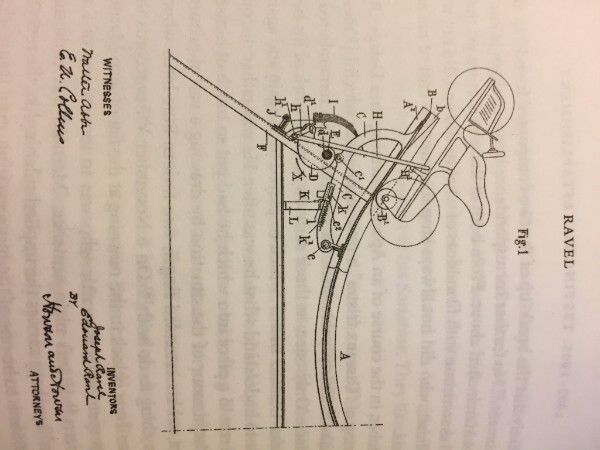
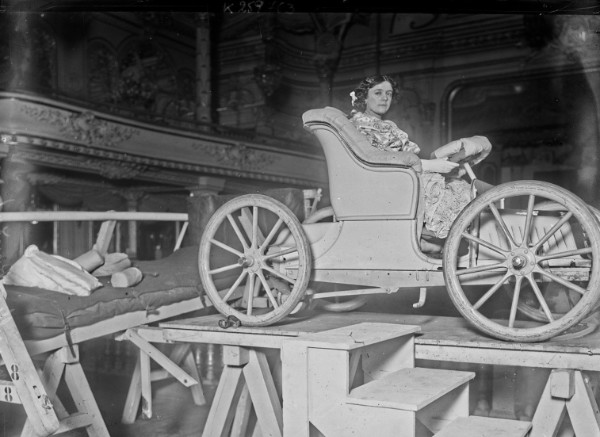
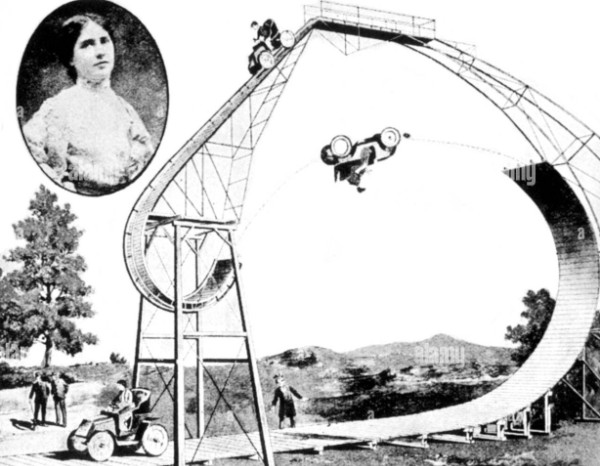
In 1905, Pierre-Joseph, age 73, and Édouard, age 32, collaborated on a daredevil device they dubbed “Le Tourbillon de la mort” (alternately translated as “The Whirlwind of Death” or “The Vortex of Death”). It would become their most infamous invention.
The Whirlwind/Vortex consisted of a track with a break in the middle that enabled daredevil drivers to spin their car around in the air, much like a real-life modern-day Hot Wheels toy.
One contemporary press report described the tourbillon and its operator, an acrobat named Marcelle Randal:
The car in which Mrs. Marcelle Randal, a young girl of twenty-two, was tied up, descended with dizzying speed from a height of 8 meters [26 feet], along a steeply inclined floor; at the bottom of this floor, the rear wheels triggered a powerful spring, which threw the car into the air, making it tip over; the result was a real somersault, at the end of which the vehicle landed…
The tourbillon was meant to be employed as a circus act, and apparently it made quite the splash when it first appeared at the Casino de Paris in the spring of 1905.
The promoters used a sob story to advertise it, claiming that it had been invented by a poor old man in bad health, whose daughter was the only one brave enough to demonstrate it for the public. Although it is true that one of the inventors was a man in his early seventies, he was Maurice Ravel’s father, not the acrobat’s!
The Ravels were hopeful that Pierre-Joseph and Édouard had finally landed on an invention that would enrich the whole family: “Offers of engagements are reaching us from all sides, especially from America. Perhaps it’s the beginning of wealth!”
However, there were early signs that the machine was doomed. Apparently, Randal fainted twice over the course of a few days, and she had to be cut out of the car and carried away by assistants.
Somewhat predictably, only three weeks of operation passed before disaster struck:
On the evening of Friday, April 14, Mrs. Randal, her exercise completed, did not get up, as usual, to greet the spectators: she was taken unconscious to her home, where she died the next day, without having regained consciousness.
A judicial investigation has been opened and, according to the doctors’ opinion, it seems that this death should not be attributed to an accident, but to the repetition of the concussion, a consequence of the violent shocks given to the young acrobat’s body.
Father and son were indicted for reckless homicide, alongside the directors of the casino and Marcelle Randal’s agent (although ultimately acquitted).
That didn’t keep the Ravels from following through with applying for a U.S. patent, which they received in January 1906.
Miscellaneous Inventions
A few other of Pierre-Joseph’s inventions included:
- A machine for sewing paper bags
- A water track with an artificial current as a training aid for swimmers (this foreshadowed the invention of the Jacuzzi, which was developed as a form of hydrotherapy in the late 1940s)
- An automobile that traveled at 6 kilometers per hour (3.7 miles per hour)
Pierre-Joseph Ravel’s Death
In 1906, perhaps in part due to the strain of the legal drama surrounding the Whirlwind of Death, Pierre-Joseph suffered a cerebral haemorrhage.
He and Maurice traveled to Hermance on Lake Geneva, where Ravel reported in a letter to his friend that his father’s headaches had disappeared. But any improvement in health proved to be temporary, and Pierre-Joseph died in 1908.
Did Pierre-Joseph Shape Ravel’s Music?
Although Pierre-Joseph’s eclectic career is certainly interesting on its own, it’s also worth thinking about how it may have helped to inspire his son’s unique creative voice.
Like we mentioned above, Igor Stravinsky famously compared his friend’s output to a Swiss watchmaker’s. Indeed, Maurice had a penchant for propulsive musical elements that can sound very mechanical, in the best of ways.
Take, for example, the final movement of his violin sonata, which sounds like some kind of whirring machinery at work.
Maurice Ravel: Violin Sonata in G Major, Mvt. III
His best-known work, Bolero, is famously repetitive, relying on orchestral colour and texture to provide contrast rather than variations in structure.
Ravel : Boléro (Orchestre philharmonique de Radio France / Lionel Bringuier)
And although Ravel would later disavow this interpretation, his ballet La Valse breaks down the waltz genre in a way that seems to reflect the destruction wrought by mechanised warfare during World War I. There is more than a hint of doomed circus attraction to this music.
Ravel: La valse ∙ hr-Sinfonieorchester ∙ Pablo Heras-Casado
So the next time you hear a piece by Maurice Ravel, listen for ways in which Pierre-Joseph’s career – and his wildly dangerous inventions – may have left an imprint on his son’s approach to composition.
For more of the best in classical music, sign up for our E-Newsletter