Classical music lovers don’t always like acknowledging it, but every idolised canonical composer has been deeply inspired by the people who surrounded him.
And in many cases, one of the most inspirational people in any artist’s life is their spouse.
In fact, some of the most cherished works in the classical canon were inspired by composers’ wives.
These were women who loved their husbands deeply – who often suffered and sacrificed for them – and who shaped their partners’ legacies in profound ways. These women weren’t incidental to the creation of these works: they were essential.
Today, we’re looking at some of the classics they inspired and had dedicated to them.
Bluebeard’s Castle by Béla Bartók (1911)
Márta Ziegler Bartók
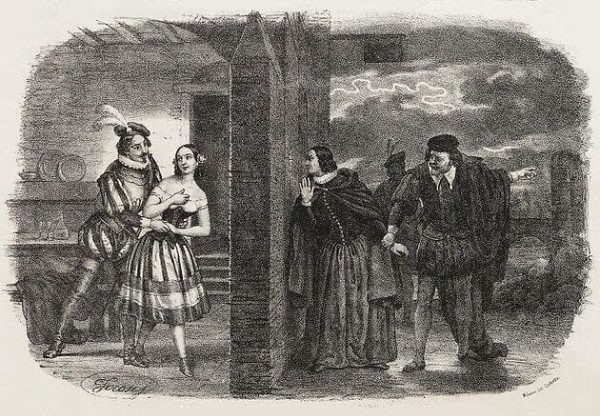
Bluebeard’s Castle, composed in 1911, is Béla Bartók’s only opera. It is a psychological horror story filled with harrowing imagery and themes of secrecy and intimacy.
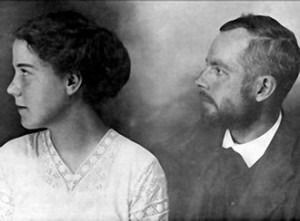
Márta Ziegler and Béla Bartók
Dedicated to his first wife, Márta Ziegler Bartók, whom he’d married just two years earlier, the opera centers on the mysterious Duke Bluebeard and his new bride Judith, who insists on opening the seven locked doors in his castle to uncover the truth of his past.
The combination of dedication and subject matter is perhaps somewhat eyebrow-raising, given that at the time of their marriage, Béla was 28 and Márta was 16.
The marriage would ultimately end in divorce in 1923, when Béla left Márta for a 19-year-old pianist named Ditta Pásztory-Bartók.
Violin Sonata by Claude Debussy (1916-17)
Emma Bardac Debussy
Claude Debussy’s Violin Sonata in G minor, completed in 1917, was his final completed composition.
He had initially intended to write a series of six sonatas as an homage to French musical tradition: he wanted to cement French musical identity while under attack by the Central Powers during World War I.
Unfortunately for Debussy, by 1917, he was battling rapidly worsening terminal cancer. He wouldn’t survive to finish the cycle.
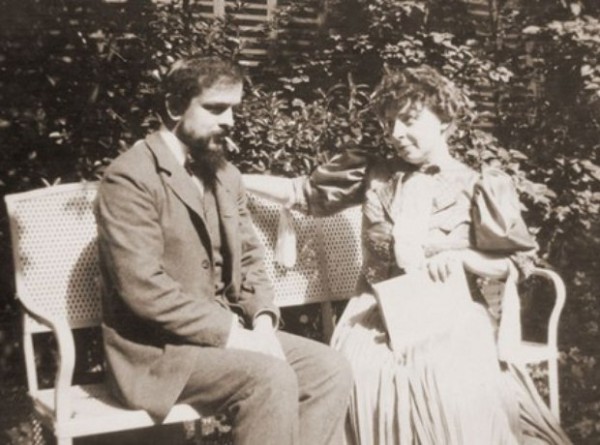
Claude Debussy and Emma Bardac
He dedicated the violin sonata to his second wife, Emma Bardac. A decade earlier, he’d left his first wife for her (and she had left her first husband for him). In 1905, they had a beloved little girl, Claude-Emma, whom they nicknamed Chouchou.
Despite the ensuing scandal, Debussy’s cancer diagnosis, and the outbreak of World War I, Emma stayed by her husband’s side. It’s fitting that the final dedication of his career belonged to her.
Octet, by Igor Stravinsky (1923)
Vera de Bosset Stravinsky
Igor Stravinsky’s Octet for Wind Instruments, written between 1922–23, marked the composer’s turn from lush Russian romanticism toward a more neoclassical, ascetic style.
Scored for a distinctive ensemble of flute, clarinet, two bassoons, two trumpets, and two trombones, the piece is fresh, modern, and witty.
This change in aesthetic coincided with a new arrangement in his personal life. In July 1921, he had begun an affair with dancer and artist Vera de Bosset. He was still married and (delusionally) hopeful that his wife and mistress could become good friends.
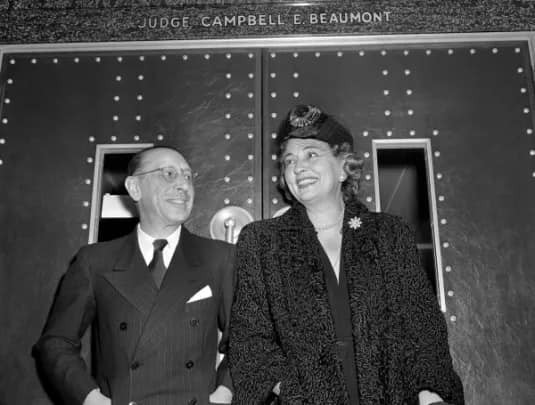
Igor and Vera Stravinsky
Igor would marry Vera in 1939, after his devastated first wife died of tuberculosis.
The octet was one of his first works to herald the new directions that both his personal and professional lives were headed in.
Kammermusik No.4 by Paul Hindemith (1925)
Johanna Gertrude Rottenberg Hindemith
Paul Hindemith’s Kammermusik No. 4, composed in 1925, was written for violin solo and chamber ensemble.
It was dedicated to his new wife, Johanna Gertrude Rottenberg Hindemith, whom he had married in 1923.
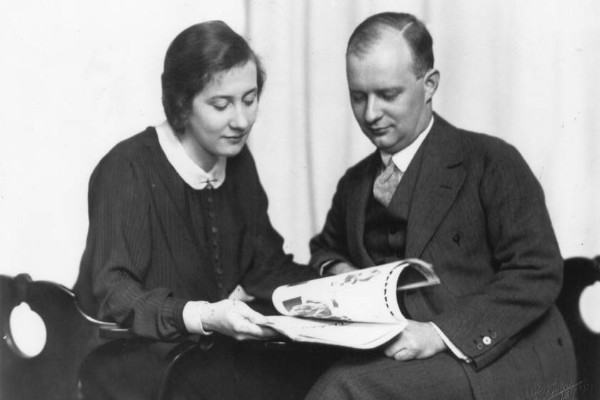
Paul and Johanna Gertrude Rottenberg Hindemith
Hindemith met Johanna’s father, a conductor at the Frankfurt Opera Orchestra, when he auditioned for the concertmaster position there at the tender age of 19.
Despite his youth, Hindemith won the job. Soon, he began visiting the Rottenberg home, where he met and fell in love with Johanna.
Paul found Johanna to be an intriguing figure: she was a singer and actress who ended up not pursuing a career because of debilitating stage fright. She could also play piano and the cello.
The couple never had any children, and she ended up devoting herself to Paul’s career. She would become an invaluable musical partner to her husband.
Given that the violin is the instrument that brought them together, it’s fitting that he would dedicate this work to her.
Learn more about how Hindemith met Rottenberg.
For more of the best in classical music, sign up for our E-Newsletter