Jehan Alain is one of classical music’s great “what-ifs.”
A brilliant French composer and organist, he grew up in a Paris household filled with music. Over the course of just a few short years, he produced more than 120 works that blended faith, humour, and bold originality.
Then, at the age of 29, his life was cut brutally short in World War II.
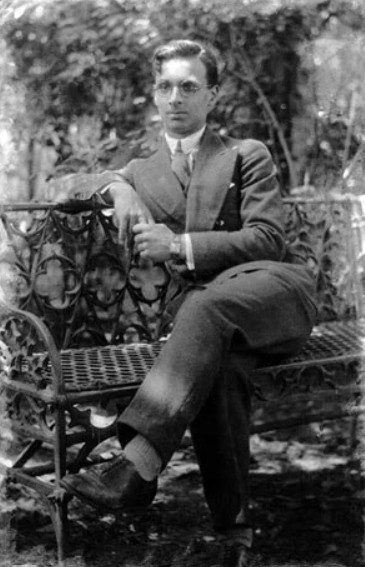
Jehan Alain
Today, we’re looking at his story, as well as the music that he left behind.
A Musical Childhood
Jehan Alain was born on 3 February 1911, the eldest son of a musical family that lived in the Paris suburbs.
Both sides of his family were musical. His father, Albert, was a composer, organist, and organ builder whose pet project was constructing a massive organ inside the family home. In addition, his maternal grandmother was a pianist who had studied with a student of Chopin’s.
Given their background, it’s not surprising that Jehan and all three of his siblings became professional musicians.
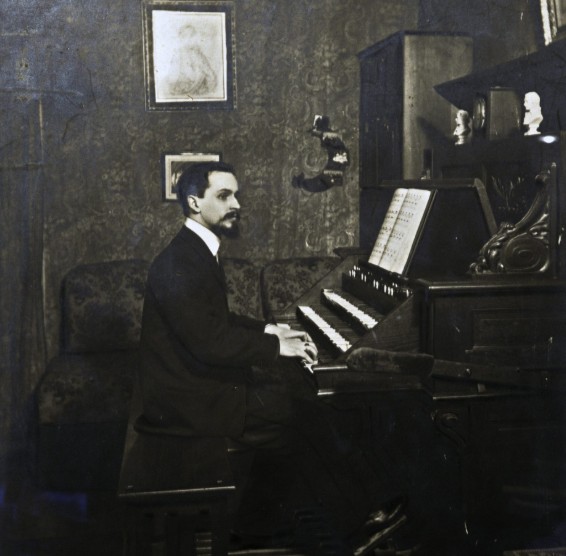
Albert Alain, Jehan Alain’s father
During their childhoods, between their pianos and homemade organ, it was common to hear multiple keyboard instruments being played at once while the kids practised.
Jehan started studying the piano as soon as his hands were big enough to play, and organ studies with his father soon after.
By eleven, he was working as a substitute organist, filling in for his father at church.
Marie-Claire Alain plays Deuxième fantaisie by Jehan Alain
Enrolling in the Paris Conservatoire
In 1927, the year he turned sixteen, Alain enrolled at the Paris Conservatoire.
He had mixed feelings about the practicality of the training, comparing the Conservatoire and its students to a “hothouse where the plants grow very quickly thanks to the temperature and the right humidity which is maintained around them, but of which certain ones may wilt when they are transplanted to open ground.”
Despite any reservations, he proved to be a talented student and won a number of prizes there, including first prizes in harmony, fugue, organ and improvisation.
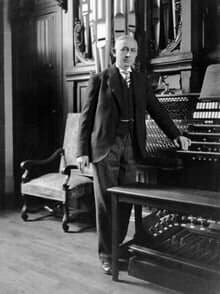
Marcel Dupré
His teachers here included Marcel Dupré and Paul Dukas (composer of The Sorcerer’s Apprentice).
He continued studying at the Conservatoire intermittently until 1939. His time there was interrupted by military service and the tragic, unexpected death of one of his sisters.
His Professional Life
While still a student, he took two jobs as an organist, working at both the Eglise Saint-Nicolas de Maisons-Laffitte and the Rue Notre-Dame-de-Nazareth synagogue in Paris.
He also worked as a composer, writing a large number of works including chamber music, piano music, and choral music.
A brief snippet of a documentary about Jehan Alain
He was remembered as someone with changeable moods: he could be deliriously happy one minute and deliriously upset the next.
He made frequent jokes about the bourgeoisie, even as he lived his life as a devoted Catholic, church organist, husband, and father.
Despite his devotion to his faith and family, he was attracted to unconventionality. He loved the music of iconoclast Erik Satie, and wrote in a mysterious dedication to his piano piece “Ecce Ancilla Domini”:
“I want the earth made square. I want to read the blue of the sky. I want to see behind… I want my temples to burst under irrational monstrosities… Lord, give me eternal peace.”
His Military Service Begins
In 1933, when he was 22, as part of France’s compulsory military service, Alain was inducted into the 26th regiment of the French infantry.
He joined as a musician and played the saxophone, writing:
“I have a horrible saxophone on which I make sparkling chromatic scales; I also play swaying tangos, with the requisite vibrato. In the hall where I am, about fifteen saxophones of all dimensions blow, coo, and otherwise carry on, in a sort of thick rumble that fills your ears like a cotton swab. It is deadly boring in the long run…”
He was discharged in 1934 after falling severely ill with pneumonia.
Once he was well enough, he resumed his musical studies at the Conservatoire and, in 1935, married his childhood friend Madeleine Payan.
They had three babies together: Lise in 1936, Agnes in 1938, and Denis Jean-Sebastien in 1939.
Jehan Alain’s Intermezzo
World War II Begins
In September 1939, just two months before the birth of Denis, World War II broke out. Nazi Germany invaded Poland on 1 September, and Britain and France declared war two days later.
However, Alain himself had already been mobilised in late August as part of the Eighth Armoured Division.
He mused to his diary:
“A troubled time, suspended over the unplumbed depths of democracy and of war. Luckily, the smile of good old Bach, the tears of obstinate Beethoven, the sighs and cries of some others form a solid base on which we hang the dark ladder of circumstances.”
His division didn’t see any action that winter. To entertain himself and his fellow soldiers, Alain founded a choir and played piano for them in the evenings. He worked on some compositions, too, but sadly, these were lost during the war.
He also pursued his hobby and expertise in fixing and riding motorcycles.
His Final Weeks
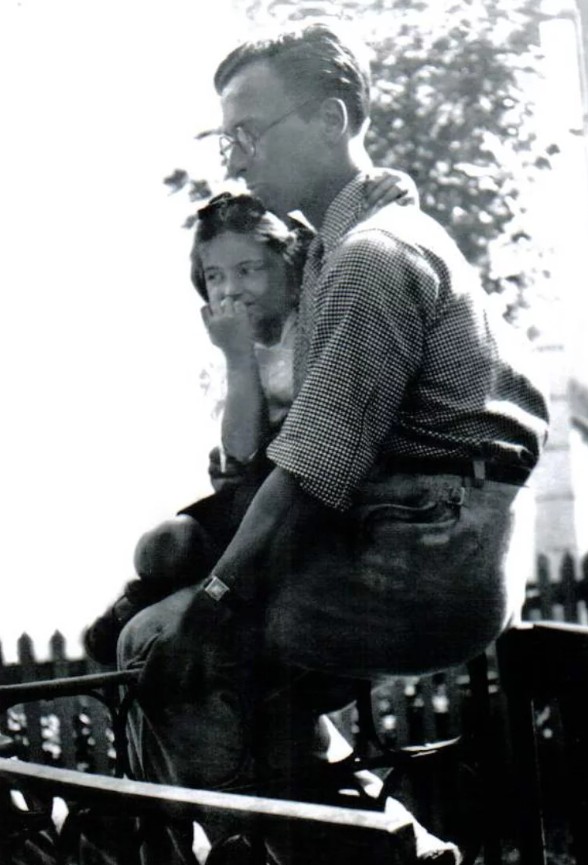
Jehan Alain and his daughter
Finally, in May 1940, the Eighth Armoured Division received orders to advance into Belgium after the Nazis invaded.
Alain put his motorcycle skills to good use, working long shifts (some as long as twenty hours) to deliver messages.
He took part in aiding the Dunkirk evacuation; his actions during that campaign earned him a medal for bravery.
A few weeks later, on 20 June 1940, Alain made a fateful offer: to spy on a German outpost.
Outside Saumur, France, a town 250 kilometres southwest of Paris, he ran into a platoon of Nazi soldiers. Instead of retreating or surrendering, he shot sixteen before running out of ammunition. As he was running back to his motorcycle, he was shot and killed. He was 29 years old.
Legend has it that the sheet music he was keeping in the sidecar of his motorcycle was found scattered across the countryside for days following his death.
Jehan Alain’s Legacy
Jehan Alain left behind an astonishing 120 compositions.
Many were championed by his sister, Marie-Claire Alain, who was just thirteen when her brother died. She went on to follow in his footsteps, becoming a world-renowned organist in her own right.
Marie-Claire Alain plays Litanies by Jehan Alain
Today Alain remains one of the biggest what-ifs in classical music history, and one of the most tragic musical losses of the twentieth century.
He once wrote:
“If you love my music, if it speaks to you, that you think likewise, then my dream is fulfilled.”
Learn about four other composers who died tragically young.
For more of the best in classical music, sign up for our E-Newsletter