If you’re wondering how to find a music teacher, you’re not alone – and it’s harder than it looks.
A Google search will favour teachers with optimised websites, which means the best teacher in your community might not show up at all.
Here are seven proven ways to find private music lessons in your area.
1. Online search

© longevity.technology
Your first step should be looking up “[instrument] lessons in [your city].”
Write down names and read biographies. See if they’re involved with a studio or music shop, or if they teach in their own space.
However, don’t stop your research there, because the best teacher in town may not show up in search results.
Many established music teachers who rely on word-of-mouth, or who are older, or who are just busy teaching, don’t put a lot of work into their website’s search engine optimisation.
That means the best candidate may not be totally obvious from a Google search.
Nevertheless, it’s still a good place to start to get the lay of the land.
Pianist Jeewon Lee describes how to find a music teacher.
2. Call music stores that sell the instrument you’re interested in.
For instance, if there’s a band shop in your city and you want to play the flute, call them and ask if they have a list of teachers.
Store owners are often excited to share information about local teachers with you. Some even provide teaching space in the back rooms of their shops.
They know that you’ll likely buy method books or supplies from them if you start playing, so they have a motivation to maintain an up-to-date list and share it.
Here’s an important note for aspiring string players: string instruments are very different from band instruments, and the band and orchestra worlds do not always overlap. If you want to get the most comprehensive list of potential teachers, you’ll be better off asking the owner of a violin shop specifically, not a shop that specialises in band instruments.
3. Contact local music schools.

© ThePiano.SG
Different kinds of music schools in your area are worth contacting.
Some umbrella organisations employ teachers directly or, alternately, provide physical studio space to freelance teachers. Contact them and see what names they recommend to help you achieve your musical goals.
Another type of school worth contacting is a college or university. As a beginner, you aren’t going to get in with a professor. However, if professors’ students are majoring in music, even if they’re seeking a degree in performance and not education, they’re probably going to have to teach at least some of the time to make ends meet.
Sometimes you can get lower rates if you start learning from a student early in their career who is learning how to teach. You may also get access to university facilities, too.
The downsides of learning from a college student: your teacher will be less experienced, and you might turn into a bit of a guinea pig as they learn how to teach. You also risk having to find a new teacher if they move away after graduation.
4. See local performances and collect some programs.
At symphony and chamber orchestra concerts, there will be a program that lists the personnel. Take it home and study it. Of course, not everyone who plays in an orchestra teaches. But many do, especially principal players.
This is a good place to learn if a particular teacher is plugged into the performing side of their art. There are definite benefits to having a teacher who also actively performs. (We wrote about that here: https://interlude.hk/performing-teacher/ ) Such a person can help teach you how to perform, which is a skill in and of itself, apart from just learning an instrument.
Likewise, if you see concert listings of chamber music groups or solo recitals, go to those concerts. You’ll get a sense about what the person’s abilities are, and maybe even get a chance to chat at a reception afterwards.
A performance of Beethoven’s Symphony No. 9 by the Bloomington Symphony in Minnesota
5. Ask friends what their experiences have been.
Most people know at least one person who plays or has played the instrument they’re interested in. Get in touch with them and ask who they think would be a best fit for you.
The music world is very small, and everyone knows each other, so your friends may know more than you think.
6. Find out which musical activities teachers’ students participate in.
© CMUSE.org
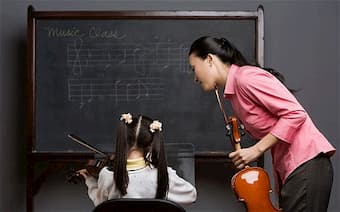
The resumes of a particular teacher’s students speak for themselves.
If you’re interested in focusing on technique, you might want to look for a teacher whose students have been accepted into prestigious summer camps, music schools, or professional ensembles.
On the other hand, if you’re an adult who wants to have an enjoyable time learning a new instrument, you might want to look for a teacher who has a lot of adult students already.
7. Remember that you can take trial lessons!
Once you’ve used these methods to find names and learn about where they teach and what kinds of students they specialise in, you can contact them and set up a trial lesson.
Some teachers don’t charge for this initial consultation; others do. At a trial lesson, you can hopefully get a sense of whether you click with a particular teacher.
Don’t be embarrassed if you don’t feel comfortable with someone. Professionals don’t take your leaving personally.
A video on five things to look for in trial lessons.
Conclusion
Finding a music teacher takes more legwork than a simple Google search – but the right match is out there.
Use these seven strategies together, and you’ll cast a wide enough net to find someone who’s genuinely the right fit for you.
Let us know in the comments how you found your music teacher.
For more of the best in classical music, sign up for our E-Newsletter