Johann Strauss II, known as the Waltz King, is one of the most famous composers of all time.
His wife, Henrietta (Jetty) Treffz, was an integral inspiration behind her husband’s music, including the famous Blue Danube waltz.
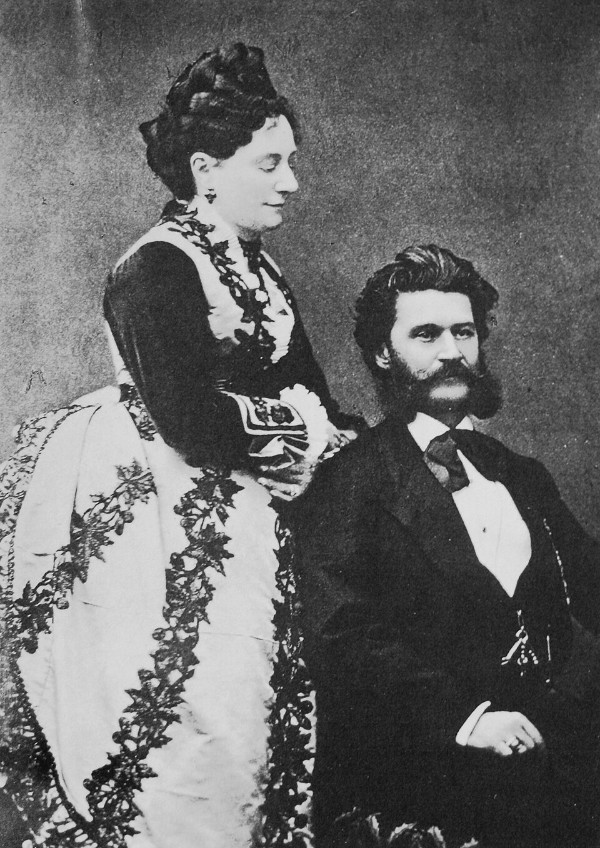
Jetty Treffz and Johann Strauss Jr.
There isn’t much English language scholarship about Jetty Treffz, but today we’re going to piece together what we can.
Henrietta’s Background
The woman who would become the Waltz King’s wife was born Henrietta Chalupetzky on 1 July 1818.
Her family lived in the district of Alsergrund, Vienna: the same neighbourhood where Beethoven would die just a decade later.
Her father was a goldsmith and silversmith. When she was a child, her parents divorced.
(Johann II’s parents also divorced after his father’s serial infidelity. Maybe this unusual shared background helped to bond Jetty and Johann when they met.)
Henrietta began studying music as a young girl. She studied with a variety of teachers, including an opera singer and painter named Giovanni Gentiluomo.
When she began her career as a professional mezzo-soprano, she ditched the last name Chalupetzky and began using the surname Treffz, her mother’s maiden name.
Early Musical Successes: Impressing Mendelssohn and More
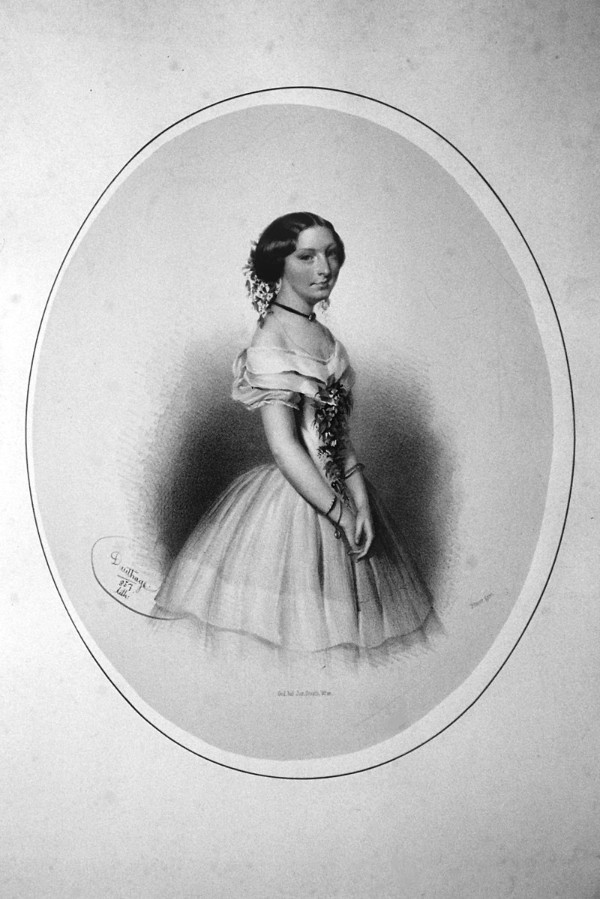
Henrietta (Jetty) Treffz, 1857
In 1837, at the age of nineteen, she made her professional debut at Vienna’s Theater am Karntnertor.
Two years later, in 1839, she sang at the Leipzig Gewandhaus under Felix Mendelssohn.
Mendelssohn was so inspired by her voice that he wrote the song “Es ist bestimmt in Gottes Rath” (“It is ordained by God’s Decree”) for her.
It is said that he was especially impressed by her ability to sing German lied. Throughout her career, Treffz was praised for her ability to sing in different languages without an accent.
“Es ist bestimmt in Gottes Rath” by Felix Mendelssohn
During the 1840s, Treffz sang at court theaters in Leipzig and Dresden. She also made regular appearances at Viennese venues like the Theater in der Josefstadt and the Theater an der Wien. In 1846, she sang opposite Jenny Lind in a production of Bellini’s Norma.
She also continued learning. In Dresden, she studied with Wilhelmine Schröder-Devrient, one of Wagner’s early musical inspirations. Schröder-Devrient had a very colourful romantic life. It’s possible she became a model for Treffz.
Henrietta’s Children
In 1841, at the age of 23, she had her first child, a daughter. In 1853, a man named Peter Cavaliere di Galvagni, twenty years her senior, would adopt that daughter. Historians have posited that Peter may have been the baby’s biological father.
In 1843, she moved into the mansion of wealthy banker, industrialist, and patron of the arts Moritz Todesco.
Todesco and Treffz never married. It’s unclear why. It may have been because of religious differences (Todesco was Jewish and Treffz was Catholic), because the difference in their social standings forbade it, or because they had no interest in entering a traditional marriage. More research needs to be done.
All in all, Treffz had six children with Todesco, in addition to her daughter with (presumably) Peter Cavaliere di Galvagni.
Interestingly, Todesco adopted his two daughters with Treffz, but not his sons. This was likely so that the daughters could receive dowries and be more attractive on the marriage market.
While Treffz benefited from Todesco’s wealth and connections, she also helped him socially by overseeing an impressive salon, attended by a variety of Vienna’s greatest musicians, artists, and thinkers.
Appearing in Britain and Meeting the Strauss Family
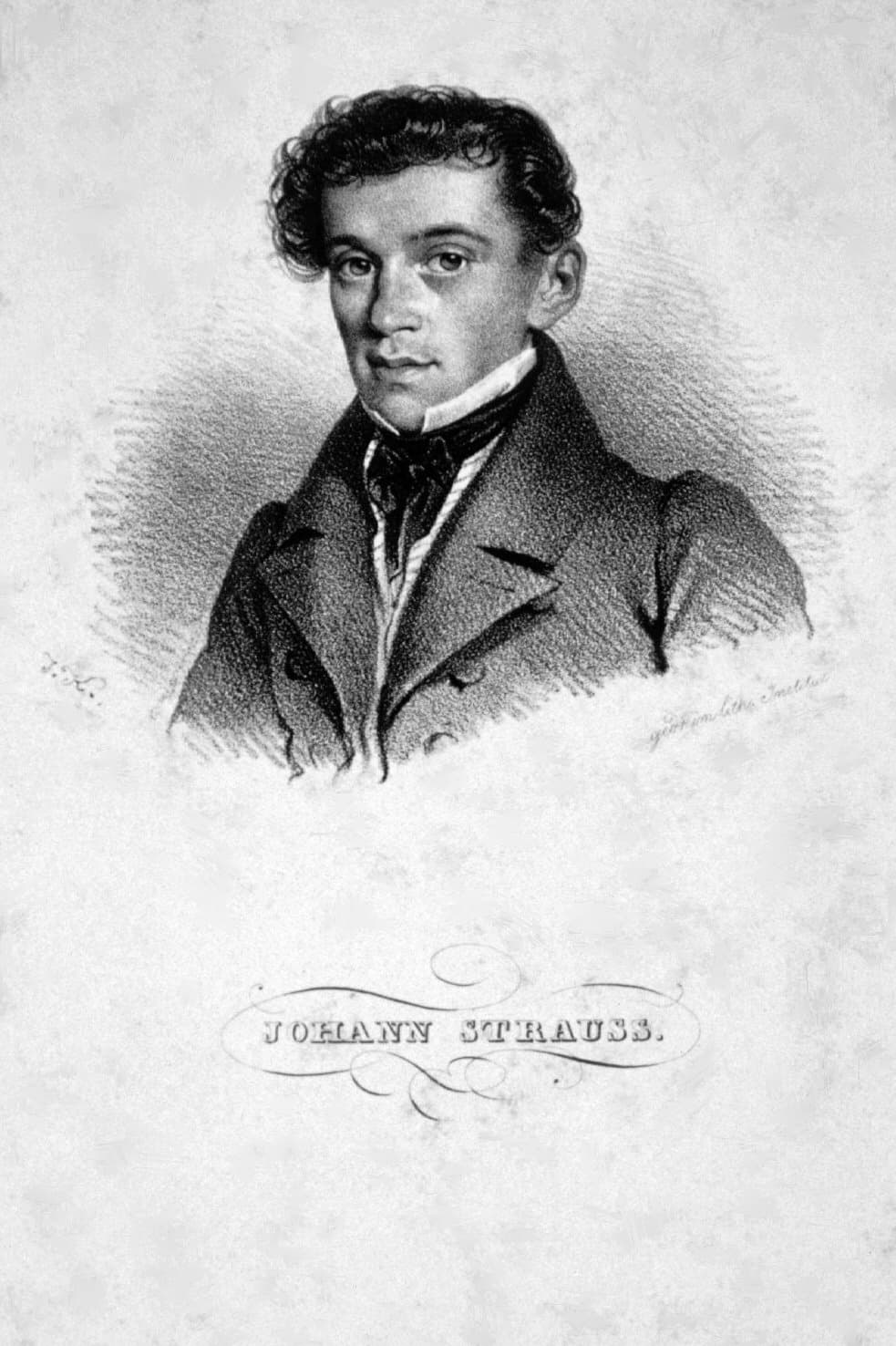
Johann Strauss I
Her relationship and pregnancies didn’t stop her musical career. She appeared with Johann Strauss I in England in 1849, to great acclaim.
London’s Morning Post referred to her as “a handsome woman with a ripe mezzo-soprano voice, a charming style, and great dramatic feeling.”
There were rumours that she had an affair with Johann Strauss I around this time. It would not have been out of character. He was a serial adulterer, and Treffz clearly valued her romantic and sexual independence.
Years would pass before her paths crossed with the Strauss family again.
Meeting Johann Strauss II
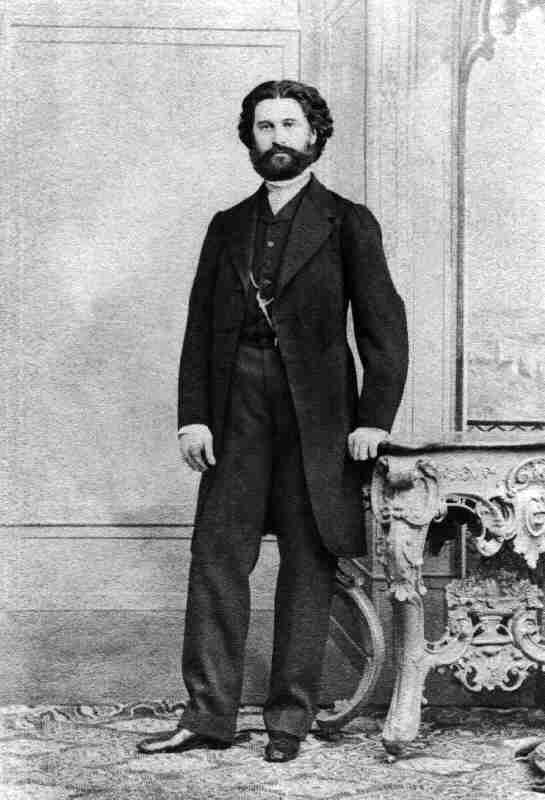
Johann Strauss II
In 1862, thirteen years after working with Johann I, she met Johann Strauss II at one of her soirees in Todesco’s home.
The two began meeting secretly and fell in love. Ultimately, she left Todesco for him, and they became engaged.
The Strauss family was initially appalled at the match. They disapproved of her personal history, as well as their age difference (at the time of their marriage, she was 44 and he was 36).
Despite the familial objections, on 27 August 1862, she married Johann Strauss II at St. Stephen’s Cathedral in Vienna.
Getting Involved in the Family Business
She immediately took a very active role in the family business. Not coincidentally, Johann II’s career began soaring around the same time.
By the mid-1860s, he came to be known as the pre-eminent composer of dance music in Europe.
In 1869, Johann II’s composer brother Josef wrote to his wife that Treffz was “indispensable in the home. She writes up all accounts, copies out orchestral parts and sees to everything in the kitchen with such efficiency and kindness that it is admirable.”
The family couldn’t deny that their marriage brought Johann II professional and financial success. In the end, she won the Strausses over.
Johann Strauss II’s Career Goes Into Overdrive
Treffz’s belief in him kicked Strauss’s career into high gear.
She encouraged him to apply for the prestigious position of Hofballmusikdirektor (Music Director of the Royal Court Balls), which he won. This job enabled him to retire from constant touring, making composing easier.
In 1866, he composed the waltz that would become known as the Blue Danube. It came at a moment of high nationalism: he composed it after Prussia threatened to go to war with Austria. In the decades since, the Blue Danube has become a de facto Austrian anthem.
There’s an old story that Strauss wrote the theme to the Blue Danube waltz on his shirt cuffs and that his wife saved them from the laundry. That story is likely apocryphal, but it’s fun to imagine…and it certainly wouldn’t be out of character for Treffz to do!
“On the Beautiful Blue Danube”
Over the following years, Strauss wrote dozens of other famous waltzes. Urged on by his singer wife, he also composed fifteen operettas, including 1874’s Die Fledermaus, which became a classic of the genre.
Adele’s Laughing Song from Die Fledermaus
Just because Johann II was experiencing new career highs didn’t mean that Treffz wasn’t, too. In 1863, the year after their marriage, she accompanied Johann II on his tour to Russia. While there, she sang a recital for the emperor while Johann accompanied her on piano.
She also helped to plan and execute a massive 1872 tour of the United States. Strauss participated in the monumental World Peace Jubilee and International Musical Festival in Boston, Massachusetts, and conducted 1000 musicians in a performance of “The Blue Danube.”
Treffz’s Death – And Johann’s Grief
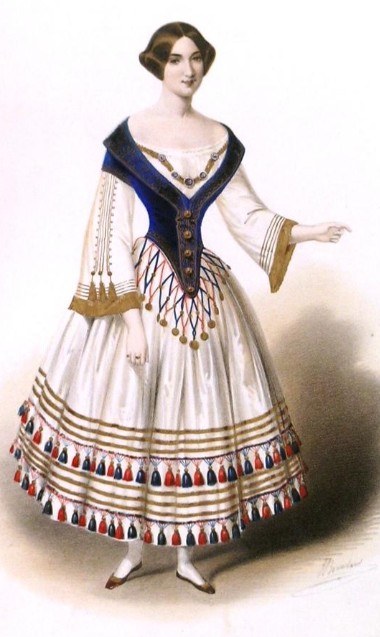
Henrietta (Jetty) Treffz
Shortly after their return from America, sometime around 1873, it is believed that Johann II began seeing other women.
In the later part of her life, Treffz started having health troubles, battling chronic pain and mobility issues. She began referring to herself as a “poor, old cripple.”
She died suddenly of a stroke or heart attack at 11:30pm on 8 April 1878 in Vienna.
Johann was so shocked by her sudden death that he left the house and didn’t return. His brother Eduard was forced to make funeral arrangements.
Johann didn’t attend the funeral or burial. Instead, in an episode of manic grief, he married a 20-year-old woman named Ernestine Dittrich.
Not surprisingly, his second marriage was unhappy, and the relationship became a struggle…a story we wrote about here: Danubian Debauchery III
For more of the best in classical music, sign up for our E-Newsletter