In September 1892, Antonín Dvořák arrived in America with his wife and two of his children, ready to start a new life in the New World.
His American sojourn only lasted for three years, but those three years produced some of the most beloved and influential music of his career.
Today, we’re looking at Antonín Dvořák’s time in America and the masterpieces that came out of his stay there.
Why Did Dvořák Come to America?
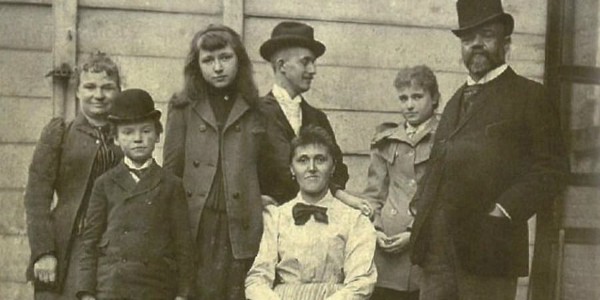
Dvořák and his family
In the 1890s, America was slowly but surely starting to shed its reputation as a provincial backwater.
Internationally, the late nineteenth century was a time of rising nationalism in the arts. The question began to be asked: what sort of style should American composers embrace, given the fact that nearly all Americans have immigrant backgrounds?
A woman named Jeannette Thurber found herself at the forefront of these debates. Thurber was a wealthy music lover who had founded the National Conservatory of Music in New York City.
She thought that Dvořák would be a valuable partner in advancing the cause of American music, given that he had written so many impressive works boasting a distinctively Czech voice.
Initially, Dvořák turned down Thurber’s offer of the Conservatory directorship. He didn’t want to leave his beloved homeland.
However, as negotiations continued, he found himself unable to turn down a massive $15,000 salary, plus summers off. (At the time, $15,000 was roughly thirty times what an average labourer made in a year.)
Four of his children stayed in Bohemia, but two went with him, along with his wife and his assistant Josef Kovarik. The party arrived in September 1892.
Dvořák’s Thoughts on the Future of American Music
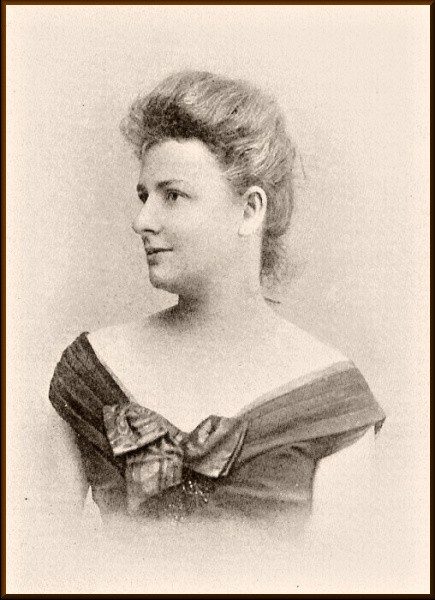
Jeannette Thurber
Thurber had arranged for Dvořák’s responsibilities to consist mainly of his two favourite activities: teaching and composing.
Dvořák was delighted with the young talent he taught at the conservatory. The student body was diverse for the era, including women and Black Americans.
Dvořák was especially taken by the rich heritage of the African American musical tradition.
In one interview, he declared that “the future music of this country must be founded upon what are called Negro melodies. They are the folk songs of America, and your composers must turn to them… In these melodies, I find all that is needed for a great and noble school of music.”
It turns out he was right: jazz, rock, and hip hop – arguably the most influential genres to emerge from America during the twentieth century – all emerged from the Black tradition.
Dvořák Writes His “New World Symphony”
Dvořák’s Symphony No. 9, “From the New World”
Within months of his September 1892 arrival, Dvořák began working on his ninth symphony. He finished it in the spring of 1893, and it premiered at Carnegie Hall that December. It was published with the subtitle “From the New World.”
It had taken a European composer to write the first major symphony inspired by American folk music. (Dvořák claimed that the unforgettable melody in the slow movement Largo was inspired by spirituals and Native American folk songs.)
Dvořák’s Symphony No. 9, Movement 2
Arrangements of the Largo soon began appearing in hymnals. To this day, many people think that this is a traditional spiritual, but actually Dvořák wrote it himself.
Dvořák Visits the Midwest
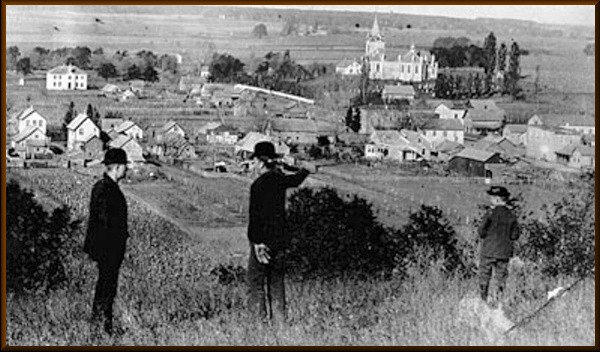
Spillville, Iowa
A few weeks after announcing the completion of his ninth symphony, the Dvořáks set out on a railroad journey to the little town of Spillville, Iowa, encouraged by his secretary Josef Kovarik, whose family was from Spillville.
On their way west, they stopped in Chicago to see the famous World’s Columbian Exposition. (They would visit again on their way back to New York.)
Once Dvořák arrived in Iowa, he was hugely relieved to be out of the big city and back in a place that reminded him more of the Bohemian countryside he had so reluctantly left behind. “I was walking there in the woods along by the stream, and after eight months, I heard again the singing of birds!”
While in Spillville, he wrote his twelfth string quartet, nicknamed the American, as well as his String Quintet in E-flat major.
Dvořák’s String Quartet No. 12, “American”
Dvořák’s Quintet in E-flat-major
These works, like his Ninth Symphony, were inspired by the character of folk music. In them, Dvořák employed a five-note pentatonic scale, commonly found in Black and Native American folk melodies.
Decades later, while writing his memoir, his son Otakar remembered how his father had, to his delight, met and chatted with Native Americans in Spillville. He wrote, “My father was interested…in their songs and instruments… Father received photos from the Indians. These photos were among my father’s prized possessions.”
How a Midwestern Waterfall Inspired the Violin Sonatina
In September, on his way back to New York, Dvořák stopped in Minneapolis. While there, he visited Minnehaha Falls, made famous by Henry Wadsworth Longfellow, whose 1855 epic poem The Song of Hiawatha featured a character named after the waterfall.
Dvořák’s Violin Sonatina
While observing the falls, he had a melody come to mind. He asked his assistant, Kovarik, for a pen and paper, but all Kovarik had on him was a pencil. Dvořák made do by writing the melody on his shirt cuff.
That melody would go on to become the Larghetto from his Violin Sonatina.
Dvořák’s Violin Sonatina, Mov. 2
The Cello Concerto and Saying Goodbye to America
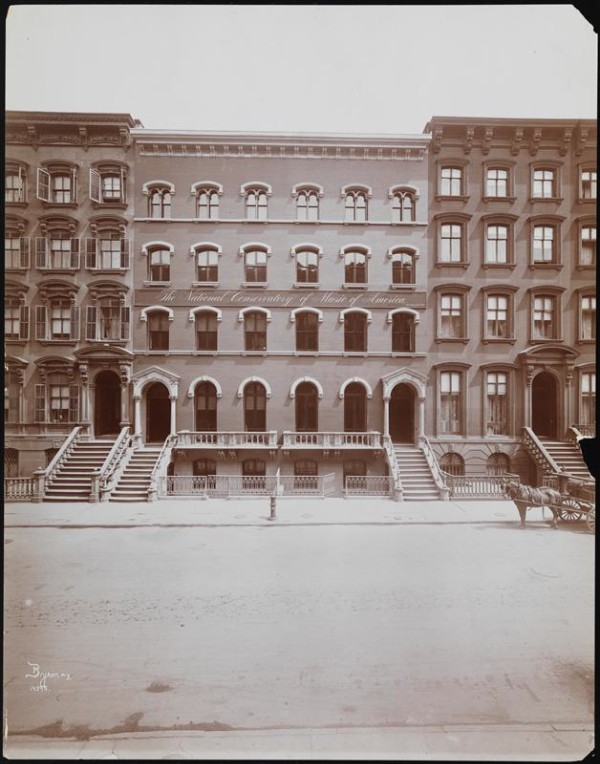
The National Conservatory of Music building
Unfortunately, while Dvořák was traveling in the Midwest, the country found itself in the grips of a major economic downturn. In February, the Panic of 1893 began, and it dragged on for months.
Many people lost massive amounts of money, including Jeannette Thurber. In fact, she had to cut Dvořák’s salary down to $8000 a year due to financial trouble at the Conservatory.
It became increasingly obvious that, with a decreased salary, Dvořák’s rising profile in Europe, and the family’s acute homesickness, the American contract wasn’t going to be worth renewing.
Therefore, the 1894-95 school year would be Dvořák’s last.
However, he wasn’t done writing sojourn-inspired works. During his final months in New York, he wrote his cello concerto, which would become one of the most beloved cello works of all time.
Part of his inspiration for the work came from hearing American cellist Victor Herbert play his own concerto in New York.
But another inspiration was his homesickness for Europe. The entire work is infused with the yearning, bittersweet emotions Dvořák was feeling around this time, which were perfectly suited for expression by the cello.
While writing the concerto, Dvořák was devastated to learn of his sister-in-law Josefina’s terminal illness. She was more than just an in-law to him: he had actually fallen in love with her before falling in love with her sister. To pay tribute to Josefina, he included a quotation of one of her favourite songs of his in the concerto finale. Her illness and death in 1895 reminded him of the family and culture he had so unwillingly left behind, and underlined to him the importance of going home.
Dvořák left in April 1895. But the musical legacy of his sojourn in America is still alive and well, over a century later.
For more of the best in classical music, sign up for our E-Newsletter