George Onslow (1784–1853) was a master of chamber music, and some of his best works are his string quintets, of which he wrote 34. Despite his English name, Onslow was born in France, and at his height of fame, he was called ‘our French Beethoven’. He never met the Viennese master, but both Beethoven and Schubert were aware of Onslow’s compositions. In Germany, Schumann owned some of his autograph scores and paired him with Mendelssohn as a master of the string quartet. Berlioz, in France, considered him ‘one of the greatest harmonists of the period’.
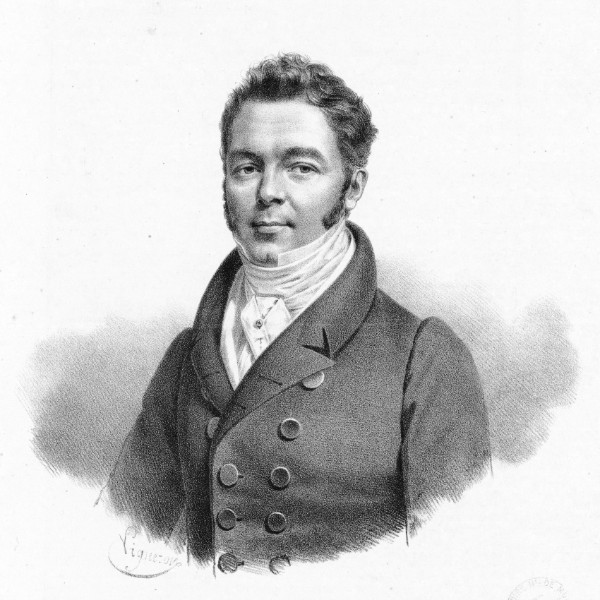
Pierre-Roch Vigneron: George Onslow, 1834 (Gallica: btv1b8423275z)
A string quintet is, essentially, a string quartet with an extra instrument, typically a viola (viola quintet), a cello (cello quintet) or a double bass. In his string quintet writing, Onslow had two great models to follow: Mozart, who added a 2nd viola to a string quartet, and Boccherini, who added a second cello. In many ways, in style, Onslow’s own music is not unlike that of Mozart’s student Hummel.
Onslow followed Boccherini’s model of a cello quintet, but at a concert in England where the second cellist was missing, the double bass virtuoso Domenico Dragonetti stepped in. This proved inspirational to Onslow, and so his string quintets were written with the double bass in mind. He worked with Dragonetti in a productive partnership for a number of years.
The autograph instructions for his String Quintet No. 14 say that it’s for ‘two cellos, or cello and double bass’. When the double bass is employed in the quintet, it’s necessary to make some changes to the cello part to accommodate the lower instrument, generally adding lower octaves.
The String Quintet No. 14 in F major, Op. 37, was completed in 1829 and follows a standard string quintet pattern.
The first movement opens with an Allegro moderato and establishes a distinctive motive. The second theme, played by all 5 instruments, is in a contrasting legato. The development section focuses on the second theme before returning to the opening ideas.
George Onslow: String Quintet No. 14 in F Major, Op. 37 (arr. M. Baker for string quartet and double bass) – I. Allegro moderato (Ensemble Telos, Ensemble)
The second movement, Menuetto, dances with syncopations and is then served by a slower, pensive Trio section in a minor key.
George Onslow: String Quintet No. 14 in F Major, Op. 37 (arr. M. Baker for string quartet and double bass) – II. Menuetto: Allegretto (Ensemble Telos, Ensemble)
The slow movement, Andante cantabile, doubles the violins for a greater effect. It sings lightly and brings all the instruments into the conversation.
George Onslow: String Quintet No. 14 in F Major, Op. 37 (arr. M. Baker for string quartet and double bass) – III. Andante cantabile (Ensemble Telos, Ensemble)
The final movement is lighter than you’d expect, with motifs built around repeated note patterns.
George Onslow: String Quintet No. 14 in F Major, Op. 37 (arr. M. Baker for string quartet and double bass) – IV. Finale: Allegretto (Ensemble Telos, Ensemble)
As a string quintet from the early Romantic era, it seems closer to those of the Classic period. But yet there’s a little bit there that’s more exploratory than a simple Classical era chamber piece.
Onslow had a touch and a skill in his chamber music that seem to transcend simple definitions.
For more of the best in classical music, sign up for our E-Newsletter