Spanish composer and pianist Gustavo Díaz-Jerez (b. 1970) takes his dual role of composer and performer seriously. In discussing it, he draws parallels with the great composers/performers of the past and says that ‘each blank page reveals a new space…to experiment’.
His ongoing series Metaludios consists of short works for the piano. It’s a portmanteau word, combining ‘meta’ (beyond) and ‘-ludio’, from the Latin ‘ludere’, to play. His titles are indicative of each work’s character, whether an underlying process, a mythological story, a tribute to an artist, and so on. By underlying processes, he incorporates scientific and mathematical elements in his music, including ‘the use of fractals, number theory, cellular automata, analysis of the harmonic spectrum, and psychoacoustics, among others.’ Some of his work happens inside the piano, not just on the keyboard.
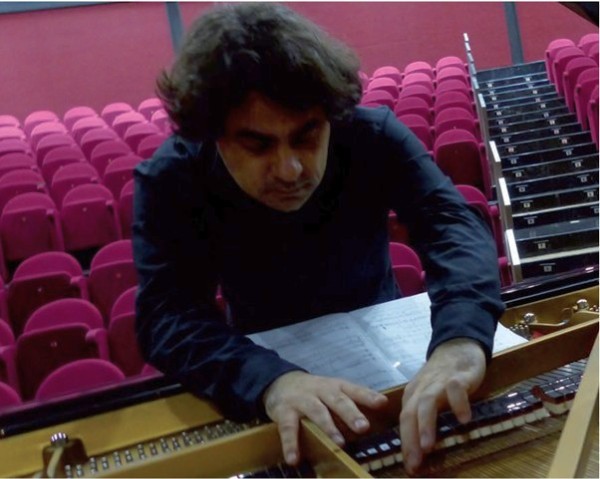
Gustavo Díaz-Jerez playing in the piano, 2018 (photo by Noah Shaye)
Metaludios, Book 1 opens with Izar iluna (Dark Star in Basque). This is a transformation of fractal images into sound with the use of computer programming.
Gustavo Díaz-Jerez: Metaludios, Book 1 – No. 1. Izar iluna (Gustavo Díaz-Jerez, piano)
Contrast this with No. 4, his homage to Antonio Soler (1729–1783), built around two contrasting minor-key sonatas by the late-Baroque composer. Sonata No. 10 in E minor is fast and virtuosic, and Sonata No. 24 in D minor is slow and cantabile. Díaz-Jerez combines his musical material and then uses it to generate new musical material.
Gustavo Díaz-Jerez: Metaludios, Book 1 – No. 4. Homenaje a Antonio Soler (Gustavo Díaz-Jerez, piano)
Stheno is named for one of the monsters of Greek mythology. Stheno and her two sisters, Euryale and Medusa, were Gorgons, who turned anyone who looked at them to stone. This work is played using inside-the-piano techniques. This is one of his works where psychoacoustics, the study of sound perception, is used, working with ‘textures that combine registers, intervals, and dynamics are often used to create new sonorities’.
Gustavo Díaz-Jerez: Metaludios, Book 1 – No. 6. Stheno (Gustavo Díaz-Jerez, piano)
Another figure from Greek mythology in the Metaludios is Sisyphus. The founder of the city of Corinth, he angered Zeus by telling one of his secrets. Gaining immortality by chaining up Thanatos, the personification of death, he was turned over to Hades for punishment. Sisyphus might have eternal life, but that life would be spent rolling a huge boulder up a steep hill, but it would roll to the bottom every time he got to the top.
Gustavo Díaz-Jerez: Metaludios, Book 2 – No. 6. Sisyphus (Gustavo Díaz-Jerez, piano)
In another look to the past, Prelude non mesuré takes an unmeasured prelude by Louis Couperin (ca 1626–1661) as its model. Using the Prelude in E minor written in 1658 (Bauyn MS), the sounds are sampled and then turned into a synthetic scale that divides the octave into 13 equal parts, which is then combined with the usual chromatic scale where the octave is divided into 12 equal parts.
Gustavo Díaz-Jerez: Metaludios, Book 3 – No. 1. Prélude non mesuré (Gustavo Díaz-Jerez, piano)
In Metaludios, Book 4, there’s a work based on the colours you see in a total blackout (a dark grey), on music by Carlo Gesualdo, the Slavic god of wind and storms, and Melussyne, a spirit of fresh water. His piece is based on the iron spirals of sculptor Martín Chirino, which make magnificent use of the lower end of the piano.
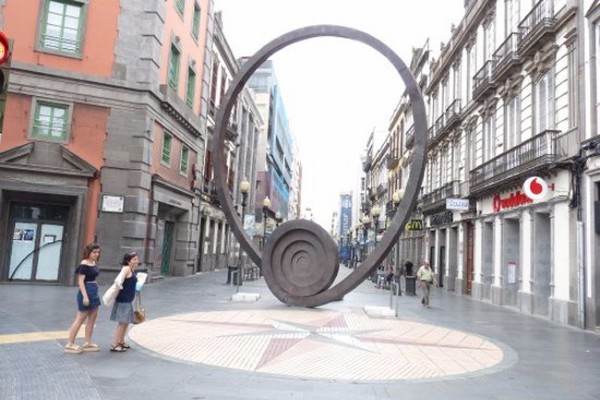
Martín Chirino: La Espiral del Viento, 2003 (Las Palmas de Gran Canaria)
Gustavo Díaz-Jerez: Metaludios II, Book 4 – No. 6. La espiral del viento (Gustavo Díaz-Jerez, piano)
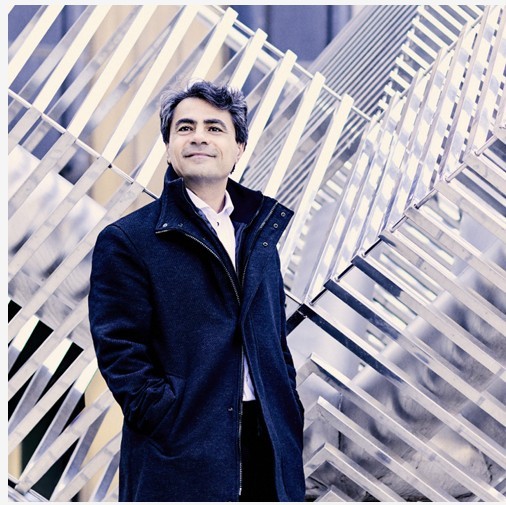
Gustavo Díaz-Jerez, 2025 (photo by Michal Novak)
There are now 7 books of Metaludios, and in each there’s a tribute to a composer (Ravel, Schumann), more mythological characters and places (The River of Oblivion, Perseus) and above all, a sense of experimentation in both compositional techniques and extended techniques for the keyboard.
The combination of science, computing, and music in Gustavo Díaz-Jerez’s work is unique and will lead you down interesting paths of discovery, both in science and in music.
For more of the best in classical music, sign up for our E-Newsletter