For nearly three decades, the Venice Baroque Orchestra has stood as one of the leading ambassadors of historically informed performance. Founded in 1997 by Andrea Marcon, the orchestra’s artistic DNA remains inseparable from his vision. A scholar, harpsichordist, and conductor deeply immersed in Venetian Baroque repertoire, Marcon shaped not only the ensemble’s sound but also its intellectual foundation. His commitment to historically informed performance was rooted in rigorous source study and a profound understanding of Venetian musical life. Under his leadership, the orchestra quickly established itself internationally as a benchmark for clarity, vitality, and expressive authenticity in eighteenth-century repertoire.
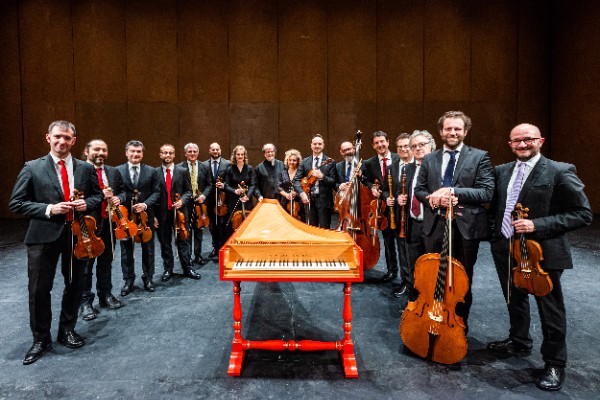
Venice Baroque Orchestra © Luca Valenta
At the heart of the ensemble’s identity is its unbreakable bond with its native city. “There is a fixed point that never changed over decades, and it’s the very strong relationship we have with Venice and with our homeland in general,” Catana explains. “Most of the music we perform was composed in the Venetian Republic, which was the centre of music in the eighteenth century, and for sure we live that repertoire with an incredibly intense connection.” For him, this connection transcends research and technique. “It’s easy for us to understand very well the music that our ancestors sang or wrote. Venice is a unique city. If you don’t live that atmosphere in first person, it’s hard to describe just with words in books or treatises.”
This deep sense of place naturally extends to the orchestra’s dedication to rediscovering overlooked Venetian masterpieces. Over the years, the ensemble has premiered modern performances of works such as L’Orione by Francesco Cavalli and Atenaide by Antonio Vivaldi. “All the composers you mentioned were Venetian or worked in Venice,” Catana says. “Discovering scores that nobody has touched before is an incredible feeling.”
Italy’s rich historical archives continue to surprise us. “In Italy, we’re very fortunate because our long history always holds surprises,” Catana notes. “If you visit the Venetian city library or even browse some private palace collections, you can easily find new scores that were not known before. It is not because they weren’t good, of course, but because of the fascinating story of the books themselves.” Manuscripts often passed through many generations of owners and sometimes disappeared from public knowledge. “You never know what you’ll find if you search an Italian library. I can describe discovering new scores much like finding an unknown painting, romance, statue, or ancient ruin.” For Catana, the thrill of bringing these works to life far outweighs any challenges. Practical difficulties do occur, however: “Sometimes you might miss an instrument part or ensemble piece, or if even just one page of the full score is missing, it becomes very hard to perform the music. But if you can manage it, only the most rewarding part of the job remains.”
Even as the orchestra tours under Catana’s leadership, that foundational vision remains present. “The orchestra was born from his vision,” Catana says of Andrea Marcon. “His deep study of the sources and of Venetian music gave us a very clear direction.” That influence continues to guide the ensemble’s approach, not as something fixed or static, but as a living framework for exploration and rediscovery. It shapes everything from repertoire choices to the smallest details of articulation and phrasing.
Carrying that tradition across continents, however, brings practical realities. “We usually find in the hosting venues both the harpsichord and the double bass, because they are the biggest instruments we cannot bring on flights,” Catana explains. “Cellos and violins can travel as extra seats.” Although temperament is determined in advance, instrument quality inevitably varies. “Sometimes we’re very lucky, sometimes less. But it’s part of the job.” Acoustics also demand constant flexibility. “We are forced to adapt our way of playing to the acoustics of the venue where we’ll perform. We, of course, need some hours to understand how to play with different instruments and different acoustics.”
Amid these variables, one of the orchestra’s defining strengths is its unity. “Ninety-nine percent of the time we have a fixed core of musicians,” Catana emphasizes. “It is very important for us, first of all, to maintain our identity while playing, and also because, when touring, it is crucial to have a very united group.” Beyond artistic cohesion, personal bonds sustain the ensemble’s spirit. “Friendship is very useful both for performing and to be always happy to work together.”
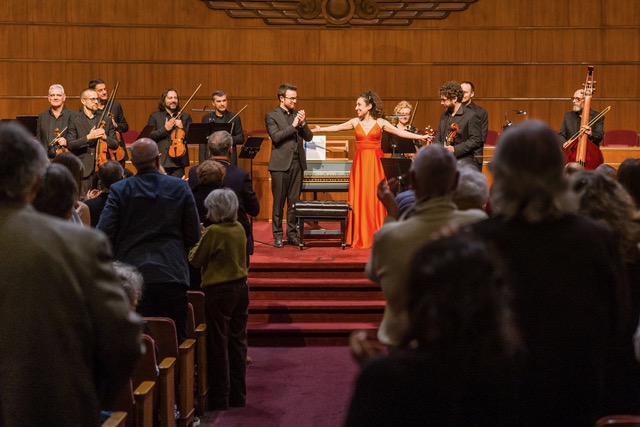
Among the ensemble’s recent artistic collaborations, violinist Chouchane Siranossian has brought particular vitality. “Chouchane is an incredible violinist and a great person. It’s such a pleasure to perform alongside her,” Catana says. Their collaboration, which began in 2019, continues to grow deeper. “She has an incredible sense of sensitivity, and when we first met, she tried to absorb all our experience in playing Venetian music. On the other hand, for us, she’s an inspiration because of her exceptionally refined violin technique and her energy. She never stops, in a very positive way, and pushes us to improve every day.” Looking ahead, he adds, “We have many other projects with her, and we’re both excited about this inspiring cultural exchange.”
© Veritography LLC
Audience energy influences each performance in subtle yet powerful ways. “Audience reactions vary significantly from country to country and city to city,” Catana notes. “Having traveled the world, it’s clear that Asian audiences differ from Europeans, who in turn differ from Americans.” This diversity energises musicians. “Live performances are always shaped by the audience. It’s like a sports match, where the feelings and energy of those around you create different sensations.” As a result, “each performance varies from day to day and feels alive.”
Through rediscovered manuscripts, international touring, and an enduring connection to Venice, the Venice Baroque Orchestra continues to embody a living dialogue between scholarship and performance, rooted in history, sustained by friendship, and animated by the unmistakable atmosphere of its homeland.
To learn more about their tours, please visit https://www.instagram.com/venicebaroqueorchestra/?hl=en and https://www.facebook.com/profile.php?id=100063584529428
For more of the best in classical music, sign up for our E-Newsletter