Composer and singer Barbara Strozzi is one of the best-known women composers of the Baroque era.
Born in Venice in 1619, her upbringing and natural talent combined to make her one of the most prolific women composers in a time and place that was acutely hostile to women composers.
Today, we’re looking at how, despite countless challenges, she managed to make such an impactful musical career.
Barbara Strozzi’s Mysterious Parentage
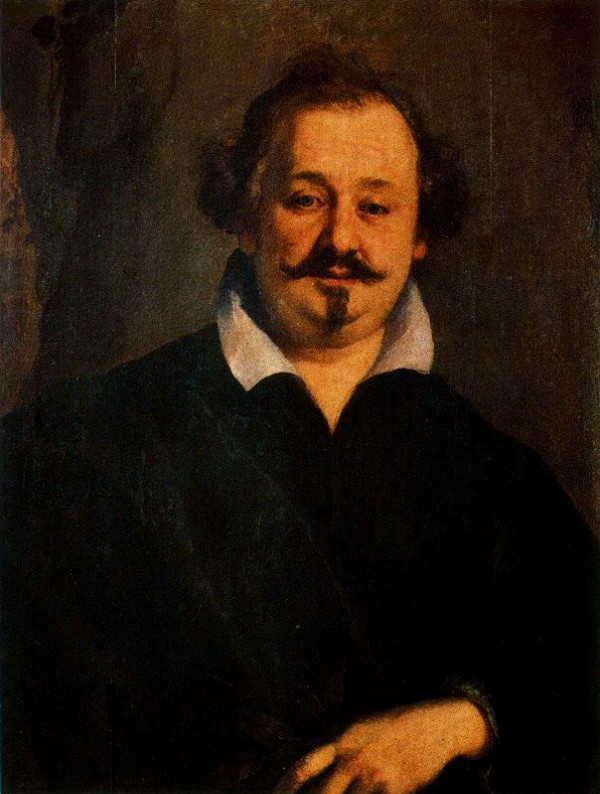
Barbara Strozzi’s father
Barbara Strozzi was born in August 1619 in Venice to a servant named Isabella Garzoni.
At the time, Isabella Garzoni was in the employ of writer Giulio Strozzi, a poet and librettist who was on the cutting edge of an innovative new art form called opera. He was also a member and founder of various clubs for artistic intellectuals called accademias.
Barbara’s birth certificate listed no father, but Giulio openly referred to her as his “adopted” or “chosen” daughter, and she lived in his house with another woman, whom historians have theorised was Isabella.
Barbara Strozzi’s Early Influences
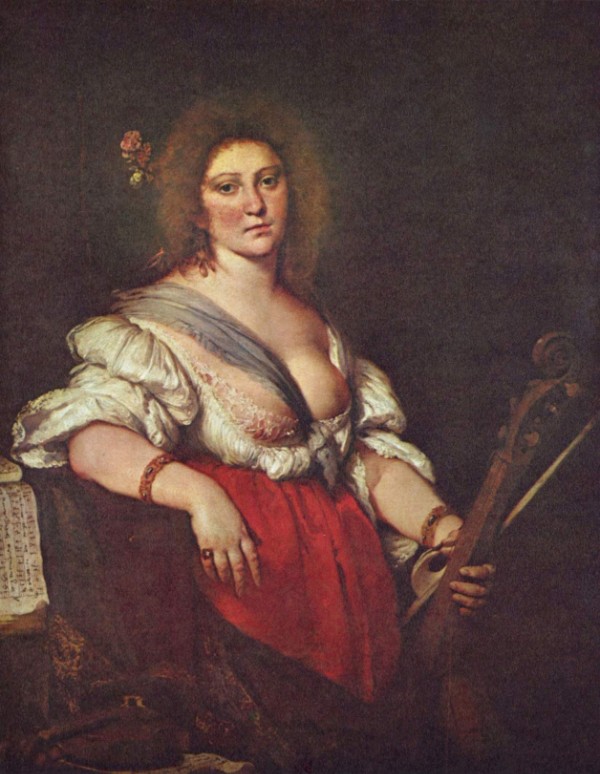
Barbara Strozzi
Barbara demonstrated musical talent at an early age. Fortunately for future listeners, Giulio encouraged her to study music.
With Giulio’s blessing, she began studying composition with Francesco Cavalli, an early opera composer who had been a student of the great Monteverdi.
Giulio allowed his daughter access to the talented visitors and Venetians who came to visit their home.
In 1634, when she was fifteen, Giulio had her sing at one of these at-home accademia meetings. The attendees were awed and inspired by her artistry.
In response, his friend, composer Nicolò Fontei, composed two volumes of songs for Barbara, called Bizzarrie poetiche (Poetic Oddities). Giulio himself wrote most of the lyrics.
An excerpt from Nicolò Fontei’s Bizzarrie poetiche
Hosting the Accademia degli Unisoni
In 1637, Giulio created a new accademia, which he named the Accademia degli Unisoni.
This new group focused on music and was made up of members from the most prestigious Venetian accademia, the Incogniti. All members of both the Incogniti and Unisoni were writers, thinkers, and artists of the first rank.
One of the Unisoni’s purposes was to give Barbara a platform to share her musical talent. In 1638, the accademia assembled a publication (dedicated to Barbara) that reported on the accademia’s activities during three of their meetings.
Surviving accounts indicate that those present at the accademia spoke of deep philosophical questions (“does love bring more happiness or unhappiness?” “does slander encourage virtue?”).
Between their discussions and debates, they listened to music together, some of which Barbara would have composed and performed.
However, according to the accademia’s publication, Barbara was not just present at these meetings as a guest or a performer; she was also the hostess.
In fact, historian Ellen Rosand refers to her as a “mistress of ceremonies, suggesting the subjects on which the members were to display their forensic ingenuity, judging the discourses, and awarding prizes to the best of them.”
Barbara Strozzi’s Reputation
It was considered unseemly for women to be so interested in music and to play a leadership role in an accademia.
Rosand writes:
To at least one seventeenth-century Venetian observer, Barbara’s function [at the Accademia degli Unisoni] seems to have evoked the traditional association between music-making and sexual license so well documented in Cinquecento Venice.
In 1637, an anonymous author wrote a brutal satire criticising the group, and Barbara particularly. They write that at one gathering, she passed out flowers to the members, then commented of her gift: “It is a fine thing to distribute the flowers after having already surrendered the fruit,” insinuating she was granting sexual favors to the accademia’s members.
As a young woman, rightly or wrongly, Barbara Strozzi developed a reputation as promiscuous. This may have been an image she chose to embrace, or at least accepted, for practical purposes.
Her famous portrait, painted when she was a young woman, made a point of showcasing her breasts, one of which is uncovered.
And in 1655, Antonio Bosso wrote to Carlo II, the duke of Mantua:
I will tell your most Serene Highness some curiosities that are not too serious. Barbara Strozzi dedicated to the Archduchess of Innsbruck some of her music; her Highness sent to her the other day a small gold box adorned with rubies and with her portrait, and a necklace, also of gold with rubies, which the said Signora prizes and shows off, placing it between her two darling, beautiful breasts (Oh, what tits!).
It is unknown whether the rumours of promiscuity were made up whole cloth, or whether she did, in fact, work as a courtesan as well as a composer. Venetian courtesans of this time were famous for their cultivation of musical talents.
Barbara Strozzi’s Op. 1
Sadly, we do not know much about Strozzi’s career in the 1640s, besides the fact that she published her opus 1, a book of madrigals, in 1644, at the age of 25. Her father provided the texts.
Barbara Strozzi’s Il Primo Libro de’ Madrigali, Op. 1
Anticipating a sexist backlash, she wrote in the dedication to the Grand Duchess of Tuscany, Vittoria della Rovere:
I must reverently consecrate this first work, which, as a woman, I publish all too anxiously, to the Most August Name of Your Highness, so that under an oak of gold it may rest secure against the lightning bolts of slander prepared for it.
Barbara Strozzi’s Family and Children
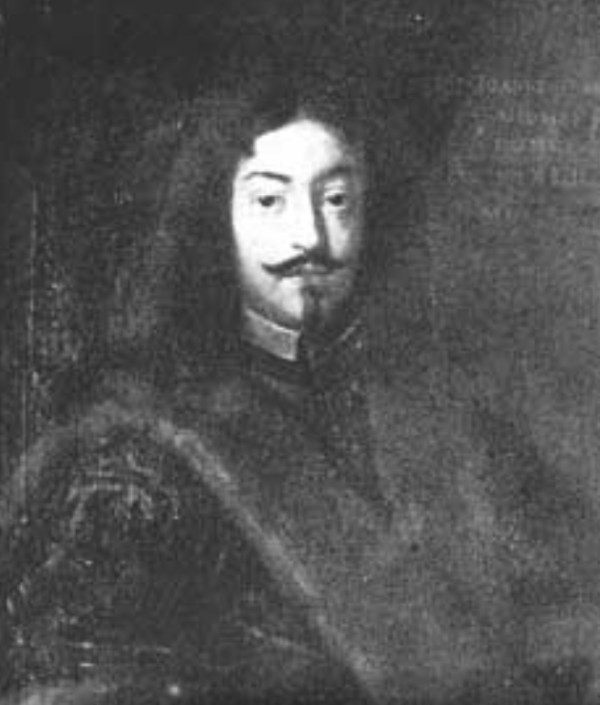
Barbara Strozzi’s lover Giovanni Paolo Vidman
Around 1640, it is believed that Barbara Strozzi entered into a sexual relationship with an Italian nobleman named Giovanni Paolo Vidman. This is the same individual to whom Giulio Strozzi dedicated his most famous libretto, La finta pazza, in 1641.
Barbara had four children: Giulio, Isabella, Laura, and Massimo. Although it’s not known for sure, historians have theorised that Vidman may have been the children’s father.
A letter has been found in the Venetian archives, written by an unknown author, that claims that Barbara was sexually assaulted by Vidman and then pressured into a longer-term relationship with him.
It is unclear if this story is true, a misunderstanding, or simply a story that was contrived to protect her reputation, since she never married Vidman.
Barbara Strozzi’s Op. 2
In 1651, when she was thirty-two, Strozzi published a collection of cantatas that became known as her op. 2.
An excerpt from Strozzi’s Op. 2
Like her op. 1 dedication, this work’s dedication also included a reference to her womanhood:
The lowly mine of a woman’s poor imagination cannot produce metal to forge those richest golden crowns worthy of august rulers.
(Interestingly, as Strozzi got older, she stopped including references to her gender in her dedications.)
She dedicated her op. 2 to Ferdinand III of Austria and Eleanora of Mantua in honour of their April 1651 marriage.
Like most composers who dedicated their music to royalty, she was doubtless looking for some kind of professional or financial reward. Perhaps Barbara saw in Eleanora of Mantua a kindred spirit, as both were well-educated women with passions for music and literature.
Unfortunately, neither Ferdinand nor Eleanora ever acknowledged the dedication in any way.
The Death of Giulio Strozzi
Giulio Strozzi died in March of 1652, when Barbara was thirty-three.
He had died poor, passing along a bed, some clothing, a few books, and his remaining writings. He didn’t even have enough to pay for his own burial.
The unmarried Barbara was going to have to make her own way in the world economically. Luckily, she had proven to be a savvy investor, and she appears to have been modestly well-off.
Barbara Strozzi’s Later Career
One of the ways she appears to have supplemented her income was by composing multiple vocal works and dedicating the resulting works to various wealthy personages, hoping to secure financial rewards or a court position.
Her Op. 5 was published in 1655, her Op. 6 in 1657, and her Op. 7 in 1659. Her final opus, op. 8, was published in 1664. She was forty-five.
An excerpt from Strozzi’s Op. 8
Barbara Strozzi’s Death and Legacy
Barbara Strozzi died in November 1677 in Padua, Italy, at the age of fifty-eight, after an illness of between one and three months, and after a sudden decline.
Her death certificate places her age at seventy, an intriguing detail that suggests that nobody present at her deathbed knew her age or birth date.
Although Barbara Strozzi’s surviving output is narrowly focused on the genre of madrigal, that output was considerable and of incontrovertibly high quality. More of her music may still be awaiting rediscovery in Italian archives.
Her biography may be incomplete, but Barbara Strozzi is rightfully recognised as one of the greatest composers of the Baroque era.
Hopefully, her elegant, poetic works will appear on more and more concert programs in the years to come.
For more of the best in classical music, sign up for our E-Newsletter