In the spring of 1846, dashing French author George Sand began writing a novel inspired by the breakdown of her romantic partnership with pianist and composer Frédéric Chopin. She titled it Lucrezia Floriani.
Lucrezia Floriani tells the story of three people:
- the weak and perpetually anxious 24-year-old Prince Karol;
- Prince Karol’s flirty and lighthearted friend Salvator; and
- Lucrezia, a wealthy 30-year-old actress and mother of four children (who, scandalously, has gotten pregnant by three men).
Prince Karol is clearly based on Chopin, and Lucrezia on George Sand herself. If there was any doubt about that, she wrote their six-year age difference into the novel.
The portrayal of Karol/Chopin that Sand created was not flattering, to put it mildly. Unsurprisingly, the couple split the year after it was written, which means it can be read as a kind of pre-breakup post-mortem.
A piece of fiction is never going to tell the objective truth about a situation, especially not a messy breakup.
However, George Sand was known for taking liberal inspiration from her tumultuous real-world love life and applying it to her novels.
And as long as the passages are taken with considerable grains of salt, perhaps they can offer insight into the secrets behind the disintegration of one of the nineteenth century’s most famous love affairs.
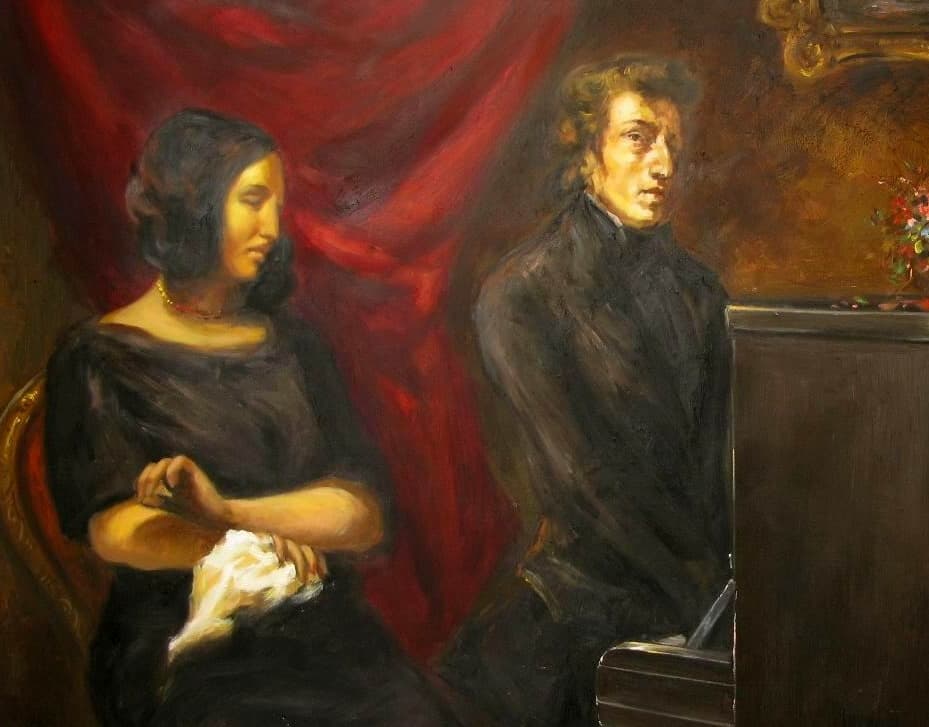
Portrait of Frédéric Chopin and George Sand by Eugène Delacroix
It seems that George Sand simultaneously deified, infantilised, desexualised, and feminised Chopin in her own mind.
Here’s a passage early in the book describing Karol’s appearance:
The spirit of Karol was, by nature, delightful.
Gentle, sensitive, exquisite in all things, at the age of fifteen, he had all the graces of adolescence combined with the gravity of maturity.
He remained physically delicate, as he was spiritually. But this very absence of muscular development had the advantage of preserving in him a charming beauty, an exceptional physiognomy which, so to speak, was without age or sex.
It did not have the boldness and virility of one descended from that race of ancient grandees who knew of nothing but drinking, hunting and fighting, nor was it the effeminate prettiness of a pink cherub.
It was something like those ideal beings created by the poetic imagination of the Middle Ages to adorn Christian places of worship: an angel with the beautiful face of a sad woman, tall, perfect and slim of figure like a young Olympian god, and to add to all this, an expression both tender and severe, chaste yet ardent.
Chopin had a prudish streak, and it extended to his interactions with other people.
At one point, his friend Salvator quips to Karol:
If you had a slightly improper thought, you would blow out your brains. Consequently, you are implacable when others think that way.
Despite this, it seems like in the early days, Chopin was taken by Sand’s physicality.
Sand writes of the idyllic early days of Karol and Lucrezia’s romance:
At the beginning, she found utter happiness and unadulterated joy in the arrangement.
Karol was so unassertive, so submissive, he had pledged himself so completely, he was so greatly under her spell that a single word, a glance, an innocent caress was sufficient to send him to the heights of indescribable ecstasy.
Bruce (Xiaoyu) Liu Plays Chopin’s Etude in C sharp minor, Op. 10 No. 4
Chopin struggled with Sand’s romantic history.
Before devoting herself to Chopin, Sand had had a colourful love life.
In the book, Sand writes about Karol’s horror of Lucrezia’s considerable sexual experience and agency:
Then again, when speaking of herself, Lucrezia had hurt him deeply. She had used words which had burned him like a red-hot iron.
She had said that she had never been a kept woman; she had depicted the lives and morals of her colleagues with terrible truth. She had told of her first loves and had actually mentioned her first lover by name.
Karol would have wished that the mere idea of evil should not occur to her, that she should be unaware of the existence of evil on earth or that she should not remember it when speaking to him.
In short, in order to complete the total sum of his fantastic requirements, he would have wished that without ceasing to be the kind, tender, devoted, voluptuous and maternal Lucrezia, she should also be the pale, innocent, severe and virginal Lucie [Karol’s late and idolised fiancée].
This was all that our sad lover of the impossible asked for!
Thoughts of poor health and death were constantly hanging over Chopin’s head.
Sand writes:
Hitherto, Karol had lived with the thought of death. He had grown up so accustomed to it that, before he had been stricken with this illness, he had reached the stage when he believed that he belonged to death and that every day of respite which he had been granted was by mere chance.
He even went so far as to joke about it; but when we form that kind of idea when we are well, we can accept it with philosophical calm, whereas it is rare not to be driven to panic when it invades a mind weakened by illness.
In my opinion, the only sad thing about death is that it comes to us when we are so prostrated and demoralised that we can no longer see it for what it is, and that it even terrifies souls which are in themselves calm and resolute.
Thus, what happened to most sick people happened to the prince. When he had to pit himself at close quarters against the idea of dying in the springtime of life, the sweet melancholy on which he had fed hitherto degenerated into black despair.
Vladimir Horowitz Plays Chopin’s Ballade in G Minor
Chopin viewed George Sand as a substitute mother figure, and she viewed him as an outlet for her maternal instincts.
After escaping political turmoil and violence in Poland, Chopin became deeply homesick for his family, whom he could not regularly see.
Perhaps that’s one reason why he was attracted to a partner who would serve more the role of a mother or sister than a lover or equal partner.
In the book, Prince Karol comes down with an illness while visiting Lucrezia. She takes him in and nurses him back to health.
On another occasion, Karol still leaning on Madame Floriani’s arm, tried to support himself unaided.
“I feel better,” he said, “I have more strength. I have tired you too much. I don’t understand how I could take advantage of your kindness to such an extent.”
“No, no, lean on me, my child,” she answered gaily, using the familiar form of address which was a habit she easily adopted with people who interested her, and in Karol’s case, she had come to regard him almost as a son.
“Are you my mother, then? Are you really my mother?” asked Karol, whose mind was beginning to become confused again.
“Yes, yes, I am your mother,” she replied, without thinking that for Karol such a statement might be sacrilege. “Rest assured that at this moment it is absolutely the same thing.”
Chopin may have had deep insecurities about taking on a fatherly role to George Sand’s children.
Chopin was clearly attracted to the idea of Sand playing a maternal role in his life, but Karol in the book is deeply upset about the prospect of becoming a stepfather.
“And I, if I had the misfortune of being a father,” Karol retorted and his voice was strained, as if he were suffering, “I could not tolerate the discordant sound of rebellion and threats, the conflict with one’s children, the bitter tears shed by a helpless creature who does not understand the laws of the impossible, the sham tempers whipped up by paternal morality, the sudden frightful upheaval of domestic calm, the storms in a tea-cup which I know are nothing, but which would perturb my soul as if they were serious events.”
With time, and as Chopin’s health became worse, their relationship became less physical.
Chopin’s struggle to engage with Sand’s sexuality is suggested in the book:
Lucrezia had always been deeply touched by the respect he showed her in the presence of her children and her servants. Nothing in him recalled the offensive over-familiarity and the impertinent lack of restraint of successful lovers.
But when they were alone, she was not accustomed to seeing him turn his face away from her lips and greet her by kissing her hand, like an abbé paying his respects to a dowager.
She attempted to put an end to this cold atmosphere; she reproached him tenderly, she poked gentle fun at him: it was all in vain.
Seong-Jin Cho Plays Chopin’s Mazurka in B minor Op. 33 No. 4 (third stage)
Sand didn’t like that Chopin kept so many thoughts and feelings inside.
In a meta twist, the book’s unnamed narrator, possibly George Sand herself, often steps into the narrative to offer her thoughts about the story.
At one point, this narrator starts delivering a monologue about the repression of emotion:
Of all angers, of all vengeances, the darkest, the most atrocious, and the most agonising is the one which remains cold and polite.
When you see a person master himself to that degree, say if you wish that he is great and strong, but never say that he is tender and good.
I prefer the coarseness of the jealous peasant who beats his wife to the dignity of the prince who rends his mistress’ heart without turning a hair. I prefer the child who scratches and bites to the one who sulks in silence.
By all means, let us lose our tempers, be violent, ill-bred, let us insult one another, break mirrors and clocks! It would be absurd, but it would not prove that we hate one another.
Whereas, if we turn our backs on one another very politely as we part, uttering a bitter and contemptuous word, we are doomed, and no matter what we do to be reconciled, we will become more and more alienated.
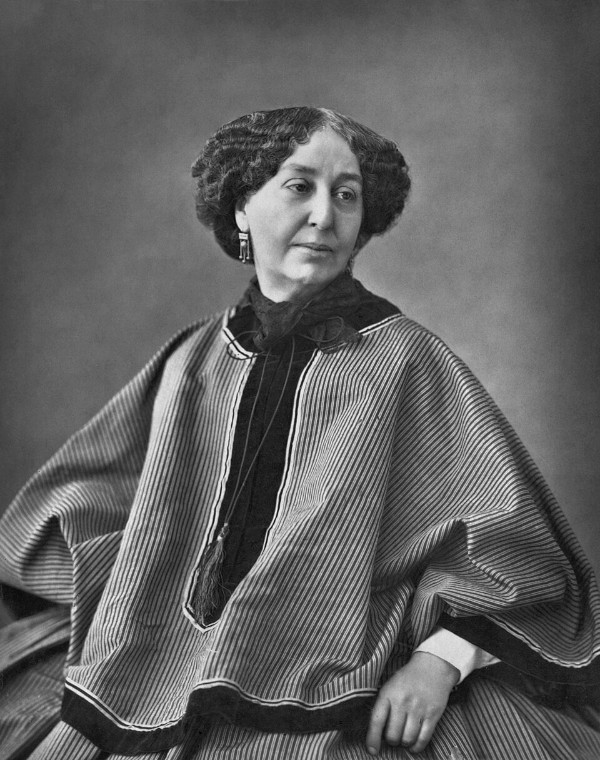
George Sand – Portrait by Nadar (1864)
Chopin’s depression and anxiety clearly took a heavy toll on the couple’s relationship.
A modern reader will recognise that Karol has many symptoms of mental health issues. He frequently spirals and catastrophizes, making assumptions that have no bearing in reality.
This passage describes how his friend Salvator reaches a breaking point:
Salvator Albani had always known that his friend was inconsistent and temperamental, both excessively demanding and excessively unselfish, but in the old days, the good moods used to be the most frequent and the most durable.
Now, on the contrary, since his return to the Villa Floriani, Salvator saw the prince lose more and more of his hours of serenity each day and sink into a habit of strange sullenness; his character was becoming visibly more bitter.
At the beginning, it was one bad hour a week, then one bad hour a day. Gradually, he had only one good hour a day and finally one good hour a week.
However tolerant and good-humoured the count was, he ultimately found Karol’s behaviour intolerable.
He said so first to his friend, then to Lucrezia, then to both of them together.
Finally, he felt that his own character would become bitter and deteriorate if he persisted in living in their company.
He resolved to leave them both.
Menahem Pressler Plays Chopin’s Nocturne C# minor
Sand clearly believed that continuing their relationship would result in a kind of living death.
Despite the increasingly toxic nature of their love, at the end of the novel, Karol and Lucrezia marry. Marriage spells tragedy for them both, and Sand’s description of what happened is chilling:
They loved each other for a long time and lived very unhappily ever after. Their love was a desperate struggle as to which would consume the other…
He loved her so much, he was so faithful, so absorbed, so fettered, enchained, he spoke of her with so much respect that it would have been a glory for a vain woman. But Lucrezia did not hate anyone sufficiently to wish him or her that kind of happiness.
He ended by triumphing, as always happens to a will bent on a single goal. He brought Lucrezia back to the villa, which was still the most secluded place they could find, and there he succeeded in isolating her so effectively that people thought she was dead long before she actually was.
The real George Sand, however, was not like her fictional creation. She parted ways with Chopin for a variety of reasons, including those explored here, and the break was final. In fact, she didn’t even come to his funeral, which occurred three years after the publication of the book.
Final Thoughts
It’s never wise to assume that a fiction writer is ever objectively recounting real life in their work.
However, as long as a reader is comfortable living with ambiguity, conjecture, and many grains of salt, fiction can certainly grant insight into the subjective truth of a particular author’s lived experience.
At the very least, Lucrezia Floriani provides emotional and psychological food for thought for all fans of Chopin and Sand.
For more of the best in classical music, sign up for our E-Newsletter