Helen Grime’s Night Songs Inspired by Joseph Cornell
The American artist and filmmaker Joseph Cornell (1903–1972) was best known for his assemblages. Using found objects, he created shadow boxes, deep boxes with glass fronts, in which he made arrangements of material, various small objects such as photographs and bric-a-brac. These were not meant simply to be looked at but generally required the viewer to interact with. He was fascinated by the once-beautiful objects he found discarded and put them together in unique assemblages. He took from Surrealism the idea of ‘irrational juxtaposition’. Many of his objects carry an air of nostalgia.
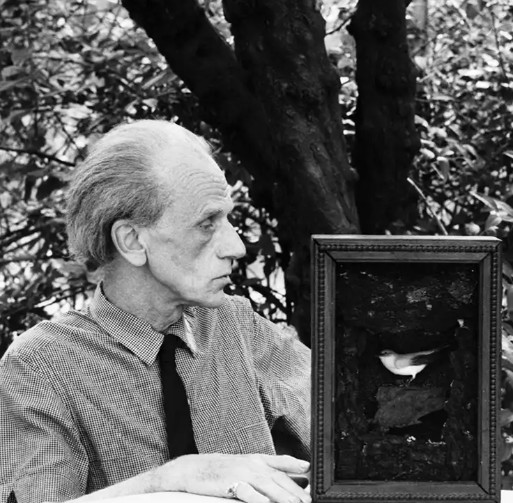
Joseph Cornell
His boxes were often created in series, changing with his interests, such as the Soap Bubble Sets, the Medici Slot Machine series, the Pink Palace series, the Hotel series, the Observatory series, and the Space Object Boxes. The Aviary series started with images of birds set against harsh white backgrounds.
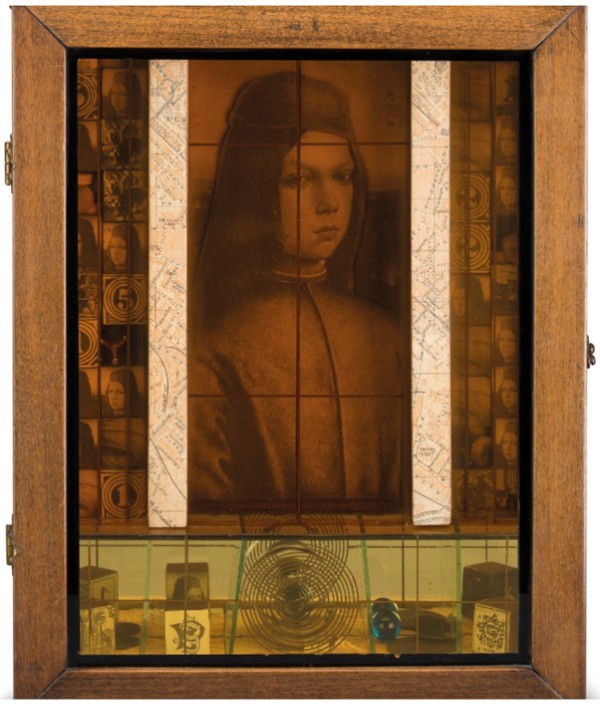
Cornell: Medici Slot Machine, 1943 (Christie’s Auction 2014)
One could see Cornell’s boxes as ‘both impossible and imaginary museums’, as one auction catalogue put it. They capture frozen moments in time and hold in stasis images that may only be seen once – birds, stars, people. In Cornell’s boxes, the glass front can operate almost as a storefront window where we sit, and the world passes by.
Night Songs, created between 1953 and 1955, is prosaically described by its holding music as being made of ‘wood, glass, xeroxed photographs, paint, spring, compass and other objects’.
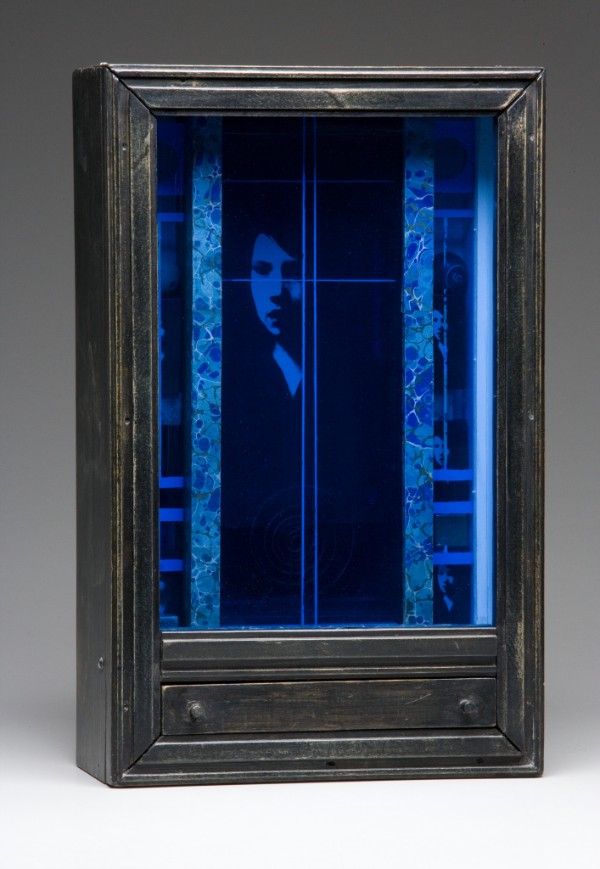
Joseph Cornell: Night Songs, ca 1953–1955 (Detroit Institute of Arts)
In a photograph by Michael Doyle, the drawer has been opened, and the objects inside can be seen.
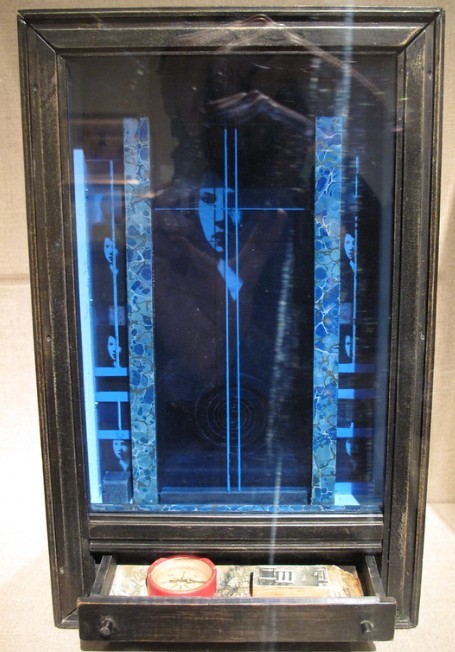
Joseph Cornell: Night Songs, ca 1953–1955 (Detroit Institute of Arts) (photo by Michael Doyle)
In the box, the central image of a girl looking off to the right is reproduced several times in a smaller size on the edges. Two vertical pieces of marbled paper separate the central image from the sides. Another image in the side panel is that of a pool ball. The drawer below the image holds a compass and some photographs. The blue cast of the main box gives the colour of night.
Scottish composer Helen Grime (b. 1981) was impressed by Cornell’s ability to create a ‘self-contained miniature world’. The dimensions are just 16 15/16 × 10 3/16 × 4 3/16 inches (43 × 25.9 × 10.6 cm). She sees the sculpture as having a ‘melancholy yet fantastical undertone’ and, in writing her piece Night Songs, has sought to bring out that aspect.

Helen Grime (photo by Amy Barton)
The melody in the high oboe that opens the work, which is picked up by a muted piccolo trumpet, becomes the core of the work. It shifts through the piece, changing colour, shape, and rhythm until, at the end, it comes to a ‘brief, yet passionate, climax’. There’s a final buildup to an entrance by the entire orchestra that spreads from the highest to the lowest pitches. As the work ends, elements of the earlier melodies and episodes come back like fleeting memories.
Helen Grime: Night Songs (Hallé Orchestra; Jamie Phillips, cond.)
The work was commissioned by the BBC to celebrate the composer and conductor Oliver Knussen’s 60th birthday. It was given its premiere at the BBC Proms in 2012, with Oliver Knussen conducting the BBC Symphony Orchestra.
Cornell lived an isolated life in New York City, caring for his disabled brother and his mother. Although he had no formal art training, he was fully aware of the art scene of the 1950s and 1960s in America and is considered an innovative Surrealist.
Cornell has been quoted as saying that his idea of perfect happiness was quickly being plunged into a world in which every triviality becomes imbued with significance. In her music, Grime has taken a simple melody and made it the driving force behind a significant orchestral statement.
For more of the best in classical music, sign up for our E-Newsletter