As the weather cools, our desire for a lovely glass of red wine heats up. Red wines are judged on 4 criteria: colour, body, tannin, and flavour. With those 4 criteria come a host of descriptive words.
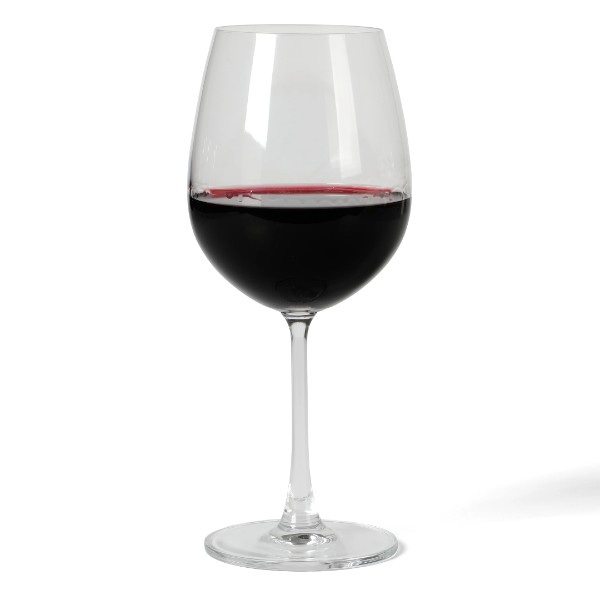
Glass of Red Wine
All wine comes from grapes, but when you leave the grape skins in the pressing and fermentation, your wine changes from white to red and in that world of colour is a world of taste. Colour is tied in with the concept of a wine’s body (light, medium, or full). Red wines come in colours ranging from deep purple (generally for younger wines) to brown for older wines. If you have a light-bodied red, then you’ll have a colour that’s more translucent.
Tannins are the feeling of wine on the tongue. A very tannic wine can make your mouth feel (over) dry. Descriptors such as rustic, green, or astringent give you an idea of the tannins, whereas on the other side, the words ripe and smooth describe a different tannic experience.
The idea of flavour is where descriptors go wild. Trying to convey a complex and changing flavour in mere words is the challenge to the taster. Descriptions based on familiar fruits, flowers, herbs, and spices are important as well as less-defined descriptions such as ‘earthy’, ‘wet gravel’, or ‘forest floor’.
As you develop your palate, you too will start to develop your vocabulary of wine, seeking to communicate the nature of taste in words.
From Homer in The Iliad and The Odyssey, we have the wonderfully evocative phrase of the ‘wine-dark sea’. The true meaning of this has been discussed for centuries, but although we don’t know what colour Homer was referring to, everyone agrees that it means ‘dark’ and not ‘blue’. Zeus was described as having ‘wine-dark’ eyebrows, which certainly won’t mean ‘blue’!
Jocelyn Morlock: 3 Meditations on Light – Bioluminescence (Wine-dark sea) (Couloir, Ensemble)
Brazilian composer and guitarist Egberto Gismonti brought together two of the ancient liquids of the world in his jazz piece Wine and Water.
Egberto Gismonti: Agua e Vinho (Water and Wine) (Sharon Isbin, guitar)
Wine as a colour can mean only dark reds, as in this painting by Mark Rothko
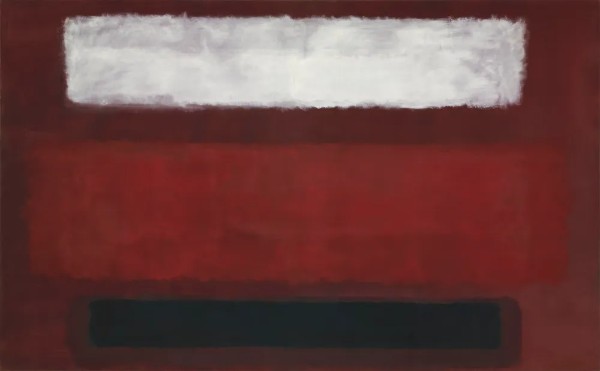
Rothko: White and Black on Wine (Potomac, MD: Glenstone)
Adam Schoenberg: Finding Rothko – Wine (Kansas City Symphony; Michael Stern, cond.)
The key to the hedonistic lifestyle, according to 19th-century composers, always involved wine. For Johann Strauss II, there were two other elements that were very important: a Wife (or a Woman) and a Song. This may seem an odd choice for a dance, but since this started out as a work for the Wiener Männergesang-Verein (Vienna Men’s Choral Association), it was a choral waltz that later became an orchestral dance. The orchestral waltz was so popular upon its premiere in Russia in 1869 that it had to be repeated and was played a total of 14 times during the Strauss Orchestra’s Russian tour.
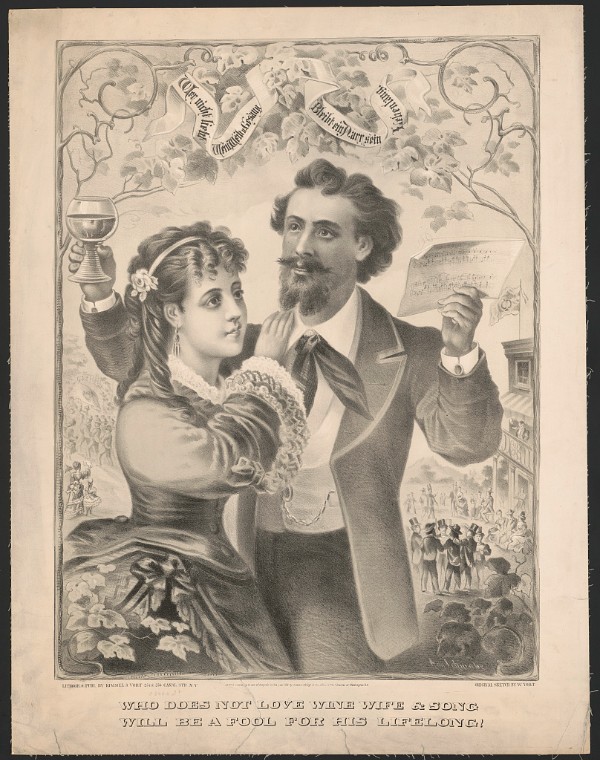
Who does not love wine, wife & song, will be a fool for his lifelong! Advertisement, 1873 (Library of Congress, LC-USZ62-59585)
Johann Strauss II: Wein, Weib und Gesang! (Wine, Woman, and Song!), Op. 333 (Estonian National Symphony Orchestra; Neeme Järvi, cond.)
Because of its fame, the pianist Leopold Godowsky made a ‘symphonic metamorphoses’ of the work as part of his 3 Symphonic Metamorphoses on Themes of Johann Strauss II. Other Strauss works that were part of these were Künstlerleben (An Artist’s Life) and Die Fledermaus.
Leopold Godowsky: 3 Symphonic Metamorphoses on Themes of Johann Strauss II: No. 3. Wine, Women and Song (Konstantin Scherbakov, piano)
Drinking in opera is the way to indicate celebration, or, if your beloved has left you, to signal a deeper unhappiness than even wine can help with. At the end of Pietro Mascagni’s Cavalleria rusticana, the lover Turiddu is trying to get Alfio’s wife, Lola, to come back to him. Alfio challenges Turiddu to a fight. Turiddu has a final song for his mother (Lucia), Lola, and Santuzza, a peasant girl who loves him, Mamma, quel vino e generoso, telling them that he’s drunk too much, but still has to go meet Alfio. Unfortunately, Alfio is triumphant.
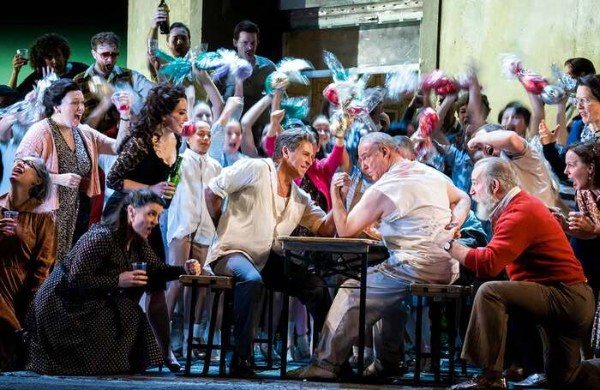
The cast of Cavalleria Rusticana at the Royal Opera House, London, 2023 (Photo by Tristram Kenton)
Pietro Mascagni: Cavalleria Rusticana – Mamma, quel vino e generoso (Turiddu, Lucia and Santuzza) (Giacomo Aragall, tenor; Alzbeta Michalková, contralto; Stefka Evstatieva, soprano; Slovak Radio Symphony Orchestra; Alexander Rahbari, cond.)
In the opera Bomarzo, by Argentinian composer Alberto Ginastera, the opera is set in the dream world of the Duke of Bomarzo after he’s been poisoned, in a glass of red wine given to him by his astrologer…
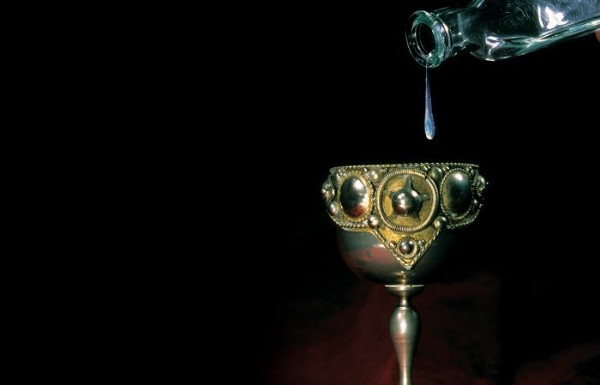
The poisoned chalice
Alberto Ginastera: Bomarzo, Op. 34 – Act II Scene 9: Omen of the Red Wine (Isabel Penagos, soprano; Salvador Novoa, tenor; Richard Torigi, baritone; Washington Opera Society Chorus; Washington Opera Society Orchestra; Julius Rudel, cond.)
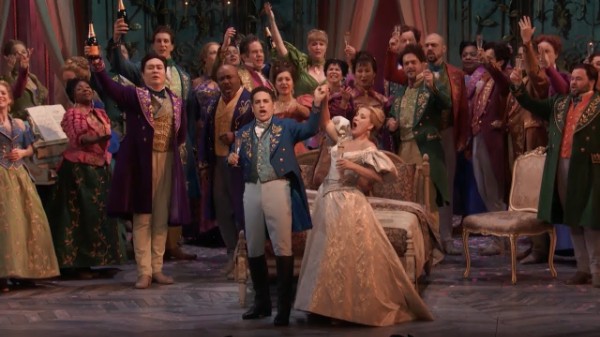
The Spanish composer Juan Ponce, born around 1476 and died around 1520, attended Salamanca University and left a drinking song, arranged for 4 voices, Ave color vini clari with the wonderful student sentiment: Hail, clear colour of wine / Hail, flavour without equal / And your deeming power / To make us drunk (inebriari)! The students scarcely need the encouragement.
Achille Pinelli: Tavern Scene, 1833
Juan Ponce: Ave color vini clari (Orlando Consort, Ensemble)
In northern France is the forgotten city of Laon, once a thriving wine capital to the point that one of Europe’s finest Gothic cathedrals is there. Its Notre-Dame de Laon began construction in 1160 and was built concurrently with the much more famous Notre-Dame de Paris. Wine production began in the 7th century, and monasteries in Belgium and England sourced their wine there. In red wines, it’s thought that an early pinot noir and possibly an early gamay may have been grown here. After the 18th century, wheat fields replaced vineyards, and all we have left is Dufay’s farewell to the good wines of the city.
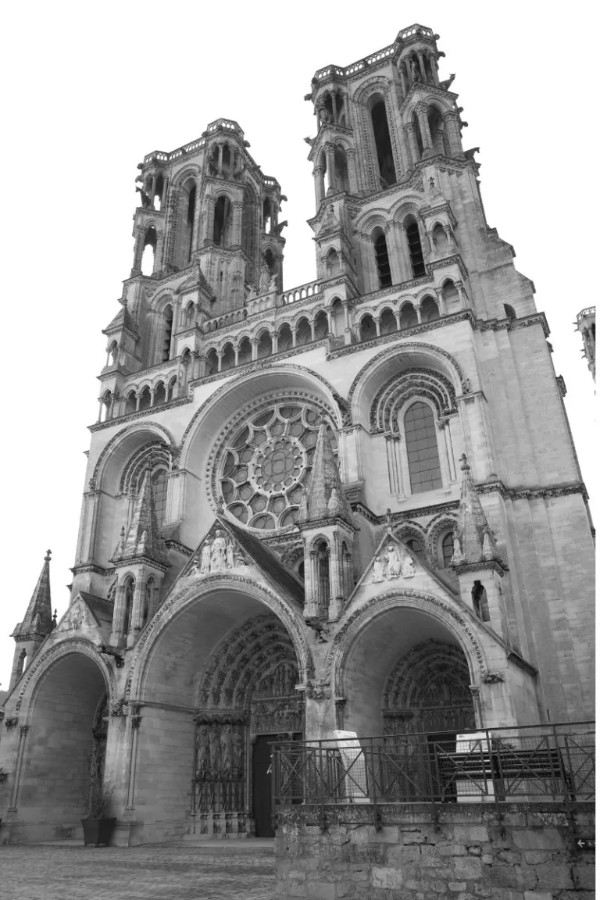
Façade of Notre-Dame de Laon
Guillaume Dufay: Adieu ces bons vins de Lannoys (Orlando Consort, Ensemble)
Dark red wine is the wine of meat, of rich and heavy flavours; Lighter red wines go with salmon. If you have a very tannic wine, pair it with fat and protein, such as beef, lamb, or a robust cheese. The peppery taste of a Shiraz pairs beautifully with a spicy sausage. It’s all part of that delicate balance. Just don’t overpower either your food or your wine!
For more of the best in classical music, sign up for our E-Newsletter