In June 1816, thirty-one-year-old Leipzig-based piano teacher Friedrich Wieck married his talented student, nineteen-year-old Mariane Tromlitz.
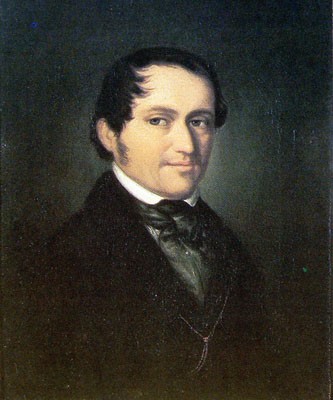
Friedrich Wieck
Although their marriage would only last a few years, it ended up producing one of the most talented and influential musicians of the nineteenth century: Clara Wieck Schumann.
However, Clara had siblings, as well as a bevy of half-siblings. What happened to them? What role did they play in the Wieck family dramas? Were they able to make a living in music like their sister?
Today, we’re looking at what happened to Clara Schumann’s siblings.
Adelheid Wieck (1817-1818)
Clara’s mother, Mariane, was a talented pianist and piano teacher. She performed at the prestigious Gewandhaus concert hall while pregnant with her first baby, a girl named Adelheid.
Tragically, Adelheid died the following year, in 1818.
Clara Josephine Wieck (1819-1896)
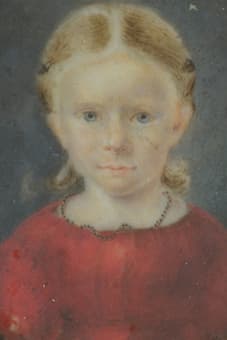
Clara Wieck as a young girl
The year after Adelheid’s death, Mariane gave birth to her daughter, Clara Josephine Wieck.
Clara Wieck (known as Clara Schumann after her marriage) was one of the greatest pianists of the nineteenth century.
We have many articles about her life and work. You can read more about her here:
13 September: Clara Schumann Was Born
Clara Wieck-Schumann: “I once believed that I possessed creative talent”
13 Facts You Didn’t Know About Clara Schumann
Today, however, we’re focusing on her family.
Friedrich Alwin Feodor Wieck (1821-1885)
Friedrich Alwin went by “Alwin” to differentiate him from his father Friedrich.
From an early age, the household revolved around Clara, her training, and her career. It was made clear to Alwin that he and his brothers were never going to receive the support she did.
In August 1831, Robert Schumann wrote an infamous diary entry about the abuse in the Wieck family:
Yesterday I saw a scene whose impression will be indelible. Meister Raro [Friedrich Wieck] is surely a wicked man. Alwin had not played well: “You wretch, you wretch – is this the pleasure you give your father” – how he threw him on the floor, pulled him by the hair, trembled and staggered, sat still to rest and gain strength for new feats, could barely stand on his legs anymore and had to throw his prey down, how the boy begged and implored him to give him the violin – he wanted to play, he wanted to play – I can barely describe it – and to all this-Zilia [Clara] smiled and calmly sat herself down at the piano with a Weber sonata.
Alwin was one of Clara’s first piano students. He also took violin lessons from Ferdinand David, the concertmaster of the famed Gewandhaus Orchestra in Leipzig (and the dedicatee of Mendelssohn’s 1844 violin concerto).
When he was old enough, he moved out of the country to present-day Estonia, worked in an opera orchestra in St. Petersburg between 1849 and 1859, and ultimately settled down in Dresden, where he taught music until his death.
He used his famous father’s methods and eventually came out with a book explaining them. This led to a quarrel between him and his younger half-sister Marie Wieck, who also published a book of her own on the same topic. Fortunately, they eventually reconciled.
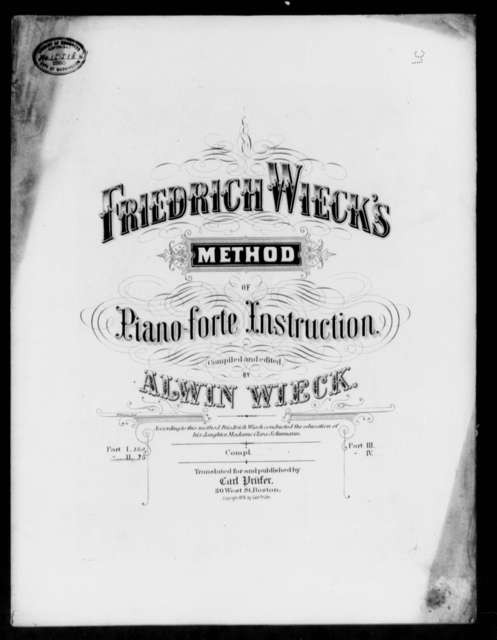
Friedrich Alwin Feodor Wieck’s book
Despite any tensions left over from their stressful childhoods, Alwin and Clara remained on good terms and sometimes spent their summer vacations together.
After his death, in a letter to a friend, Clara expressed sadness that his contribution to the preservation of their father’s legacy wasn’t more broadly acknowledged:
What saddens me deeply is the fact that Alwin had grieved so terribly in the last months, because he was not mentioned even with a single word in the newspapers on the occasion of my father’s 100th birthday, after he had been so committed to disseminating the method of our father with tireless diligence and had achieved the best results with it.
“Even though we rarely saw each other, he was always very attached to me,” she wrote.
Gustav Robert Anton Wieck (1823-1884)
Gustav was taught music from an early age, just like his siblings.
He appears in an 1829 entry in Friedrich and Clara’s joint diary. In that performance, at the age of six, Gustav played three of Clara’s waltzes on glockenspiel before assembled houseguests.
In the autumn of 1830, the year Gustav turned seven, Robert Schumann moved into the household to study with Friedrich.
Clara and Robert’s daughter Eugenie later wrote about the joy that Robert brought to the Wieck children:
The mornings belonged to work, to serious study under Wieck’s direction…
Evenings were the nicest time. Robert would fetch the children – Clara and her two brothers, Alwin and Gustav – to his room, and here he would become a child again with the children.
He told them his best stories and played charades with them; he teased and frolicked and had the little boys taking turns standing on one leg – the one who could hold out the longest received a prize.
Or he appeared clothed as a ghost, so that they ran from him shrieking; told the fearful Clara about doppelganger, and about the pistol that he always carried with him, and she was the kind of child who believed everything he told her…
So, in this way, Robert was the biggest child of all and brought something of the sunshine of childishness to the serious life of his little friend[s].
As his sons reached their teenage years, Friedrich officially gave up on them, telling them that they were on their own.
In 1838, he wrote to their stepmother, “[Alwin’s] fate is irreversible – he must go – take the first
opportunity [to ship him off] during the first week of the fair. He will never see his family home until he becomes a useful person.”
He also ordered their stepmother to find a suitcase for Gustav: “Their father’s home no longer exists for these bad boys.”
At the time, Alwin was seventeen and Gustav was fifteen.
Historians don’t know what behavior Friedrich objected so intensely to, but it seems likely they were just behaving like typical teenagers.
Gustav moved to Vienna in 1838, the year he turned fifteen, and began working as a piano builder. He died in Vienna in 1884.
Victor Wieck (1824-1827)
Victor Wieck was born in February 1824 as his parents’ marriage was unravelling due to Friedrich’s abuse and controlling nature.
A few months later, in May 1824, his mother, Mariane, left Friedrich’s household and fled to her father’s house.
(Mariane also brought Clara with her and Victor, but the German legal system of the time allowed Friedrich to order Mariane to return her to him by that September…which he did, immediately after Clara’s fifth birthday.)
Tragically, little Victor Wieck died when he was just a toddler.
The Marriage of Mariane Tromlitz Bargiel and Adolph Bargiel
Here’s what happened to Clara’s step-siblings through her mother’s remarriage.
Woldemar Bargiel (1828-1897)
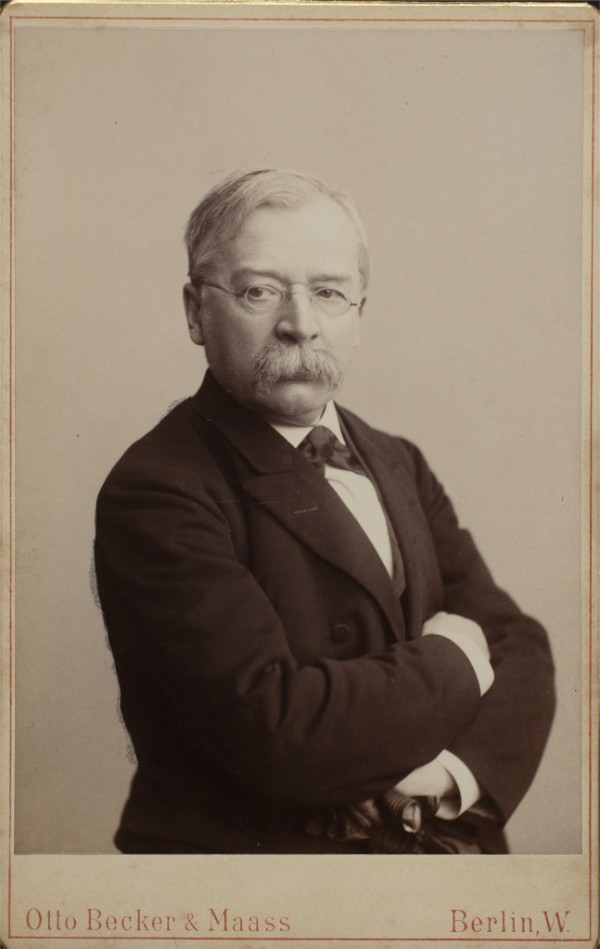
Woldemar Bargiel, 1885
In January 1825, Mariane Wieck secured a divorce from Friedrich and soon afterwards married Adolph Bargiel, a music teacher who was much kinder and gentler than her ex-husband. Their son Woldemar was born in 1828.
Both Mariane and Adolph taught piano and singing, and so, from an early age, Woldemar was taught music.
In 1846, with encouragement from Robert Schumann and Felix Mendelssohn, he started studying at the Leipzig Conservatoire. He began composing and published several works.
Woldemar Bargiel’s Octet, 1850
Woldemar Bargiel: Octet for Strings, Op. 15a (1850)
He worked as a composer and a professor for the rest of his career.
In 1865, he became the director of the conservatory in Rotterdam in the Netherlands. While there, he met and fell in love with pianist Jeanne Hermine Tours. He married her in the summer of 1870. He was forty-two and she was twenty-five.
In 1875, he left the Netherlands for Berlin to work at the Berlin Conservatory, where he continued to work until he died in February 1897.
Ernst Amadeus Theodor Eugen Bargiel (1830-1907)
We don’t know much about Eugen, as he chose not to go into the family business of music. Instead, he became a merchant and emigrated to Romania.
In 1842, when he was twelve, he and his older brother Woldemar spent the summer with his half-sister Clara and her husband Robert, two years after they were married. Clara was fond of Eugen and spoke well of him.
Cäcilie Bargiel (1831-1910)
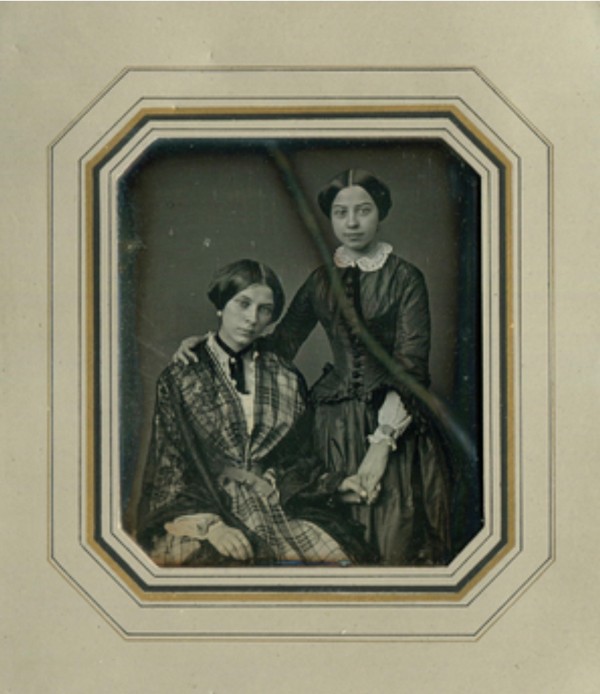
Clementine and Cäcilie Bargiel
Cäcilie became the matriarch of the Bargiel branch of the family. Instead of marrying, she had a long-term friendship with a woman named Laura Peters.
She studied music from an early age and sang in the prestigious Sing-Akademie zu Berlin choir. She also taught piano.
Her health was poor throughout her life. In the 1880s, she and Laura Peters spent time in the warmer climate of Italy for health reasons.
In 1895, she visited Clara. Upon her departure, Clara wrote in her diary, “We will miss them a lot. Cäcilie was always so nice to me, so attentive…”
She enjoyed crafting, and her mother often distributed her handcrafted gifts to various members of the family, including Clara.
Clementine Bargiel (1835-1869)
Like her siblings, Clementine studied music from an early age. Her first piano teachers included her mother and her older brother Woldemar.
In 1853, when she was eighteen, she became a private piano tutor for the Rodbertus family, and stayed with them for several years.
In 1859, when she was 24, she moved to England and taught at a music institute just outside of London. She moved in with her friend Agnes von Bohlen, an educator and translator.
Clara gave her piano lessons when their paths crossed, either when Clementine visited Clara in Baden-Baden during the summer, or when Clara was touring in London.
Tragically, she died suddenly in Bohemia while on vacation. She was just thirty-three years old.
The Marriage of Friedrich Wieck and Clementine Fechner Wieck
After Mariane divorced Friedrich in 1825, Friedrich looked for another wife. He found her in one of his students, a young woman named Clementine Fechner.
They married in the summer of 1828. He was forty-three and she was twenty-four.
The couple had three children together: Clara Schumann’s step-siblings.
Clemens Wieck (1829–1833)
Clemens died as a toddler.
Marie Wieck (1832-1916)
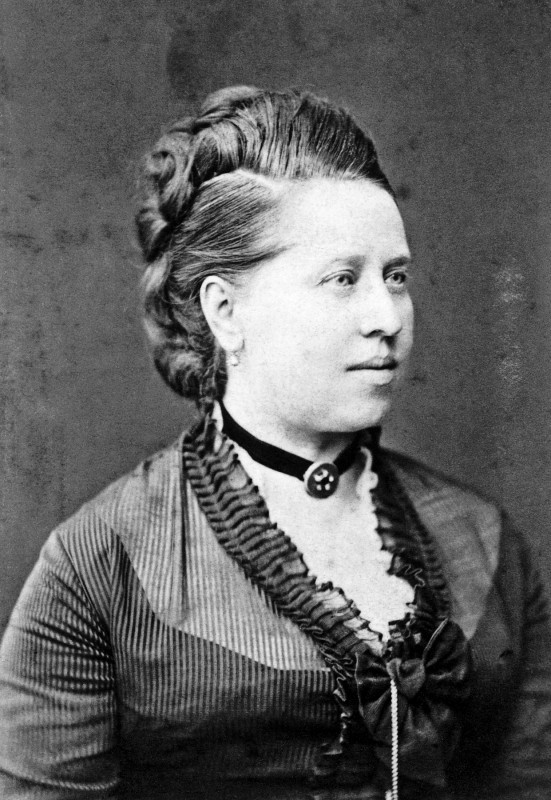
Marie Wieck
Marie was born in January 1832 in Leipzig. As a young girl, she studied piano and voice with her father, but he was often away touring with her older half-sister Clara.
Marie showed some natural talent, but not as much as Clara. However, especially after Clara (in Friedrich’s view) betrayed the family by marrying Robert Schumann in 1840, Marie felt a heavy responsibility not to disappoint her father.
Just as he had with Clara, Friedrich kept a dual journal authored by himself and Marie. He often wrote in the first person from her point of view.
One heartbreaking passage from this time reads:
I am as dim-witted, stupid and lazy as Clara. Perhaps I have got talent, too, still slumbering deeply within me, but at least I do have the right feeling, a sense of the beat, and a musical ear.
The fact that my father cannot deal with me that much because of his expanded piano and music business might perhaps lead to a slightly delayed development…
My education is thorough and similar to the one for Clara. I do not go to school yet but I regularly go to see our aunt, Mrs Kunze, Master, to learn French, together with my little sister Cäcilie.
In 1843, Marie and Clara gave a joint concert appearance together in Dresden, playing Moscheles’s Sonata, Op. 47, a piece for piano four-hands.
Ignaz Moscheles: Grande Sonate op. 47 (1819 ca.) – I. Allegro Spiritoso
However, despite the similarities of their brutal upbringings, Clara didn’t cut her eleven-year-old half-sister much slack, writing, “Marie played in a most charming manner but I was always irritated by the reluctance that could somehow be felt with each tone in her playing.”
In 1847, she began teaching piano to Clara’s daughter, also named Marie. She eventually became a piano teacher professionally.
A couple of years after Friedrich’s death in 1873, she published a book of his piano exercises. In 1877, she published a book of his exercises for singers. This caused a rift with her half-brother Alwin, as noted above, but eventually they did reconcile.
Cäcilie Wieck (1834–1893)
We know relatively little about Cäcilie besides the fact that she struggled with mental illness throughout her life. She died in 1893.
Conclusion
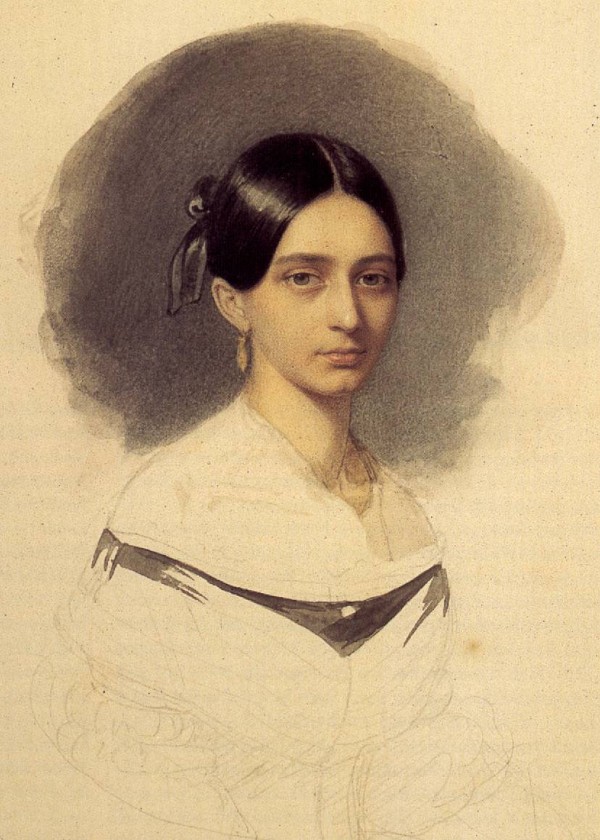
Clara Wieck Schumann
Although Clara Wieck Schumann was uniquely talented and one of the greatest musicians of her time, four of her eleven siblings or half-siblings enjoyed musical careers of one kind or another: not a bad record!
Learning about their biographies and careers helps to paint a fuller portrait of the life of this extraordinary artist and linchpin of the Romantic Era.
For more of the best in classical music, sign up for our E-Newsletter