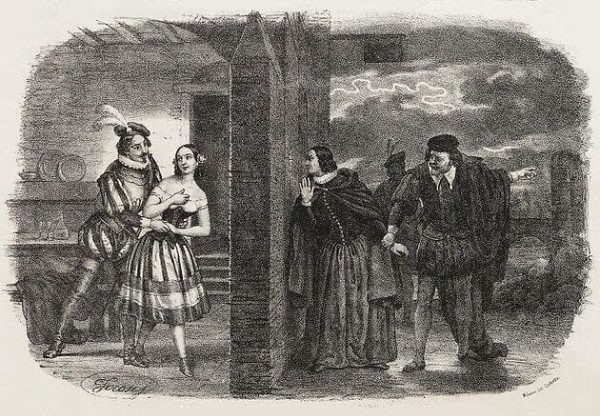
In Greek mythology, Orpheus, the greatest of all musicians and poets, lost his new bride Eurydice when she stepped on a viper and died from the bite. At the news, Orpheus wept so bitterly and sang so mournfully that all the nymphs and gods begged him to ask Hades for her return. He travels to the underworld, retrieves his beloved wife, but then loses her again when he makes the fatal look behind him to check that she is really there.
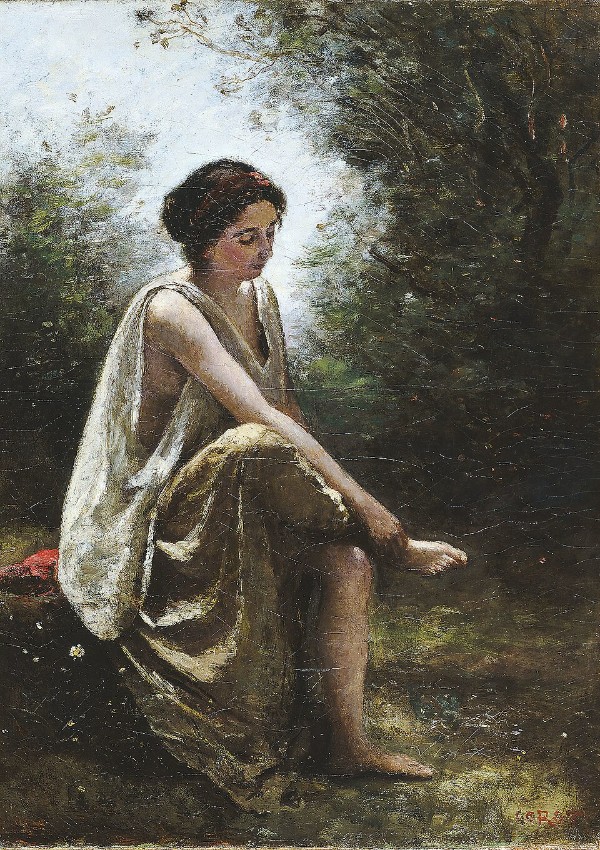
Camille Corot: Wounded Eurydice, 1868–1870 (Chicago: Art Institute)
In opera, the story of Orpheus and Eurydice was one of the first subjects for the new genre. Starting with Jacopo Peri’s Euridice in 1600, Orpheus and Eurydice appear on the musical stage until the 21st century.
The highlight of the first part of the opera is Orpheus’ lament for the loss of his new bride.
In Peri’s opera, written to a libretto by the poet Ottavio Rinuccini, the aria ‘Non piango, e non sospiro’ is Orpheus great cry, where, at the end, he promises to come to her.
| Non piango, e non sospiro | I do not weep, and I do not sigh, |
| o mia cara Euridice che sospirar, | my dear Eurydice, who sighs, |
| che lagrimar non posso, | who cannot weep, |
| cadavero infelice, | unhappy corpse, |
| o mio core, o mia speme, o pace, o vita, | my heart, my hope, peace, life, |
| ohimè chi mi t’ha tolto | alas, who has taken you from me, |
| chi mi t’ha tolto, ohimè dove se’ gita? | alas, where have you gone? |
| Tosto vedrai, ch’invano | You will see that in dying you did not call in vain |
| non chiamasti morendo il tuo consorte, | for your husband, |
| non son, non son lontano io vengo, | I am not, I am not far away, I come, |
| o cara vita, o cara morte. | dear life, dear death. |
Jacopo Peri: Euridice – Scene 2: Non piango e non sospiro (Orfeo) (Gian Paolo Fagotto, tenor; Ensemble Arpeggio, Ensemble; Roberto De Caro, cond.)
The same year, 1600, Giulio Caccini set the same text, by the same poet, for his L’Euridice. It wasn’t performed until 1602, but we can hear the difference between the two settings.
Giulio Caccini: L’Euridice – Act I Scene 2: Non piango e non sospiro (Orfeo) (Nicolas Achten, baritone; Scherzi Musicali, Ensemble; Nicolas Achten, cond.)
The most famous of the early 17th century setting, however, is Claudio Monteverdi’s L’Orfeo of 1607. The libretto, written by Alessandro Striggio, was written for a court performance at Mantua during the Carnival season.
Now, we have a true aria. Orfeo starts out in disbelief (You are dead, my life, and I still breathe?) and concludes with a farewell to the above-ground world as he vows to descend to Hades (I shall stay with you in the company of death: farewell to earth, to sky, to sun, farewell.)
Claudio Monteverdi: L’Orfeo – Act II: Tu se’ morta, mia vita, ed io respiro? (Orfeo) (Dietrich Henschel, baritone; Les Arts Florissants; William Christie, cond.)
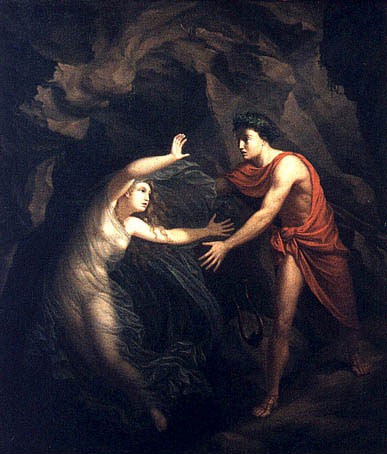
Christian Gottlieb Kratzenstein-Stub: Orpheus and Eurydice, 1806
(Copenhagen: Ny Carlsberg Glyptotek)
Domenico Belli’s Orfeo dolente of 1616 for Florence was followed two years later by Stefano Landi’s La morte d’Orfeo (1619). This opera was written for Rome and tells what happened to Orpheus after he emerged from Hades without Eurydice.
In what is partially a drama and partially a comedy, Orfeo is killed at the hands of the followers of Bacchus, the Maenads. When he returns to Hades, he finds that Eurydice, having drunk of the waters of Lethe, the River of Forgetfulness, no longer remembers Orpheus. He leaves Hades to reside with the gods in Olympus.
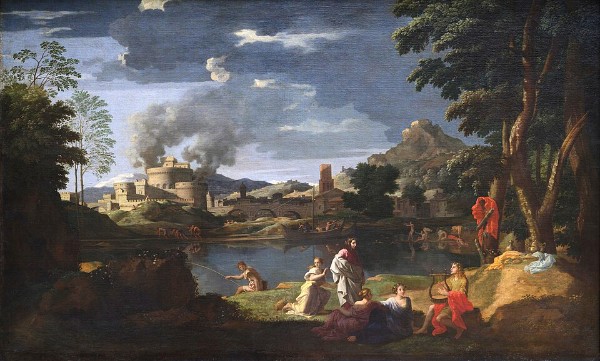
Nicolas Poussin: Orphée et Eurydice, 1648 (Louvre)
Luigi Rossi’s Orfeo, of 1647, waits until the start of Act III for Orpheus’ mourning song.
Luigi Rossi: Orfeo – Act III Scene 1: Lagrime, dove sete? (Orfeo) (Francesca Lombardi Mazzulli, soprano; Allabastrina, Ensemble; Elena Sartori, cond.)
1654 saw Carlo d’Aquino’s Orfeo, and 1659 was Johann Jakob Löwe’s Orpheus von Thracien, written for Eisenach. Written for the Teatro San Salvatore in Venice, Antonio Sartorio’s Orfeo of 1672 is overloaded with arias (about 50!) and was an unsuccessful transition between Venetian opera and the new opera seria. Orfeo is the son of Calliope, the muse of epic poetry and Apollo, so doubly blessed as a musician (or perhaps, in modern-day ideas, singer/songwriter).
Marc-Antoine Charpentier took two stabs at the Orpheus myth. His first attempt was a cantata for 3 voices. After an opening instrumental piece, a recitative by Orfeo describes his intention to descend to the Underworld and demand the return of Eurydice. Orphée descendant aux enfers consists of a conversation between Orpheus and two mortals caught in Hades: Tantalus, who can never relieve his thirst, and Ixion, bound always to a winged burning wheel. It is only Orpheus’ song in the Underworld that relieves the two of their torments.
Marc-Antoine Charpentier: Orphée descendant aux enfers, H. 471 – Air: Effroyables enfers où je conduis mes pas… (Orphée) (Reinoud van Mechelen, tenor; Vox Luminis, Ensemble; A Nocte Temporis, Ensemble; Lionel Meunier, cond.)
In the opera, there is a longer setup with happy dancers celebrating Orpheus’ and Eurydice’s wedding, and then the fatal viper enters. Orpheus’ lament is delivered to his friends, the shepherds (Ah, shepherds, it is over: Eurydice is no more!)
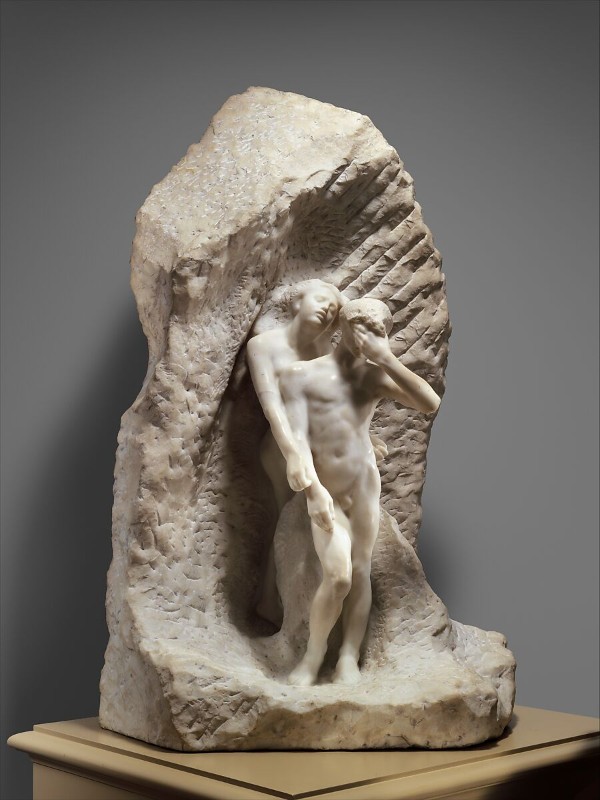
August Rodin: Orpheus and Eurydice, 1893 (Metropolitan Museum)
Marc-Antoine Charpentier: La descente d’Orphée aux enfers, H. 488 – Act I Scene 1: Ah! Bergers c’en est fait (Orphée, Chorus) (Reinoud van Mechelen, tenor; Vox Luminis, Ensemble; A Nocte Temporis, Ensemble; Lionel Meunier, cond.)
When Orpheus threatens suicide, his father, Apollo, appears to tell him to ‘implore the power of the dark prince who reigns among the dead’.
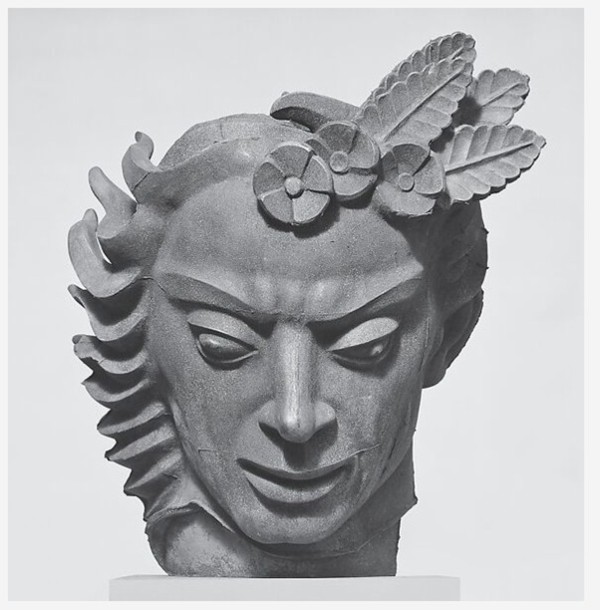
Carl Milles: Head of Orpheus, 1934 (Metropolitan Museum)
Marc-Antoine Charpentier: La descente d’Orphée aux enfers, H. 488 – Act I Scene 3: Ne tourne point, mon fils (Apollon, Orphée) (Lionel Meunier, bass; Vox Luminis, Ensemble; Reinoud van Mechelen, tenor; A Nocte Temporis, Ensemble; Lionel Meunier, cond.)
Charles Piroye (1717), Telemann (1726), Gluck (1762), and Haydn (1791) all wrote operas on the story in the 18th century, as did many others, but it took Offenbach in the 19th century to truly change the story.
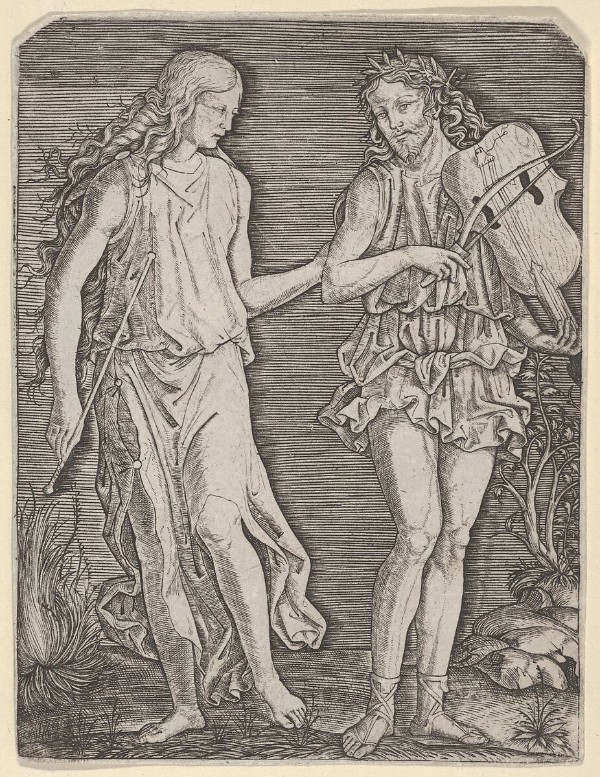
Marcantonio Raimondi: Orpheus and Eurydice, ca 1500–1506 (Metropolitan Museum)
Orphée aux enfers was given in Paris at the Théâtre des Bouffes-Parisiens on 21 October 1858, and then was extensively revised and expanded into a four-act ‘opéra féerie’ given, presented at the Théâtre de la Gaîté, Paris, on 7 February 1874.
Orpheus isn’t a hero; he’s a mere violin teacher who’s rather glad to be rid of Euridice. It takes the bullying of Public Opinion to force Orpheus into action, mostly because Euridice has taken a lover, and Orpheus has found her leaving flowers at his door. Orpheus’ time in the Underworld ends with a fast-paced Galop that has far outlived anything else in the opera. Don’t be fooled by the slow introduction!
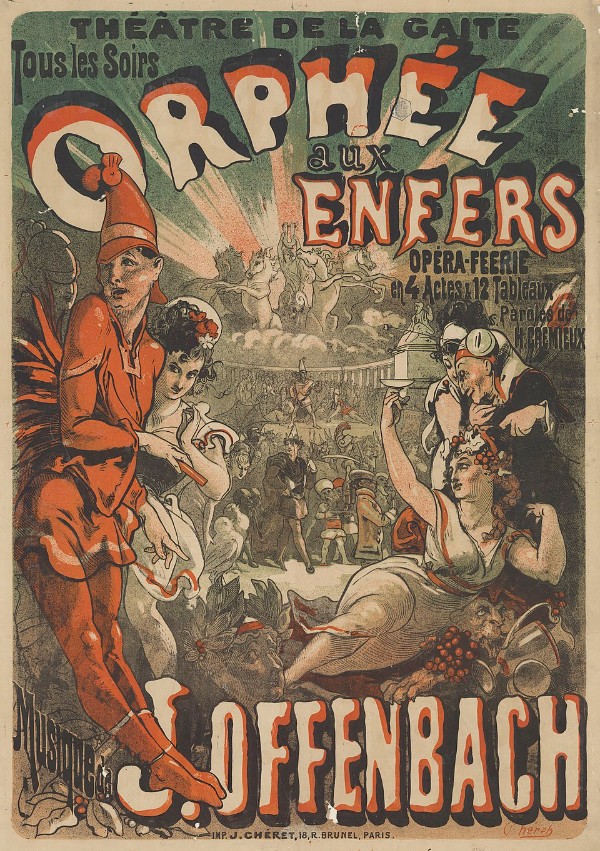
Jules Chéret: Orpheus in the Underworld, poster, 1878 (Gallica: btv1b53167755q/f1)
Jacques Offenbach: Orphee aux enfers (Orpheus in the Underworld), Act II: Can-Can (Košice Slovak State Philharmonic Orchestra; Johannes Wildner, cond.)
In the 20th century, the story was made into a rock opera, many chamber operas and as a Broadway musical as Hadestown (2016). In ‘Wait for me’, Orpheus dashes after Eurydice.
Hadestown performs “Wait For Me” at the Tony’s 2019
We’ll close with Matthew Aucoin’s opera Eurydice, created for Los Angeles Opera and the Metropolitan Opera in 2020. In this aria, Eurydice has just arrived in the Underworld and is more than slightly confused, left waiting on a subway platform for what or whom she doesn’t know. She describes what she’s experienced but has forgotten so much.
Matthew Aucoin’s Eurydice – There was a roar (The Met: Live in HD 2021/22 Season)
In moving the focus from the grieving husband to the lost Eurydice, the story has changed from a set piece of mourning to something much more dimensional.
For the beginnings of opera, the story was perfect: the ultimate musician creates the finest song of mourning and sets off to make the story right. Unfortunately, it’s not his lack of musicality that ruins the ending but rather his lack of faith in the word of a god, even if he’s the god of the underworld. In later works, it’s Eurydice who has the loss of faith and calls out to Orpheus before they’re both above ground and has to return to the Underworld. We remember, but why does everyone else forget so much?
From drama to comedy back to drama, the story of Orpheus has something for every audience for the past 400+ years.
For more of the best in classical music, sign up for our E-Newsletter