The love story between Robert and Clara Schumann is often regarded as one of the most romantic in classical music history.
Happily for historians, many of their love letters survive. They document their inner thoughts and emotions, as well as the legal struggles they ran into when Clara’s father tried to stop the marriage. They also discuss their respective careers and creative efforts.
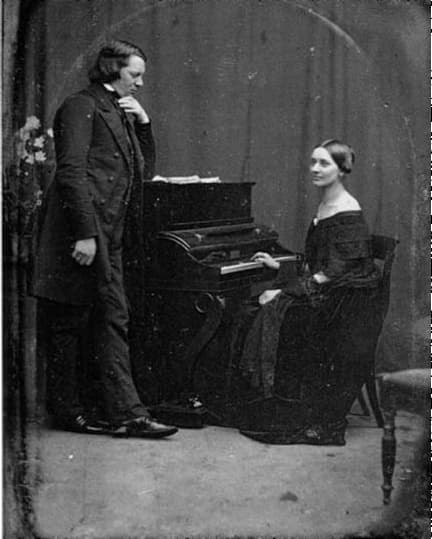
Robert and Clara Schumann
Today, we’ve picked out some of the most famous and fascinating passages from Robert’s letters to Clara.
The Timeline of Their Relationship
Robert Schumann met Clara Wieck on 28 March 1828. She was a piano prodigy preparing for her debut at the Gewandhaus. He was seventeen, and she was eight.
Schumann was so impressed by her playing that he began working with her teacher and father, Friedrich Wieck, even moving in with him to learn as much as possible (as was common at the time).
Despite the age difference, Robert and Clara became friends, especially once they became roommates, and worked on composing projects and learning piano together.
2 August 1833
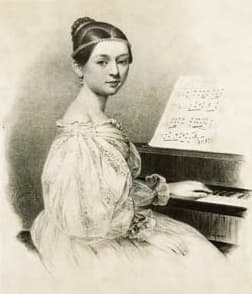
Clara Wieck at 15 years old
In August 1833, Robert was 23, and Clara was about to turn fourteen.
In this letter to her, he shows how highly he valued her creative input, as well as how touched he was by her dedication of her Romance variée, Op. 3 to him.
Clara Schumann’s Romance variée, Op.3
The letter also hints that he would like to hold hands with her:
To anyone who is not a flatterer, there can be few things more unpalatable than writing or acknowledging letters of dedication. The modesty, deprecation, and weight of gratitude one feels are indeed overwhelming.
I should, for instance, in reply to anyone else, have to ask how I deserved such a distinction, and whether you had duly considered it; or I should resort to metaphor and say that the moon would be invisible to man did not the sun’s rays illumine it at times; or, see how the noble vine twines itself about the lowly elm, nourishing the barren tree with its sap.
But, as it is you and none other, I will only proffer my warmest thanks.
If you were present, I should squeeze your hand, and that without asking your father’s permission!
I might also express a hope that the union of our names on the title page may be symbolic of a union of our thoughts and ideas in the future. This is all a poor beggar like myself can do.
18 September 1837
By September 1837, Robert was 27, and Clara had just turned eighteen. She had accepted his secret marriage proposal the month before, knowing her father disapproved of the match.
Robert wrote to her about the attitude she should take in the conflict with her father:
Remember what is at stake. Exert yourself to the utmost, and if your gentleness fails, use your strength.
31 December 1837
Robert Schumann’s Fantasiestücke, Op. 12, No. 1 (1837)
Here’s a New Year’s Eve letter from Robert to Clara, written when Robert was in Leipzig, and Clara was on tour:
I have been sitting here a whole hour. Indeed, I meant to spend the whole evening writing to you, but no words would come.
Sit down beside me now, slip your arm round me, and let us gaze peacefully, blissfully, into each other’s eyes.
This world holds two lovers.
It is just striking the third quarter.
They are singing a chorale in the distance.
Tell me, do you know those two lovers?
How happy we are, Clara! Let us kneel together, Clara, my Clara, so close that I can touch you, in this solemn hour.
6 February 1838
A few weeks later, in February, Robert wrote to Clara, who was proving to be a sensation in Vienna:
Your love and loyalty have made me a new creature…
I sometimes feel as if my heart were crossed by a thousand narrow intersecting paths, along which my thoughts and feelings race up and down, and in and out, like human beings, asking, Whither does this way lead? and that? and all the ways?
And the answer is always the same: “to Clara.” …
And now I have something to ask of you. Will you not pay a visit to our beloved Schubert and Beethoven? Take with you some sprigs of myrtle, twine them together in twos, and lay them on the graves, if you can. Whisper your name and mine as you do it – not a word besides. You understand?
14 April 1838
Clara Schumann’s Souvenir de Vienne (1838)
Clara’s father continued to forbid the two lovers from seeing each other, and for a long time they were forced to continue their correspondence in secrecy.
Robert clearly still wanted to marry her, but he was also struggling with the wait and the logistics of trying to see each other, let alone getting married.
He wrote to her in the spring of 1838, while she was still conquering Vienna:
I am half inclined to give up the idea of seeing you this summer.
If I have survived without it two years, two more of the same penance will not kill me.
What satisfaction is there in the few disjointed words we should steal at odd moments, in fear and trembling? I want you for always.
I have done with quixotic notions. Of course, I will come if you want it very much, but otherwise let us give it up as useless…
I want you for my wife. This is my earnest, sacred wish; to all else I am indifferent.
However, Clara pushed back and even went so far as to suggest that when she returned to Leipzig, she come to visit him in his rooms.
They ended up not doing so for fear of discovery, but, despite the reservations expressed in Robert’s April letter, they did meet often that summer.
At one point that June, Clara was reduced to waving a white handkerchief at a window to indicate she was free to slip out of the house to speak to him on his birthday.
20 June 1838
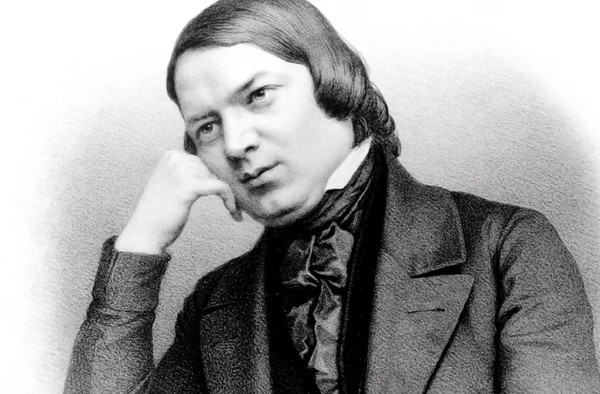
Robert Schumann
Robert wrote a few weeks after the cloth-waving incident:
I have such an urgent desire to see you, to press you to my heart, that I am sad – and sick as well. I don’t know what is absent in my life, and yet I do know: you are absent. I see you everywhere, you walk up and down with me in my room, you lie in my arms, and nothing, nothing is real. I am ill. And how long will this all endure?
9 September 1838
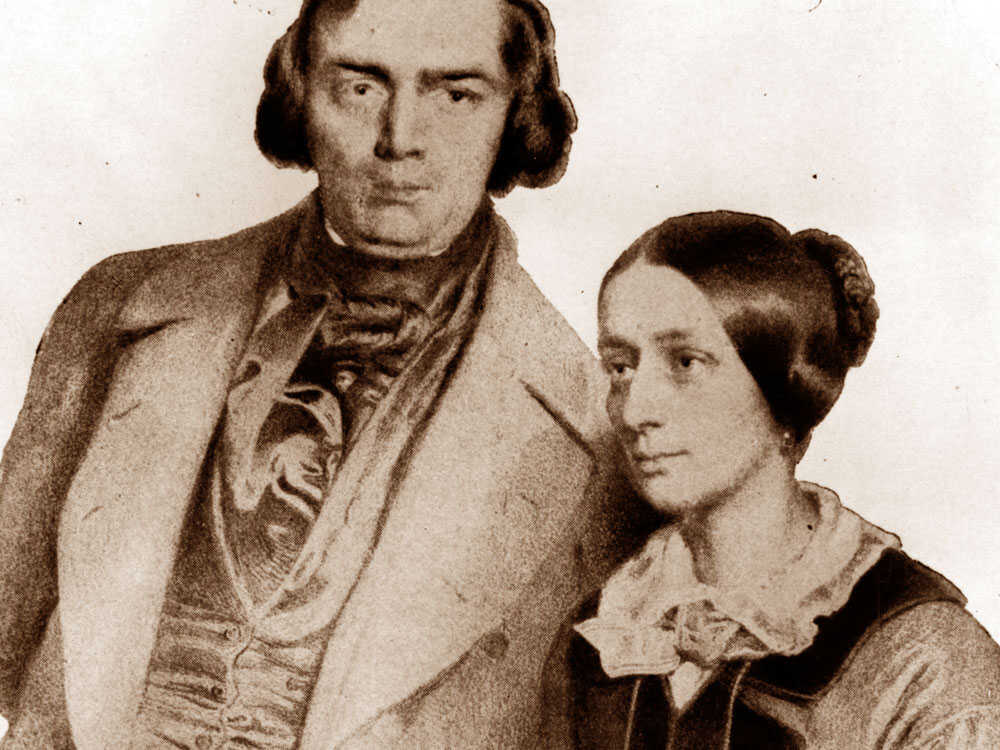
Robert and Clara Schumann
In September 1838, Robert went to see Clara perform at the Gewandhaus with the prestigious Gewandhaus Orchestra in Leipzig.
He wrote about the experience in this letter:
It is still a dream to me, all that I listened to yesterday, all that went on around me. I was divided between rage and delight.
I had chosen a nice dark corner to avoid meeting anyone’s eyes.
You probably could not see me either, much as I should have wished it.
I saw you the whole time, and the ring gleaming on the second finger of your left hand.
Come and let me kiss you again and again for the way you played to me yesterday – you, my own Clara, with your beautiful soul and your wonderful talent! You played magnificently! People don’t half deserve what you give them.
Clara Schumann’s piano concerto
Robert went on to downplay the central role that public performance would always play in his future wife’s life.
It seemed to badly misjudge how deeply intertwined performing was in her identity, and how necessary it would always be for her mental health:
As you sat there all alone, supreme in the mastery of your art, and people spoke of you as if it were all a matter of course, I thought how happy I was to call such a treasure my own, and also felt very strongly that I could dispense with the crowd who were there simply to say they had heard you.
You are too dear, too noble, for the career which is to your father the aim, the crown, of existence. Are these few hours worth so much expenditure of time and energy? Can you look forward to a continuation of this as your whole vocation?
No; my Clara is to be a happy wife, a contented, beloved wife!
Indeed, I reverence your art, and dare hardly think of all the happiness promised me in connection with it; but, unless we are really in want, you shall not touch a note to please people for whom scales are too good – unless you wish it.
Does my dear girl understand me?
As an artist, I consider that you can serve art without long concert tours, and my musical soul will not be critical if you hurry here, pause there, in your playing, or put a finer finish on to anything, so long as the inspiration is there, as in your case it is…
I had so much more to tell you to-day, but I am too excited. I shall go to sleep and dream of nothing but you.
Good-bye, my best, best-beloved, my heart’s treasure, my own dearest Clara! Yours, and yours only.
18 December 1838
Clara Schumann’s Three Romances (1839)
By the end of 1838, the relationship between Clara and her father was deteriorating rapidly.
He had always served as her manager, but because she wouldn’t break things off with Robert, he decided to withhold his services…and eventually went so far as to try to sabotage her, badmouthing her to his contacts in the music world.
She decided that she would set out for Paris in January of 1839 without him: a truly daring move, especially for a young woman in the 1830s.
Robert wrote this letter to her a few weeks before she set off on that first adult tour:
Give you greeting, my darling girl.
You have created an atmosphere of spring; I can see golden blossoms peeping forth all around me. In other words, your letters started me on composing, and I feel as if I should never stop.
Here is my little Christmas gift. You will grasp its significance.
Do you remember Christmas Eve three years ago, and how passionately you embraced me? You seemed to be almost frightened at the way in which you let yourself go sometimes.
It is different now, for you are assured of my love and know me through and through. My own love, my faithful companion, my wife!
You will embrace me in quite another way two years hence, when I display your Christmas presents: a cap, various toys, and some new compositions. “How lucky I am to have such a very good husband”, you will exclaim again and again, while I try in vain to moderate your transports.
Then you will take me into your own room and show me mine: a miniature of yourself, a writing-board for composing, a sugar slipper – which I shall eat on the spot – and much besides, for you will outdo me in generosity. Don’t I know you of old!
Then, as we become quieter and the candles on the tree burn fainter, our kisses will breathe the prayer that time may make no change, but keep us united to the end.
My festival will be a sad one this year. I shall hum many a melody, and go to the window every now and then to look up at the glittering stars. In spirit, I shall spend the whole evening with you.
29 December 1838
Robert Schumann’s Arabeske (1839)
Robert Schumann would suffer from mental health issues throughout his life. Some modern historians believe he would be diagnosed with bipolar disorder today.
In this letter, he describes his “phases” and how comfortable he feels being open about them with Clara.
I feel I should like to talk to you about certain of my phases.
People are often at a loss to understand me, and no wonder! I meet affectionate advances with icy reserve, and often wound and repel those who really wish to help me. I have often taken myself to task about it.
It is not that I fail to appreciate the very smallest attention, or to distinguish every subtle change in expression or attitude; it is a fatal something in my words and manner which belies me.
But you will take me as I am, and make excuse, I know. My heart is in the right place, and my whole soul is responsive to the good and the beautiful.
But enough of this.
It is when I think of the future that I feel we ought to open our hearts to each other as unreservedly as children who practice no concealment.
22 June 1839
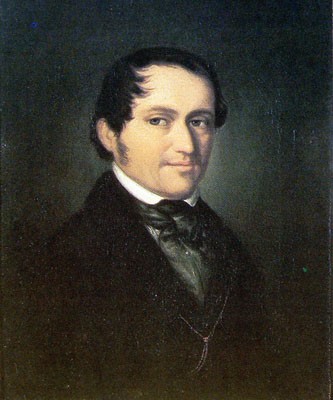
Friedrich Wieck
On 15 June 1839, the couple petitioned the local Court of Appeals to marry without Friedrich Wieck’s consent.
Robert Schumann wrote to her a week later:
Come and let me press you to my heart, you, my love, my everything.
All this you have done for me; I can never hope to repay you.
Let me kiss your brow, your eyelids, child, as I pray for your lasting happiness.
Although it would take another year to finalise the case, Robert Schumann and Clara Wieck eventually overcame the legal obstacles set in their way by her father.
They were married on 12 September 1840, the day before her 21st birthday. The marriage was by and large a very happy one, and one of the most famous in classical music history.
For more of the best in classical music, sign up for our E-Newsletter