A set of short anonymous poems in Boston’s Musical Herald did a poetical job of setting out the history in limericks, along with unique rhyming spellings.
We started in the 18th century with Gluck and then Haydn, and then looked at Brahms and Liszt. Let’s see what the French are up to!
There was a composer named Auber
Who seldom was somber or sauber
Yet he held aloof
From the opera bouffe
But he lived past life’s golden Octauber.
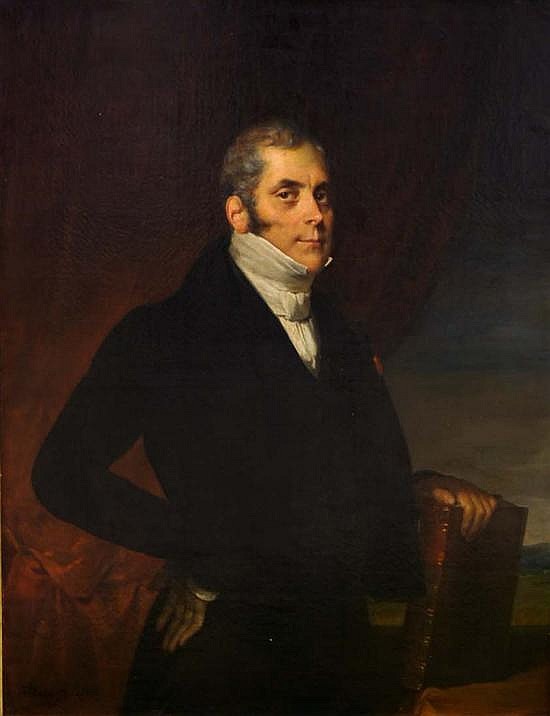
Hortense Haudebourt-Lescot: Daniel Auber, 1827 (Paris: Bibliothèque-musée de l’Opéra)
Daniel Auber (1782–1871) set the scene for Paris and the opera. He wrote 39 operas and was director of the Paris Conservatoire. He changed French opera forever with the introduction of the first French Grand Opera, La Muette de Portici (The Mute Woman of Portici) in 1828.
Grand opera is truly that: large casts and large orchestras, spectacular design and impressive stage effects, usually with stories based on dramatic historical events. Monumental was just the starting point. If you could add in an exotic locale, all the better. Melodrama was perfect for the plot lines. And, to fill out the bill, a ballet became obligatory.
In La Muette de Portici, the mute heroine, upon learning of the death of her brother, leaps into Mount Vesuvius, which has just started to erupt. The romantic passions of the protagonists are set within the context of the historical background and reduce the over-sized stage to the two people in love.
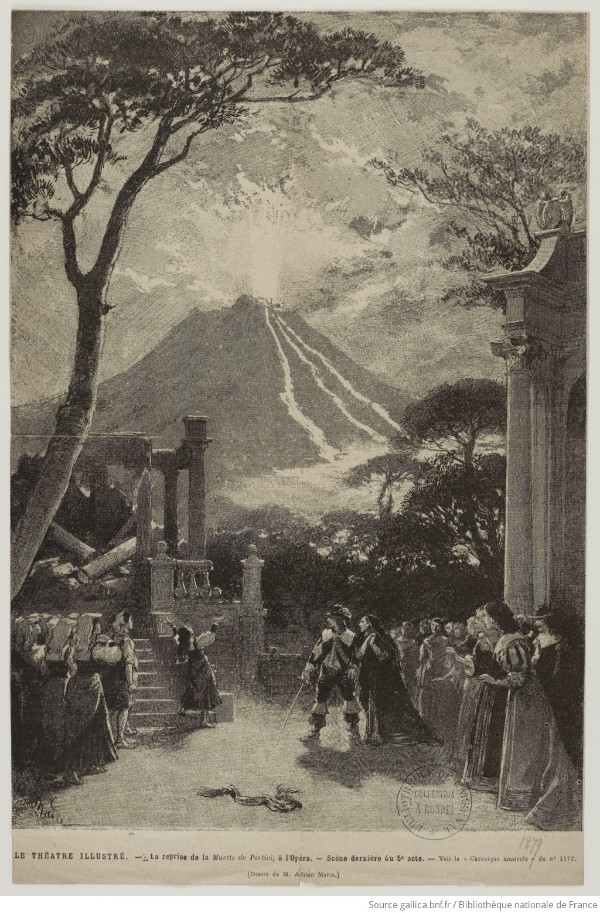
The final scene of La Muette de Portici (Gallica: btv1b84057357)
Daniel-François Auber: La muette de Portici, S. 16 – Overture (Dessau Anhalt Philharmonic Orchestra; Antony Hermus, cond.)
Despite the implication in the limerick that Auber was a composer who was seldom sober, the reverse is more probably true. He was highly regarded for his wit and lively personality, and we suspect the anonymous limerick writer just got carried away. He did live to the age of 89, and so well into his ‘golden October’.
The next limerick is on another centre point of French opera: Fromental Halévy.
That eminent Frenchman, Halévy
N’er fought in the army of nevy.
Yet musical work
He never would shork
He always ate turkey with grevy.
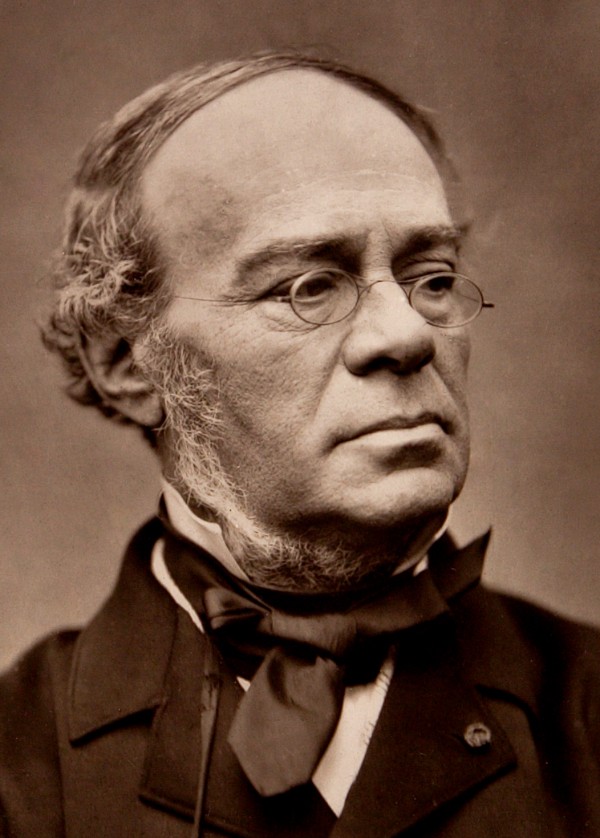
Étienne Carjat: Fromental Halévy, ca 1860–62 (Harvard Art Museum/Fogg Museum)
This is a bit dubious on the limerick front since the rhymes seem so incidental to Halévy’s real worth!
Fromental Halévy (1799–1862) was a student of Luigi Cherubini and, from his first opera, La Juive in 1835, went from triumph to triumph. Mahler considered La Juive to be ‘one of the greatest operas ever written’ and it was the inaugural work performed at the Palais Garnier, Paris’ newest opera house, upon its opening in 1875. Like his contemporary Auber, Halévy wrote more than 30 operas in the principal opera genres of grand opéra, opéra-comique, and opéra-lyrique. Although he and Auber controlled the Paris opera stages, his operas didn’t last long after his death – only La Juive lasted into the 20th century.
Halévy matched melodic invention with solid technique, and he was praised by even Wagner as an example for German composers. Critics, however, sometimes found him too complex, particularly for the general public, and felt that his reputation never matched his high level of merit.
Fromental Halévy: La Juive, Act IV: Rachel, quand du Seigneur (Jonas Kaufmann, tenor; Bavarian State Orchestra; Bertrand de Billy, cond.)
La Juive has all the grand opera elements. There’s a lost baby, the Cardinal who is searching for her, the religious persecution of the innocent, uprisings in the street, and the suicide of the heroine just before the Cardinal finds out that she is his long-lost daughter. The aria, ‘Rachel, quand du Seigneur’, sung by her father, Eléazar, is one of the most famous arias from the opera. Death in this opera isn’t by a volcano, but by a cauldron of boiling water.
For more of the best in classical music, sign up for our E-Newsletter